


Church of San Benedetto (Montemonaco)
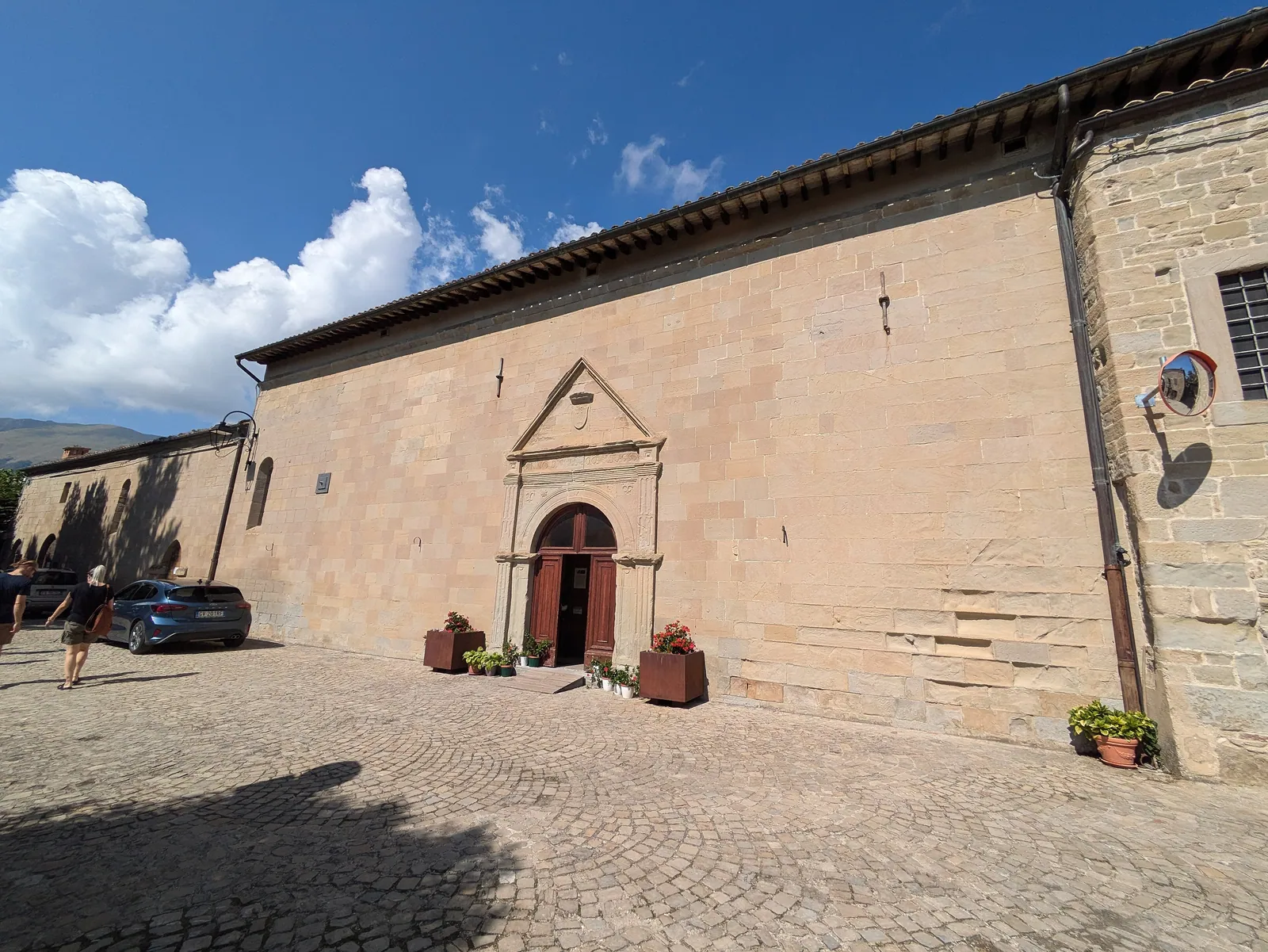
Church of San Benedetto (Montemonaco)
- Type
- Church
- Municipality
- Montemonaco (AP)
Source: site database.
The Church of San Benedetto (Chiesa di San Benedetto) in Montemonaco, in the historic center of the village, has a sandstone portal bearing the date 1546 and an interior with three naves. It holds the silver arm-shaped reliquary with the relic of San Benedetto (Saint Benedict), patron saint of the municipality. Damaged by the 2016 earthquake, it remained closed until it reopened on April 6, 2019, after restoration work.
The church stands against the old castle walls, next to the church of San Biagio. Its bell tower was also created from one of the towers of the walls.
On the map
Points from the site database. Map © OpenStreetMap contributors · Protomaps.
History of the Church of San Benedetto in Montemonaco
The date of the original construction is not known. In 1546 the master builder Guglielmo Lombardo was commissioned to rebuild the church and the facade, and that year is carved on the portal. The restoration was also needed because of the decay of the stone, which crumbles in the open air from mountain frost and rime.
The relic of the arm of San Benedetto Abate has an unusual history. It was donated to the community by Count Domenico Garulli, a captain in the armies of Charles V, who had taken it from the cathedral of Siena during the wars between the Empire and the Papacy. It was first placed in the Church of San Giovanni Battista in Montemonaco. Later the goldsmith Cristoforo da Norcia made the silver arm that holds it, and the relic was placed in San Benedetto.
The 2016 earthquake made the church unfit for use. While it was closed, services were held in the church of the Casa Gioiosa holiday home, about one kilometer from the village. The works also included the bell tower, whose damage turned out to be more serious than expected. The damaged artworks were restored thanks to several sponsors.
What to see in the Church of San Benedetto in Montemonaco
Outside, the pointed sandstone portal stands out, with a fleur-de-lis and the community's coat of arms. Inside, the cross vaults rest on large columns of tufa blocks.
To the left of the altar, in a niche, is the arm reliquary. Below the niche is an old terracotta statue: a Madonna holding on her knees the Christ just taken down from the cross.
At the back of the church is a 15th-century fresco of the school of Crivelli showing Christ crucified between the Virgin and Saint Lucy. It belonged to the apse of the older church of San Biagio. On the back wall there is also a polychrome wooden crucifix from the late 15th century. Carved wooden confessionals and a 17th-century canvas complete the ensemble.
Visiting the Church of San Benedetto in Montemonaco
The church is still in use as a place of worship: after the 2019 reopening the community began using it again. Opening times are best requested from the parish before going up to Montemonaco.
Where the Church of San Benedetto in Montemonaco is located
The Church of San Benedetto is in the historic center of Montemonaco, in Le Marche. It stands against the old castle walls, near Porta San Biagio in Montemonaco.
Around the Church of San Benedetto in Montemonaco
Next door is the older church of San Biagio. The apse of San Biagio is incorporated inside San Benedetto. The walk through the village starts from Piazza Roma, with its panoramic terrace, and passes the Palazzo Comunale (town hall), which has a 14th-century civic tower.
The village is also home to the museum dedicated to the Grotta della Sibilla, in Villa Curi. For other churches in the area, see the churches of the Sibillini Mountains page. The Basilica of San Benedetto in Norcia is dedicated to the same saint as the relic.
Frequently asked questions
Has the Church of San Benedetto in Montemonaco reopened after the earthquake?
What relic is kept in the Church of San Benedetto in Montemonaco?
When was the Church of San Benedetto in Montemonaco built?
Is the Church of San Benedetto connected to the church of San Biagio?
Nearby
What to see nearby
- under 100 m
- under 100 m
- under 100 m
Where to stay
- Taverna della Montagna, MontemonacoMountain hut700 m
- Rifugio Altino, MontemonacoMountain hut2.5 km
- Altino Campi Scout, MontemonacoCampground2.5 km
Where to eat
- Battì, MontemonacoBar and café700 m
- 700 m
- Franca, MontemonacoClimbing2.0 km
Straight-line distances.