


Church of San Michele Arcangelo (Bolognola)
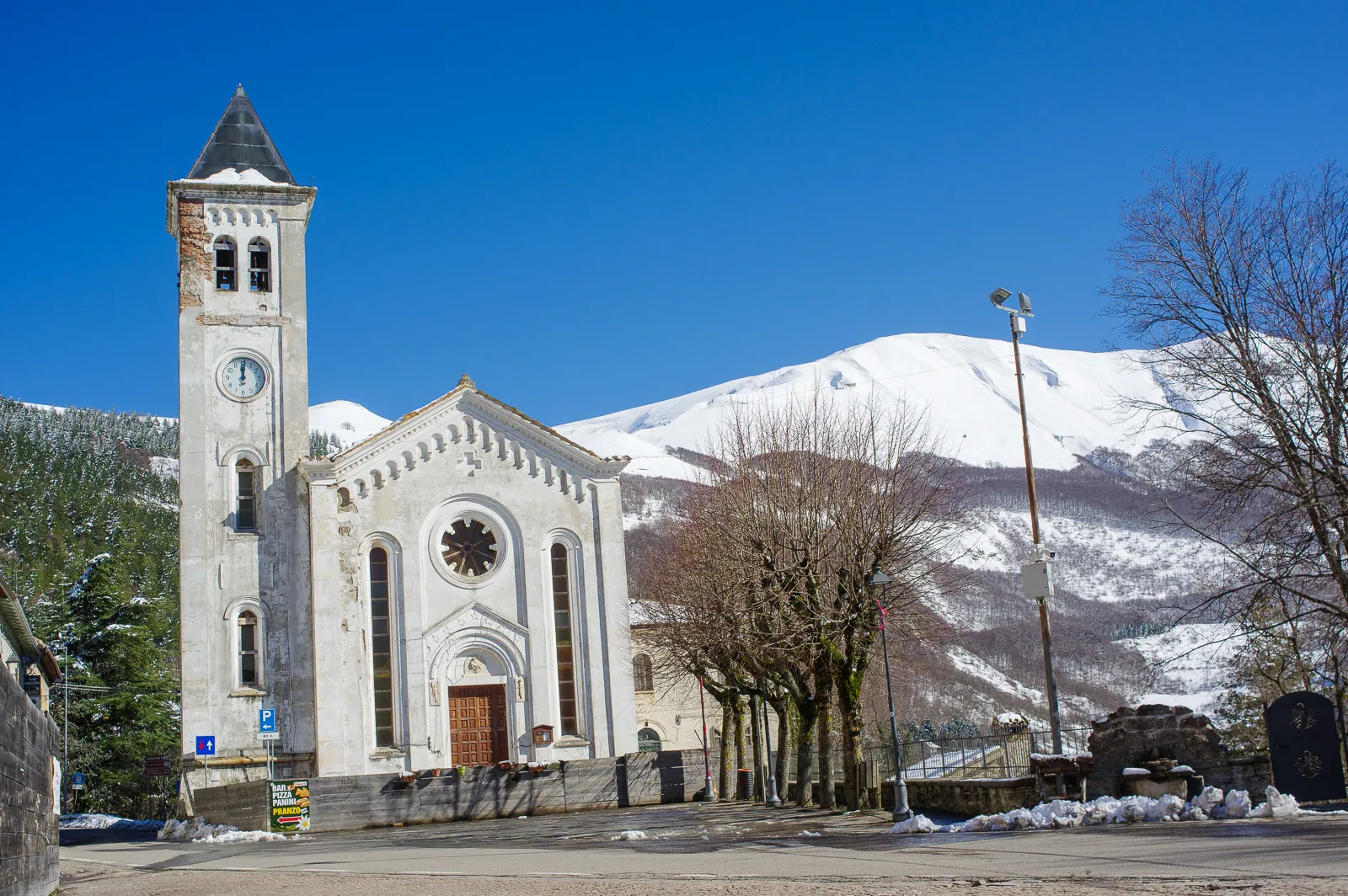
Church of San Michele Arcangelo (Bolognola)
- Type
- Church
- Municipality
- Bolognola (MC)
Source: site database, © OpenStreetMap contributors (ODbL).
The Church of San Michele Arcangelo (Chiesa di San Michele Arcangelo) is the parish church of Bolognola, in the province of Macerata, and belongs to the Archdiocese of Camerino-San Severino Marche. The current building, in Neo-Romanesque style, was built between 1935 and 1939. An avalanche had destroyed the previous church, which dated back to the 13th century. After the 2016 earthquake the church was declared unsafe.
On the map
Points from the site database. Map © OpenStreetMap contributors · Protomaps.
History of the Church of San Michele Arcangelo in Bolognola
The first church dated back to the 13th century and had been enlarged in the 15th century. It had three naves and was decorated with late medieval frescoes. It was remodeled in the 18th century.
In 1934 an avalanche badly damaged it. The perimeter walls held, but it was nevertheless decided to demolish what remained and rebuild the church from scratch. Work began in 1935 and ended in 1939. The new parish church was officially inaugurated on October 28, 1942.
In the second half of the 20th century a subsidence damaged the foundations of the apse, and the 1997 earthquake made the situation worse. The restoration was approved on February 3, 1999. The 2016 earthquake caused new cracks and led to the church being declared unsafe.
What to see in the Church of San Michele Arcangelo
The gabled facade faces northwest. At its center are the splayed portal and the rose window, set within a round arch, with two tall windows at the sides. The roof cornices are decorated with small hanging arches. Beside the church rises the bell tower, marked by corner pilasters, with a double-lancet window on each side and a pyramid-shaped spire.
The interior has a single nave of five bays. The walls are marked by pilaster strips and decorated with a row of small hanging arches. Above the entrance is the choir loft with the organ. The presbytery is raised by a few steps, bounded by balustrades and closed by a semicircular apse. The post-conciliar altar dates from 1970.
Among the works kept here:
- the panel painting of the Madonna del Rosario (Our Lady of the Rosary), painted by Giulio Vergari in 1518;
- a 15th-century fresco of the Crucifixion, from the ruined little church of Santa Maria a Piè del Sasso;
- the organ, built in 1850, which survived the 1934 avalanche.
Visiting the Church of San Michele Arcangelo in Bolognola
After the 2016 earthquake the church was declared unsafe, so the interior and the works it holds may not be visible. Before setting out, it is advisable to ask the parish or the Comune di Bolognola (the town hall) whether the situation has changed. The facade and the bell tower can be seen from outside.
Where the Church of San Michele Arcangelo is located
The church stands in the village center of Bolognola, a municipality in the province of Macerata, in the Marche. In church terms it is part of the vicariate of Pieve Torina.
Around the Church of San Michele Arcangelo
From Bolognola the road leads to Pintura di Bolognola, the area where the winter ski lifts are located. From here a very popular hike sets off toward Pizzo Tre Vescovi, which reaches 2,092 m and marked the border between three ancient dioceses. Other churches in the area are on the page dedicated to churches in the Sibillini Mountains.
Frequently asked questions
Is the Church of San Michele Arcangelo in Bolognola open?
When was the current church built?
Which diocese does the church in Bolognola belong to?
Who painted the Madonna del Rosario kept in the church?
Nearby
What to see nearby
- 800 m
- Cascate dell'AcquasantaWaterfall2.5 km
- 3.1 km
Where to stay
- Rifugio dell'Aquila, BolognolaMountain hut200 m
- Base Camp 1070, BolognolaCampground500 m
- 1000 m
Where to eat
- Ristorante Pizzeria Pa & Ma, BolognolaRestaurantunder 100 m
- Bolognola SkiSki lifts1.1 km
- Scibilliamo, BolognolaGuides and excursions1.2 km
Straight-line distances.