


Bolognola: things to see and do
At a glance
- Municipality
- Bolognola
- Province
- Macerata
- Region
- Le Marche
Bolognola is the highest municipality in the Marche. The village is in the province of Macerata, inside the Sibillini Mountains National Park, at about 1,070 meters in the upper Fiastrone valley. It has 148 inhabitants and is the smallest municipality in Italy, by population, to hold the title of città (town). The village is made up of three medieval clusters side by side, the “ville”. There is also a single hamlet, Pintura, which began as a resort and grew up around the ski lifts.
The history of Bolognola is bound to the mountains. In the winters of 1930 and 1934 two great avalanches from Monte Sassotetto each killed 19 people and destroyed much of the oldest buildings. In the first half of the 20th century the population fell sharply. More recently the village was damaged by the 2016-2017 earthquakes and reconstruction is still under way. People once lived from livestock farming and wool working. Today the economy relies on tourism: in summer the trails toward the Forcella del Fargno and the Acquasanta waterfall, in winter the snow of Pintura.
On the map
Points from the site database. Map © OpenStreetMap contributors · Protomaps.
What to see in Bolognola
The center of Bolognola consists of three clusters of medieval origin: Villa da Capo, also called Villa Malvezzi, to the south; Villa di Mezzo, or Villa Pepoli; and Villa da Piedi, or Villa Bentivoglio, to the north. The names of these Bolognese families come from a legend. Three exiled nobles, Pepoli, Malvezzi and Bentivoglio, are said to have founded the village in the 14th century, at the time of the struggles between Guelphs and Ghibellines, calling it “little Bologna”. History tells another story, however: a first settlement existed long before the 13th century. The name may come from the Latin Bononia, “land of good things”, from the Celtic bona, “fortified place”, or from the cult of the goddess Bona, once widespread in the Sibillini.
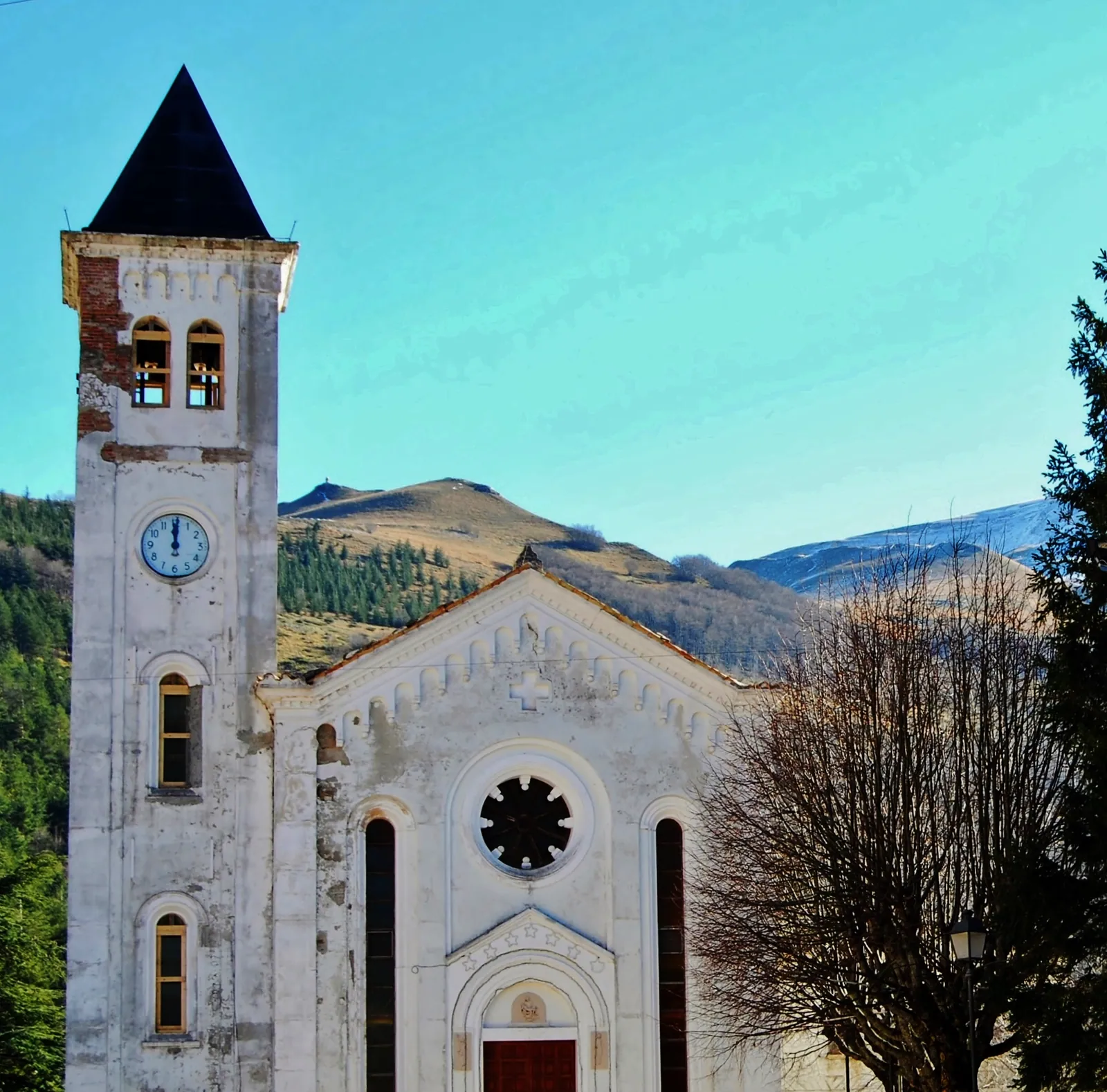
In Villa di Mezzo a few ruins remain of the castle built by the Da Varano, lords of Camerino, who for a long time held great influence over the free commune. Because of the legend it is known as Castello Pepoli. Also in Villa di Mezzo is the Church of San Michele Arcangelo, in Neo-Romanesque style, with a single nave, apse and bell tower. It was built in place of the old church, badly damaged by the 1934 avalanche and later demolished. The village also has the church of Santa Maria delle Grazie.
Palazzo Primavera, in Villa da Piedi, dates from the 16th-17th centuries and is rich in frescoes. In Bolognola wool was already worked in the Middle Ages, and for a long time this was done in the palazzo's cellars, which still hold several of the tools. Today the building hosts exhibitions and conferences. Palazzo Maurizi, in Villa di Mezzo, is the town hall. It was the home of the Maurizi family, is decorated with tempera paintings from the early 19th century, and the upper floor houses the permanent exhibition devoted to Filippo Marchetti. After the earthquake the palazzo was declared unsafe and is being restored. In June 2026 repair and seismic strengthening works were under way, with completion expected about a year later.
At Ferragosto, the mid-August holiday, the three ville compete in the Corsa della Secchia (bucket race). Three teams of four runners race through the village streets carrying a large bucket full of water, trying to spill as little as possible. The winner is the team with the best combination of time and water left. Before the race a historical parade in costume files past. On an evening after Ferragosto the village hosts a country-themed party. The full list of sights is on the page about things to do in Bolognola.
Nature and trails near Bolognola
The Fiastrone River rises in the territory of Bolognola, and Monte Rotondo towers over it. Below its summit opens the Acquasanta gorge, a narrow and impassable ravine, with the waterfall of the same name, between Monte Cacamillo and Punta Bambucerta. The waterfall is reached on a hike that starts from the village, near the church of San Michele Arcangelo. The route crosses the Fiastrone stream, rounds the Balzo della Croce and climbs the Acquasanta valley in the shade of beeches, maples and yews. Near the waterfall is one of the two Grotte dell'Orso (Bear Caves); the other is in the Vallata del Fargno, on the Costa delle Vetiche.
The Forcella del Fargno, at 1,811 m between Monte Rotondo and Pizzo Tre Vescovi, is the highest pass in the Marche that can be reached by car and is open to the public. There is a mountain hut here, and the pass separates the Val di Panico, to the west, from the Vallata del Fargno, to the east. The road climbing from Pintura to the Fargno is exposed to avalanche risk and its opening depends on official orders: it is worth checking before setting out.
From Pintura a loop climbs to Pizzo Tre Vescovi (2,092 m) and descends through the Valle del Fargno. The peak owes its name to the meeting point of the dioceses of Camerino, Spoleto and Fermo. The route is graded E (hiking) and takes about 5 hours and 40 minutes. The first descent into the Valle del Fargno is very steep and partly on scree, and almost the whole route is in the sun. A second loop graded E, on trails 311 and 313, starts from a picnic area with a fountain and tables near Bolognola. It follows the Fiastrone, climbs a gorge to the spring and the Fargno hut and returns along a mule track: about 5 hours of walking.
In Pintura there is also Macchiatonda, a circular beech wood. In winter the cross-country skiing trails run around this wood. The hamlet, at about 1,340 m, is home to the Bolognola Ski resort: six lifts, about 10 km of slopes for all levels with more than 400 m of vertical drop, a snowpark, a sledding area and a 4 km cross-country loop. In the 2025/2026 season the lifts opened on 23 November.
Where to stay in Bolognola
Bolognola has few beds. There is accommodation both in the village and in Pintura, near the slopes. To increase capacity, the municipality has launched an albergo diffuso project, with rooms spread across several buildings in the historic center. The houses are being restored and turned into lodgings with more than 5 million euros from the PNRR complementary plan for the earthquake-hit areas. In spring 2025 the works were on schedule, with the aim of finishing in March 2026.
On snowy weekends and during the summer festivals it is wise to book early. The full list of accommodation is on the page about where to stay in Bolognola.
Where to eat in Bolognola
In the Pintura ski area there are two mountain huts with food service, handy for a break during a day on the snow. In summer the village festivals are a chance to eat alongside the residents. On the Sunday before Ferragosto, Villa da Piedi hosts the Festa della Frittella, a food festival. The country party after Ferragosto also includes an arrosticini (lamb skewers) evening. The list of restaurants is on the page about where to eat in Bolognola.
Local products of Bolognola
Bolognola's tradition grew out of livestock farming and wool: wool working flourished in the village as early as the Middle Ages, and its tools are kept at Palazzo Primavera. In the kitchen Bolognola follows the tradition of the Sibillini Mountains, where the culture of shepherds and transhumance meets pork butchery. The most important cheese is pecorino, alongside fresh or aged ricotta. Among cured meats ciauscolo stands out, the soft spreadable salami typical of the Marche. The park also yields honey, truffles, mushrooms and chestnuts.
Two village festivals are devoted to simple dishes. The Festa della Salsiccia (sausage festival) accompanies the patron saint's feast of San Fortunato, on 1 June. The Festa della Frittella is held in August in Villa da Piedi.
Weather and how to get to Bolognola
Winters in Bolognola are cold and snowy. In the period 1961-1990 the average temperature was -2.4 °C in January, the coldest month, and +17.4 °C in July, the warmest. Snow falls in the village about thirty times a year, almost always heavily, and there are on average 94 frost days. About 800 mm of rain falls each year, spread over 89 days: less in summer and more in the fall. Before a hike at altitude it is always best to check the weather.
Bolognola is reached by car and is about 40 km from Macerata. From the A14 highway, exit at Civitanova Marche and take the SS 77 toward Tolentino and Macerata. At Polverina turn onto the SP 98, go through San Lorenzo al Lago and Acquacanina and follow the signs for Bolognola. Another road is the SP 120, which links the village to Sarnano by way of Sassotetto.
In winter snow and ice can make the roads difficult, and chains or snow tires are required. On the SP 120 between Bolognola and Sarnano, carrying chains or fitting snow tires was mandatory from 15 November to 15 April. The road has been closed several times, for avalanches and, in fall 2025, for roadworks. In winter 2025/2026 the prefecture introduced one-way traffic on Sundays, holidays and the days before them on the stretch between Pintura and Santa Maria Maddalena. Public transport is limited: scheduled buses link Bolognola with Macerata and Ancona. The nearest airports are Ancona-Falconara and Perugia. Bolognola is one of the villages of the Sibillini Mountains easiest to reach from the Adriatic coast.
In this section
4 results
 Things to do in Bolognola5 places
 Bolognola hotels and where to stay7 places to stay
- Bolognola restaurants3 places
- Pintura (Bolognola)Le Marche · Macerata
No results with these filters.