


Chiavano Vecchio (Cascia)
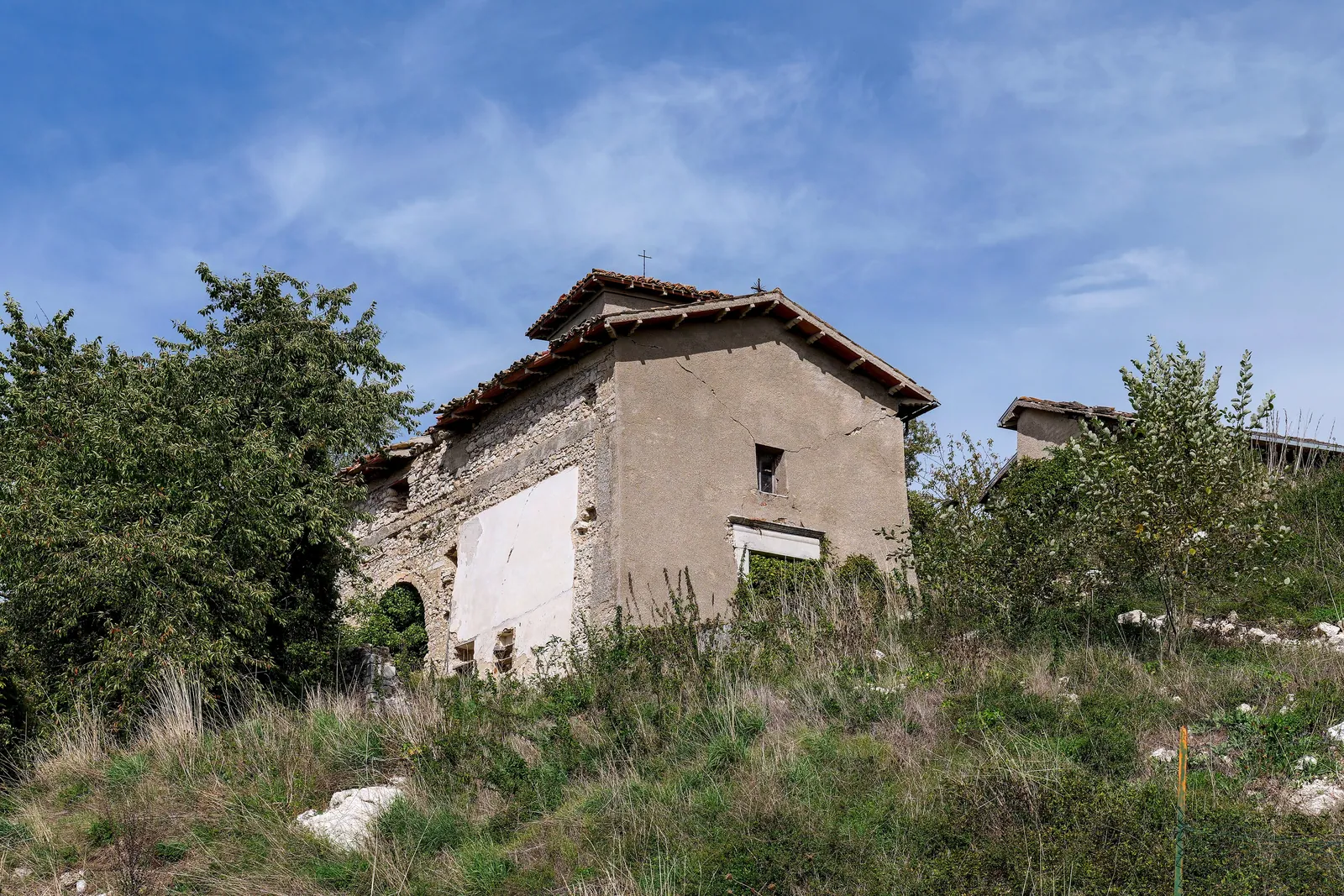
Chiavano Vecchio is the abandoned historic core of Chiavano, a hamlet of the municipality of Cascia, in the province of Perugia. Despite its abandonment, it keeps the old parish church of Sant'Ilario and the remains of the castle tower. The site was the seat of the lords of Chiavano, vassals of the dukes of Spoleto.
On the map
Points from the site database. Map © OpenStreetMap contributors · Protomaps.
History of Chiavano Vecchio in Cascia
The settlement has ancient origins. The Roman presence is documented by a block of local limestone with an inscription, reused as a step of the stairway leading to the church. A Roman road linked the Chiavano plain, together with Villa San Silvestro, to Monteleone di Spoleto.
In the Middle Ages the castle was at the center of the affairs of the Chiavano family. In 1280 Pope Nicholas III ordered the people of Cascia to pay 428 florins to the Chiavano for the damage the castle had suffered in the conflict. In 1305 Abrunamonte di Chiavano led the local Ghibellines who occupied Cascia. In 1312 his son Bartolomeo made a pact with Cascia and ceded to it the property he had come into possession of.
The old core was later left behind. The 1979 earthquake destroyed Chiavano, which was rebuilt in a safer position. The new village stands on a different slope from the original site and looks out over the Pian di Chiavano (Chiavano plain).
What to see at Chiavano Vecchio
The most important building is the church of Sant'Ilario, now in ruins. It has a single nave with a transept. After years of neglect, four dilapidated altars remain, along with an unstable coffered wooden ceiling, a headless statue of the Madonna and traces of frescoes in the two chapels. In the right-hand chapel, decorations with the Four Evangelists can be seen on the ceiling.
Of the old castle, the remains of the tower survive. The Roman block with an inscription, reused in the church stairway, is another detail worth looking for.
How to visit Chiavano Vecchio
Chiavano Vecchio is an abandoned settlement and its structures are in poor condition. In particular, the ceiling of the church of Sant'Ilario is unstable. It should not be assumed that the buildings are accessible: it is best to view them from the outside and not to enter unstable structures.
Where Chiavano Vecchio is located
Chiavano Vecchio is in the municipality of Cascia, in Umbria. The hamlet of Chiavano stands at 1,128 m above sea level. The new village looks out over the Pian di Chiavano.
Around Chiavano Vecchio in Cascia
In Villa San Silvestro, near Chiavano, are the remains of a Roman temple from the 3rd century BC. For other places of this kind, see the page on archaeological sites of the Sibillini. A route across the Chiavano plateau also starts here, from the square in front of the church of Villa San Silvestro.
Near Chiavano, a few ruins remain of the small church of San Giovanni, whose floor plan can still be made out. The area also includes the villages of Trognano, Coronella and Buda.
Frequently asked questions
Is Chiavano Vecchio still inhabited?
Which ruins can be seen at Chiavano Vecchio?
Who were the Chiavano?
What can you see near Chiavano Vecchio?
Nearby
What to see nearby
- under 100 m
- Palazzo Santi (Cascia)Museum or art gallery200 m
- Il Mulinaccio amphitheater on the Sentiero di Santa Rita (Cascia)Theater or auditorium3.1 km
Where to stay
- 100 m
- Residence San Francesco, CasciaGuesthouse100 m
- 100 m
Where to eat
- Bar Quadrifoglio, CasciaBar and caféunder 100 m
- Civitas Cassiae, CasciaBar and caféunder 100 m
- Valpan, CasciaBakery100 m
Straight-line distances.