


Sanctuary of Santa Rita in Cascia: visiting and how to get there
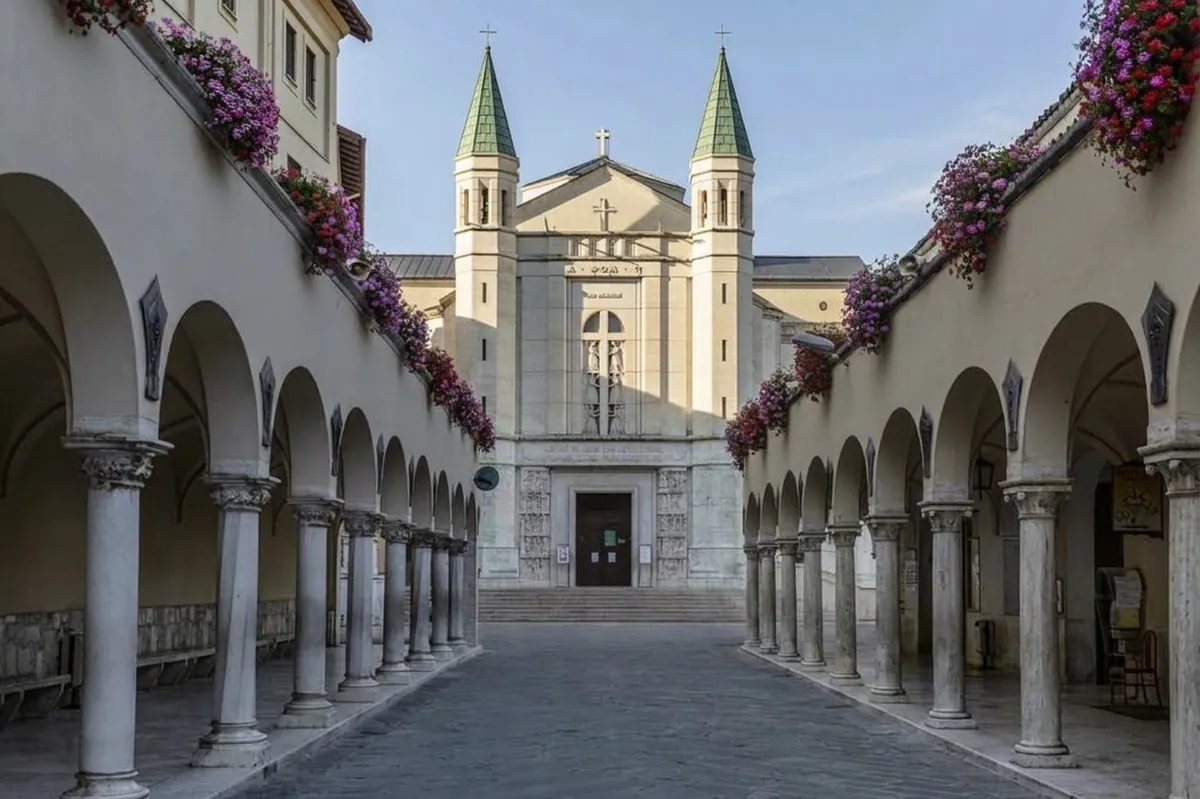
The Sanctuary of Santa Rita (Santuario di Santa Rita a Cascia) in Cascia, in the Valnerina valley, is the religious complex where Saint Rita is venerated and where the sarcophagus with her body is kept; this guide covers how to visit it and how to get there. It is not a single church. The sanctuary includes two basilicas, the Augustinian monastery where the saint lived as a nun for about forty years, a large hall for celebrations and several facilities for welcoming pilgrims.
Much of the complex tells the story of Rita's life through specific places and objects: the well and the vine in the monastery courtyard, the holes in the wall that serve as nests for mason bees, the rose garden recalling the miracle of the rose and the figs, the wedding ring kept among the relics. The most important day of the year is May 22, the feast day. Every year thousands of devotees come from all over Italy and the world to the Cascia sanctuary for the celebrations in honor of Saint Rita. Before setting out, keep in mind that the 2016 earthquake left its mark: the basilica has been made safe and restored, while the monastery can now be visited only in part.
On the map
Points from the site database. Map © OpenStreetMap contributors · Protomaps.
The history of the Sanctuary of Santa Rita in Cascia
The history of the sanctuary begins with that of Saint Rita. Rita was born around 1381 in Roccaporena, a small Umbrian village near Cascia. She married, and her husband was killed in one of the feuds that bloodied medieval Umbria. Shortly afterward her two sons also died of illness. Left alone, she asked to join the Augustinian monastery in Cascia. She was turned away several times, and on the third attempt, according to tradition, she found herself inside the convent as if carried by an invisible force. In the monastery she received the thorn on her forehead: the wound remained open for fifteen years, until her death on May 22, 1457. Pope Leo XIII canonized her in 1900.
The monastery of Santa Rita in Cascia dates from the 13th century. It was originally dedicated to Saint Mary Magdalene, was enlarged in the 18th century, and a community of Augustinian nuns still lives there today. For a long time the sanctuary was only this: the monastery and a small church with the saint's urn. When there were too many pilgrims for those spaces, Mother Maria Teresa Fasce decided to build a sanctuary suited to receive them. Mother Fasce was abbess of the monastery and was beatified in 1997 by Pope John Paul II.
Work on the Basilica of Santa Rita began in 1937. The church was solemnly consecrated in 1947, after many difficulties, mainly financial, and in 1955 it became a minor basilica. The design is by the engineer Spirito Maria Chiappetta. The lower basilica, originally the crypt, was inaugurated in 1988. In 2008 the Sala della Pace (Hall of Peace) was added, inaugurated by Monsignor Riccardo Fontana.
The 2016 earthquake is the most recent event in the sanctuary's history. After the tremors, and above all after the one on October 30, the basilica and the monastery were closed as a precaution because of the damage. It was the first time in history that the Augustinian nuns' monastery had been closed. On December 4 the basilica partially reopened to the faithful. Later the restoration was completed, mainly involving the paintings on the drum of the dome; the scaffolding under the dome was removed and the exterior cladding was finished.
What to see at the Sanctuary of Santa Rita in Cascia
At the Sanctuary of Santa Rita in Cascia you can visit the upper basilica with the saint's chapel, the lower basilica, some rooms of the monastery and the Sala della Pace.
The Basilica of Santa Rita has a Greek-cross plan with four apses at the ends. One of these opens into the Chapel of Santa Rita, where the saint's sarcophagus is kept. Part of the older church has been incorporated into the building: the restorers also restored the bell gable of the old church of Santa Rita. The interior decoration consists mostly of paintings, by artists such as Luigi Montanarini, Gisberto Ceracchini, Artemio Giovagnoni, Armando Marrocco and Ferruccio Ferrazzi.
The lower basilica, designed by the architects Rosario Scrimieri, Francesco Genco and Maurizio Caproni, holds the tomb of Mother Maria Teresa Fasce, the remains of Blessed Simone Fidati and the Eucharistic miracle. Inside there are also works by Luigi Filocamo and Armando Marrocco.
The monastery contains the places connected with the saint's life: the courtyard with the well, the vine and the holes in the wall where mason bees live; the old choir, with 16th-century frescoes and 17th- and 18th-century canvases; the oratory where Rita received the stigma; the cells, including the saint's own; and the rose garden, re-created in memory of the miracle of the rose and the figs. The vine has its own story: Rita was asked to water a dry vine branch every day. Since the earthquake, however, not all these rooms are open to the public (details are in the next section).
The Sala della Pace is a multipurpose hall that holds about seven hundred people. It is used on the busiest days, and Mass is often celebrated there. Its name recalls one of the cornerstones of Saint Rita's life.
How to visit the Sanctuary of Santa Rita in Cascia: guided tours
The basilica and the monastery are visited differently. The Basilica of Santa Rita is open for visits freely. The monastery, on the other hand, is visited in groups, at set times, with a member of the religious community as guide. Since the earthquake not all the rooms of the convent can be visited, but you can see the main relics, such as the casket that held the saint's body and her wedding ring, as well as the rose garden. The relics also include the rosary the saint used in prayer. The monastery remains a cloistered place: during the visit the guide asks visitors to keep silent.
May is the month of pilgrimages. The celebrations for Saint Rita begin on the first Sunday of May and culminate on the 22nd, when the most symbolic rites take place. On the night of the vigil, thousands of torches stay lit in Cascia and on the surrounding hills. On May 22 the procession arrives from Roccaporena, the saint's birthplace, and drummers and a historical parade precede the statue of the saint along the avenue of the basilica, where by tradition red roses are thrown at it. The roses of Saint Rita are the symbol of the feast: the blessing recalls the rose that bloomed in winter, amid the snow, after Rita, ill in her cell, had asked a relative for a rose from her home village. On those days Cascia fills with people, so it is best to arrive early.
Reaching the sanctuary from the town center is easy even for those who walk with difficulty: a system of escalators climbs up the narrow streets to the sanctuary.
Where the Sanctuary of Santa Rita in Cascia is and how to get there
The Sanctuary of Santa Rita is in the center of Cascia, in the province of Perugia. The town lies in a fairly isolated area of the mountainous southeastern corner of Umbria, at 653 meters above sea level, and is about 21 km from Norcia, on the road to Rieti.
The most practical way to get there is by car. From Rome, take the Autostrada del Sole to the Orte exit, continue toward Terni and take the Statale 209 della Valnerina, then the Statale 320 to Cascia. From Spoleto, follow the signs first for Norcia and then for Cascia, a drive of just under an hour. From the Marche side, follow the Autostrada Adriatica to Civitanova Marche, then the expressway toward Macerata and Tolentino, and at Muccia take the Visso-Valnerina turnoff. There are parking lots near the sanctuary, marked by signs.
The train does not go all the way: Cascia has no railway station, and the most commonly used stations are Spoleto and Foligno. Buses connect the area with Spoleto, Terni and Norcia, with varying schedules. One of the closest stops to the sanctuary is Cascia - Inc. Basilica.
Around the Sanctuary of Santa Rita in Cascia
Many pilgrims round off their visit at Roccaporena, Saint Rita's birthplace. The hamlet is a few kilometers from Cascia, but it has been connected to the town by road only since 1950. The sanctuary of Roccaporena was designed by the Turin architect Oreste Della Piana and consecrated in 1948. The Scoglio di Santa Rita (Saint Rita's rock) rises to 827 meters; at the top there is a chapel from 1919, and the view takes in the whole valley. The climb is demanding: it is very steep, with many steps, there are no alternative routes and it cannot be reached by car. The village also has the Church of San Montano, where the saint received her first religious instruction; the Orto del Miracolo (Garden of the Miracle), where according to tradition a rose and two figs bloomed in a harsh winter; the Lazzaretto and the Grotta d'Oro; and the saint's birth house and marital home.
Farther away, you can reach Preci and the Abbey of Sant'Eutizio, or the village of Scheggino, about 40 km toward Spoleto. For other places of faith in the area, the Santuario di Macereto and the other sanctuaries are on the page Sanctuaries and hermitages of the Sibillini.
Frequently asked questions
Where is the Sanctuary of Santa Rita, the church of Saint Rita in Cascia?
Who was Saint Rita of Cascia?
Where can you stay near the Sanctuary of Santa Rita?
How do you get to the Sanctuary of Santa Rita, and where do you start from?
What is Saint Rita the patron saint of?
What is there to see at the Sanctuary of Santa Rita?
What is the best time to visit the Sanctuary of Santa Rita?
What is the weather like at the Sanctuary of Santa Rita?
Where is Saint Rita of Cascia buried?
When did Saint Rita of Cascia live, and how did she die?
Nearby
What to see nearby
- under 100 m
- Palazzo Santi (Cascia)Museum or art gallery200 m
- Il Mulinaccio amphitheater on the Sentiero di Santa Rita (Cascia)Theater or auditorium3.1 km
Where to stay
- 100 m
- Residence San Francesco, CasciaGuesthouse100 m
- 100 m
Where to eat
- Bar Quadrifoglio, CasciaBar and caféunder 100 m
- Civitas Cassiae, CasciaBar and caféunder 100 m
- Valpan, CasciaBakery100 m
Straight-line distances.