


Birthplace of Santa Rita (Cascia)
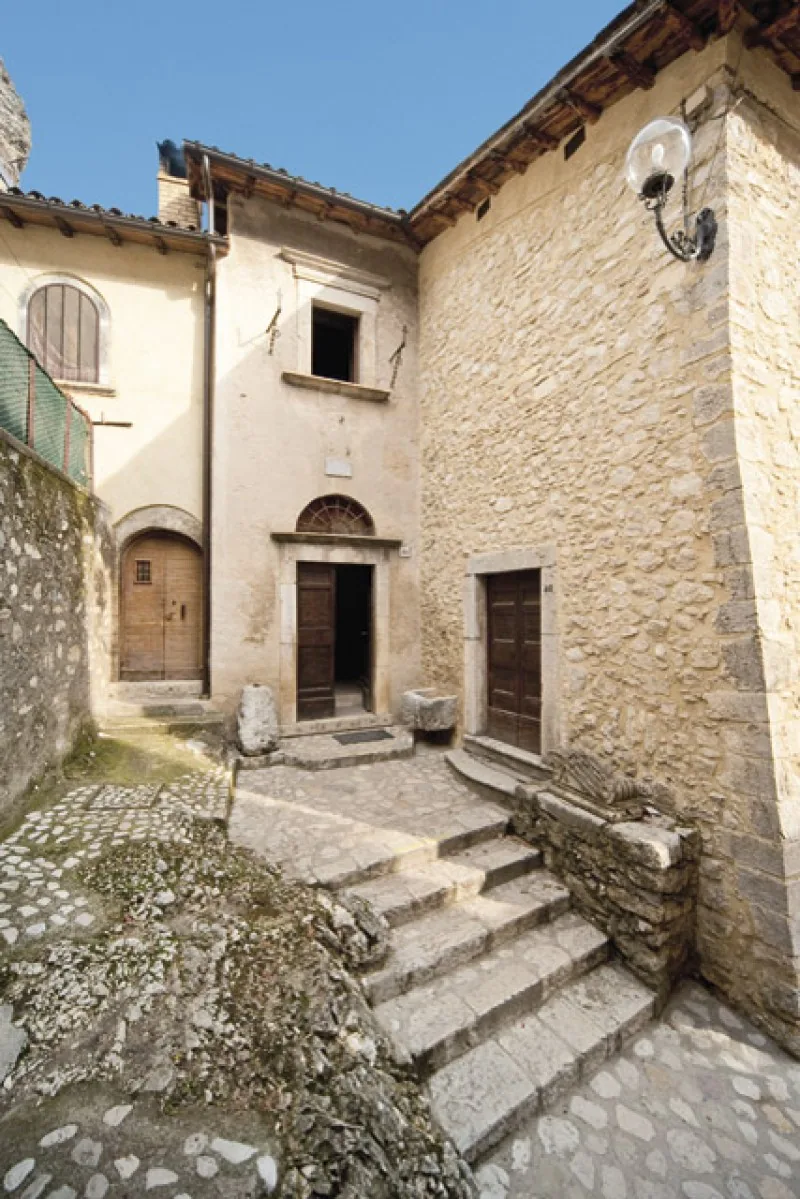
The Birthplace of Santa Rita (Casa Natale di Santa Rita) is in Roccaporena, a hamlet of the municipality of Cascia, and is a modest two-story building from the 14th century. Roccaporena stands at 707 m above sea level, at the end of a small gorge, about 6 km from Cascia. It is the village where Rita was born in 1381. The house is one of the village's places linked to Saint Rita, which also include the Orto del Miracolo (Garden of the Miracle), the Lazzaretto and the Scoglio Sacro (Sacred Rock).
Birthplace of Santa Rita (Cascia)
- Type
- Museum or art gallery
- Municipality
- Cascia (PG)
Source: site database, © OpenStreetMap contributors (ODbL).
On the map
Points from the site database. Map © OpenStreetMap contributors · Protomaps.
History of the Birthplace of Santa Rita
Roccaporena dates back to the Middle Ages. Rita lived in the house where she was born until the day of her marriage to Paolo di Ferdinando Mancini, celebrated in the Church of San Montano in Cascia. With her husband and their two sons she then lived in another house in the village, the marital home, until she entered the Augustinian monastery of Santa Maria Maddalena in Cascia.
The village changed with Rita's canonization, proclaimed by Leo XIII in 1900. Most of Roccaporena's religious buildings were built between 1930 and 1965, as devotion to the saint spread.
What to see in the Birthplace of Santa Rita
The house has a ground floor, the oldest part, entered through a doorway. An internal staircase leads to the upper floor, where there are two rooms. The first looks onto a lane of the village. From the window of the other there is a glimpse of the Scoglio Sacro. According to tradition, Rita's cradle stood near this window.
How to visit the Birthplace of Santa Rita
Along Roccaporena's main street, next to the Sanctuary, there is an Information Office open all year. It is the place to ask for directions. Before setting out, it is advisable to check the access conditions for the house. Opening times and visiting arrangements are best requested from the Information Office.
Where the Birthplace of Santa Rita is located
The house is in Roccaporena, about 6 km from Cascia. The road linking the village to Cascia is the only one and was opened in 1950. Coming from the Adriatic coast, leave the A14 at Civitanova Marche and take the expressway toward Macerata and Tolentino. At Muccia, turn off toward Visso and the Valnerina, then follow the 209 Valnerina road and the 320 to Cascia and Roccaporena. There is a parking area behind the Santuario di Santa Rita in Roccaporena.
Around the Birthplace of Santa Rita in Cascia
In Roccaporena are the Orto del Miracolo, with the bronze group by Rodolfo Maleci from 1941, and the Lazzaretto, the village's old hospital. Of the Lazzaretto, two of the three original rooms remain, with 16th-century frescoes. Then there is the marital home, turned into a chapel and opened for worship in 1629. The Sanctuary, consecrated in 1948, is also worth a visit.
The Scoglio Sacro is a rocky spur about 120 m above the village, enclosed in a small chapel. It is reached by a stairway of about 330 steps, along which the Stations of the Cross are placed.
In Cascia, the Museo civico di Cascia is open to visitors. Other museums in the area are listed on the page on museums of the Sibillini Mountains. For walkers, there is also a footpath from Cascia to Roccaporena.
Frequently asked questions
Where is Saint Rita of Cascia from, and where was she born?
How far is Roccaporena from Cascia?
How do you climb to the Scoglio Sacro?
What can you see inside the birthplace?
Nearby
What to see nearby
- under 100 m
- Il Mulinaccio amphitheater on the Sentiero di Santa Rita (Cascia)Theater or auditorium1.2 km
- Palazzo Santi (Cascia)Museum or art gallery4.2 km
Where to stay
- Casa Ma & Emy in CasciaGuesthouseunder 100 m
- under 100 m
- Casa Del Pellegrino La Margherita in CasciaReligious guesthouseunder 100 m
Where to eat
- La Pergola, CasciaBar and caféunder 100 m
- Bar - Pizza, CasciaBar and caféunder 100 m
- La Porrina, CasciaRestaurantunder 100 m
Straight-line distances.