


Church of Santa Maria Assunta (Valfornace)
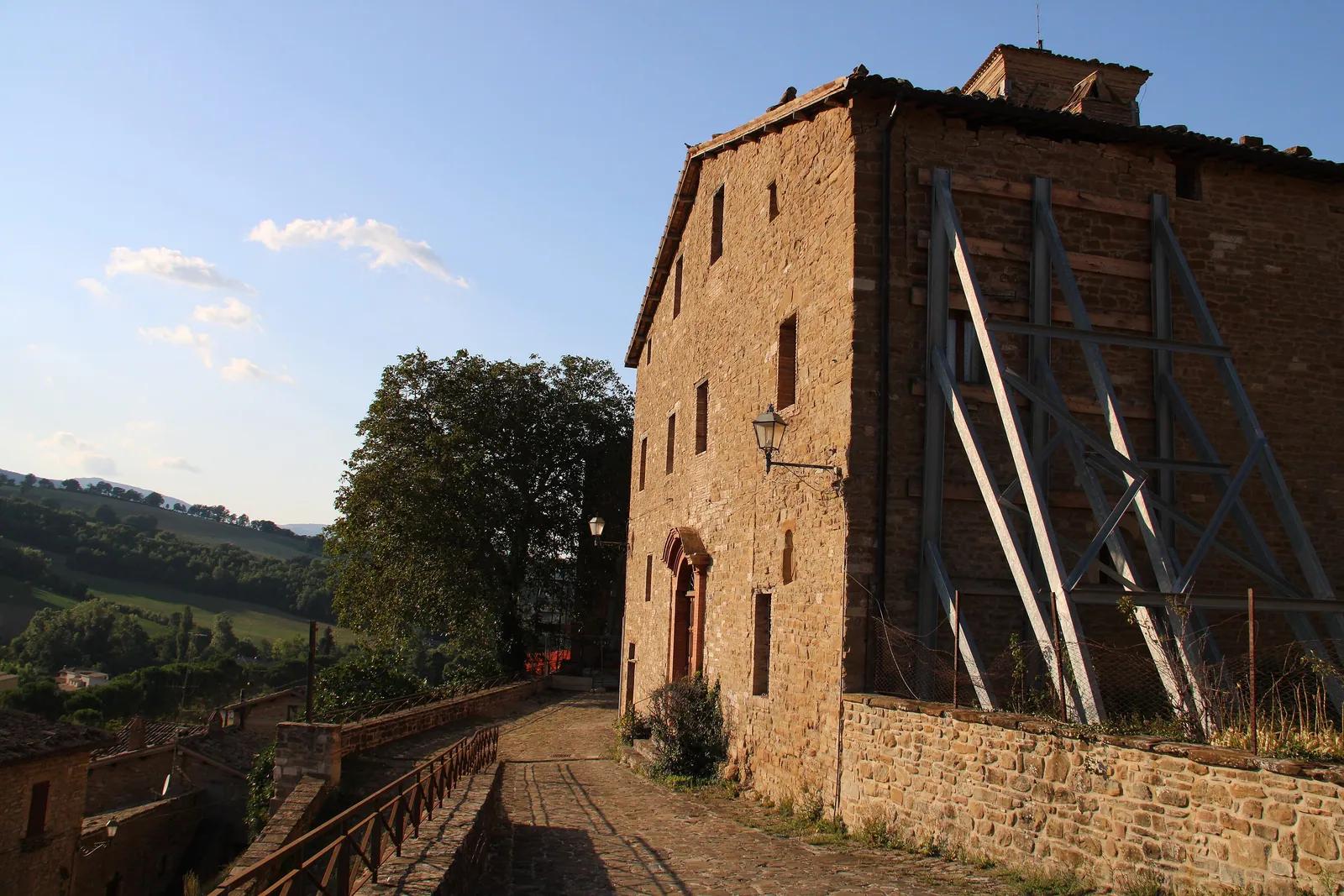
Church of Santa Maria Assunta (Valfornace)
- Type
- Church
- Address
- Via Flaminio Napoleoni 58, Pievebovigliana, 62031 Valfornace (MC)Valfornace (MC)
- Phone
- +39 0737 44126
Source: site database, © OpenStreetMap contributors (ODbL).
The Church of Santa Maria Assunta (Chiesa di Santa Maria Assunta) in Valfornace is the parish church of Pievebovigliana, the main hamlet of the scattered municipality of Valfornace, in the province of Macerata. It stands in the upper part of the village. The structure is Romanesque, the interior was restored in the neoclassical style, and a crypt survives below. The crypt dates from the 11th century and has five small aisles, three apses and four rows of columns with different capitals of Roman origin.
On the map
Points from the site database. Map © OpenStreetMap contributors · Protomaps.
History of the Church of Santa Maria Assunta
The first place of worship, of which the crypt remains, was probably built in the 11th century. A plaque found in the 19th century bears the date 1162, perhaps the year of consecration. In 1218 the bishop of Camerino, Attone II, granted the pieve various privileges. In 1634 the oratory of the Confraternita del Rosario was built next to the church, with an underground ossuary.
In 1756 rebuilding work began to a design by the architect Giovanni Ricchini. The bell tower was built on the base of a defensive tower, the roof was rebuilt, and in 1759 the church was consecrated. In 1823 the forebuilding in front of the aisles was turned into a rectory and the two side entrances were closed. On February 5, 1934 the roof collapsed; it was repaired in September 1935. On that occasion the floor was redone and the level of the presbytery was lowered. The 1997 earthquake cracked the facade and roof, and the restoration was approved in 2000.
What to see in the Church of Santa Maria Assunta
The exterior has a gabled facade facing southwest, with a round-arched portal. The square bell tower has an arched single-light window on each side of the belfry and a hipped roof.
The interior has three aisles, four bays, cross vaults and pillars painted to look like marble. The presbytery is raised and ends in a semicircular apse. The canvases by Girolamo and Antonio Aspri and by Luigi Valeri belong to the 18th and 19th centuries. Valeri painted the Madonna di Costantinopoli and a Crucifixion with Saint Macarius and Saint Cajetan of Thiene. Girolamo Aspri's Assumption serves as the altarpiece of the high altar. Behind the altar is the choir with wooden seats, and four canvases around the altarpiece show the Coronation, the Resurrection, the Ascension and Pentecost. Antonio Aspri painted the Death of Saint Joseph. The works also include a 15th-century fresco of Saint Lucy, attributed to Arcangelo di Cola. The crypt was used as a wine cellar until 1922.
How to visit the Church of Santa Maria Assunta
Below the church is the Romanesque crypt. After the 2016 earthquake the church and crypt were temporarily closed because of the damage: before visiting, it is best to check whether they have reopened. Contact details are in the box on this page.
Where the Church of Santa Maria Assunta is
The church is in Pievebovigliana, in the municipality of Valfornace (province of Macerata). It belongs to the Archdiocese of Camerino-San Severino Marche and is part of the vicariate of Pieve Torina. Part of the municipality lies within the Sibillini National Park in the Sibillini Mountains.
Around the Church of Santa Maria Assunta
Pievebovigliana is home to the civic museum "Raffaele Campelli", which traces the social and artistic history of the area from prehistory to the present; since the 2016 earthquake it has been unfit for use, so it is best to check whether it is open before visiting. The municipality also has the Beldiletto Castle in Valfornace, converted into a Renaissance villa in the 15th century, and the Romanesque church of San Giusto, at San Maroto. Other places of worship in the area are on the page about the churches of the Sibillini Mountains.
Frequently asked questions
When was the church built, and who designed the rebuilding?
What is the crypt of Pievebovigliana like?
What works of art does the church contain?
What can you visit near the church?
Nearby
What to see nearby
- 500 m
- 1000 m
- 1.3 km
Where to stay
- 300 m
- Sapori di Campagna, ValfornaceFarm stay600 m
- 700 m
Where to eat
- Bar Luigi 7.1, ValfornaceBar and café300 m
- Locanda della Pieve, ValfornaceRestaurant400 m
- Il Fagiano, ValfornaceRestaurant2.6 km
Straight-line distances.