


Church of Santa Maria delle Grazie in Caldarola
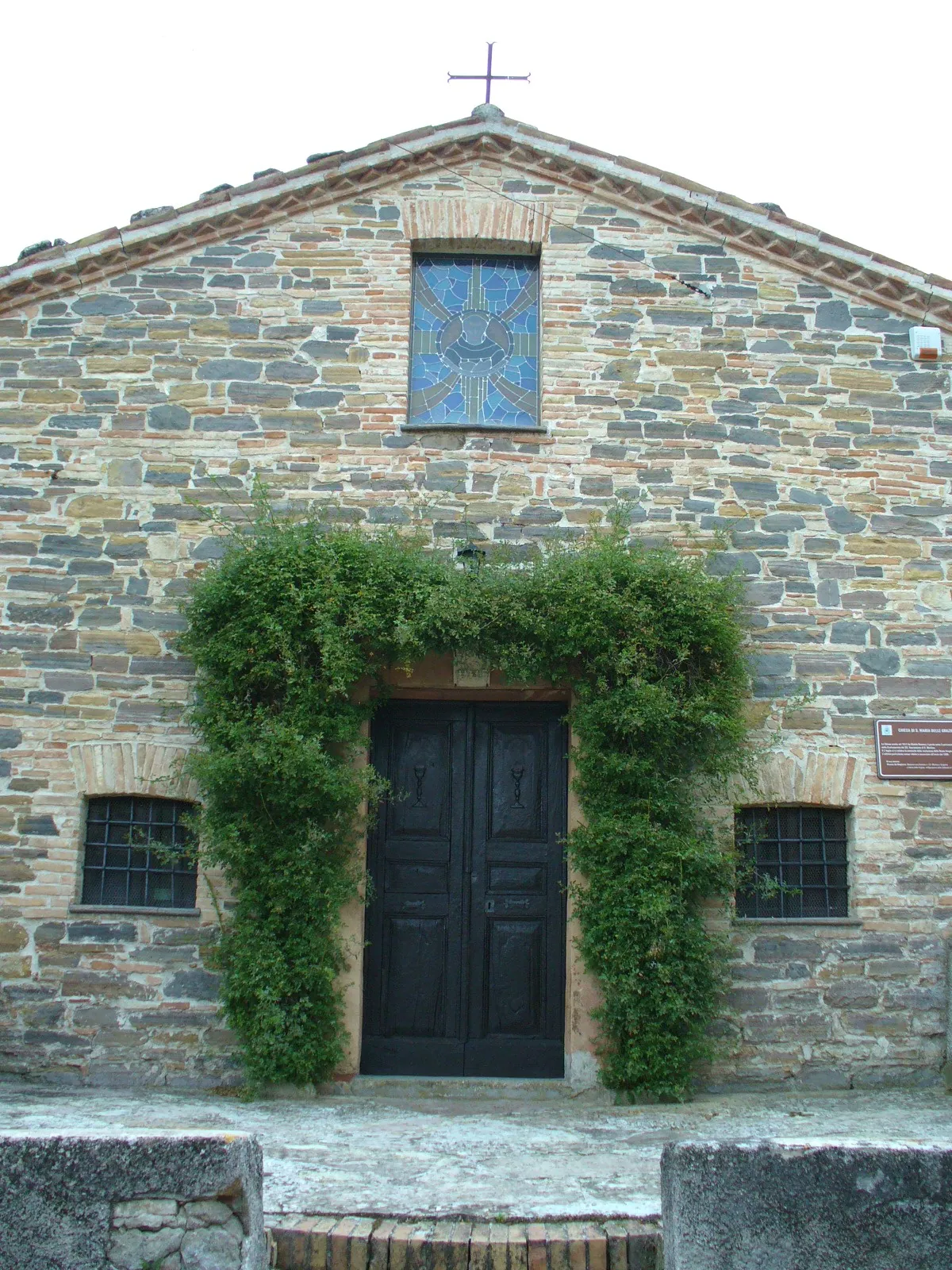
The Church of Santa Maria delle Grazie (Chiesa di Santa Maria delle Grazie) in Caldarola is a small single-nave church in the Borgo Piandebussi. Little is known about it, and it is little known even among the people of Caldarola. Its interest lies in the high altar, where part of a fresco attributed to Giovanni Andrea De Magistris survives. The fresco shows the Madonna and Child and, in the background, a view of Caldarola before the urban works of Cardinal Evangelista Pallotta. The church was severely damaged by the 2016 earthquake, so it is best to check whether it is accessible before setting out.
Church of Santa Maria delle Grazie in Caldarola
- Type
- Church
- Municipality
- Caldarola (MC)
Source: site database, © OpenStreetMap contributors (ODbL).
On the map
Points from the site database. Map © OpenStreetMap contributors · Protomaps.
History of the Church of Santa Maria delle Grazie in Caldarola
A document from 1299-1300 mentions a church dedicated to San Salvatore in Borgo Pian di Busso, which attests to a sacred building there as early as the Middle Ages. Then the records fall silent for about three centuries.
At the beginning of the 17th century, Canon Barlesi describes a church here dedicated to the Madonna delle Grazie, under the patronage of the Confraternity of the Most Holy Sacrament of San Martino. The feast was celebrated on July 2, the day of the Visitation of the Blessed Virgin Mary. According to a record reported by Barlesi himself, the church was built by Ubaldo Romano in 1612. Inside it, Porzia Lippacci founded a chaplaincy. In all likelihood the 17th-century building replaced the medieval one.
At the beginning of the 20th century, when the building was considered unsafe, the church was reduced in size and shortened.
What to see in the Church of Santa Maria delle Grazie
The main attraction is the fresco on the high altar, of which only part remains. It depicts the Madonna and Child flanked by Saints Martin and Gregory, protectors of the Terra di Caldarola. To the right of the Virgin appears Caldarola as it was at the end of the 16th century, before the major works of Cardinal Pallotta. For this reason the work is also valuable as a record of the town's urban history.
Visiting the Church of Santa Maria delle Grazie
The church was severely damaged by the 2016 earthquake. A visit to the interior therefore cannot be counted on. Before heading to the village, it is best to ask about access.
Where the Church of Santa Maria delle Grazie is located
The building is in the Borgo Piandebussi, in Caldarola, in the province of Macerata. Old documents also call the village Pian di Busso. The church belongs to the Archdiocese of Camerino-San Severino Marche.
Around the Church of Santa Maria delle Grazie
The municipality of Caldarola has other religious buildings, including the Church of Santi Martino e Giorgio in Caldarola and the Church of Santi Gregorio e Valentino in Caldarola. Other churches in the area are listed on the page about the churches of the Sibillini Mountains.
Frequently asked questions
Was the Church of Santa Maria delle Grazie in Caldarola damaged by the earthquake?
Who painted the fresco on the high altar?
When was the church built?
Why is the church only partly known to the people of Caldarola?
Nearby
What to see nearby
- Pallotta Castle (Caldarola)Castle or fortress400 m
- 400 m
- 400 m
Where to stay
- Il Frutteto, CaldarolaFarm stay400 m
- 500 m
- 600 m
Where to eat
- Caffè Manzoni, CaldarolaBar and café500 m
- Bar Gelateria "Da Savè", CaldarolaBar and café700 m
- Pizza in Piazza, CaldarolaRestaurant900 m
Straight-line distances.