


Co-Cathedral of Santa Maria Argentea in Norcia
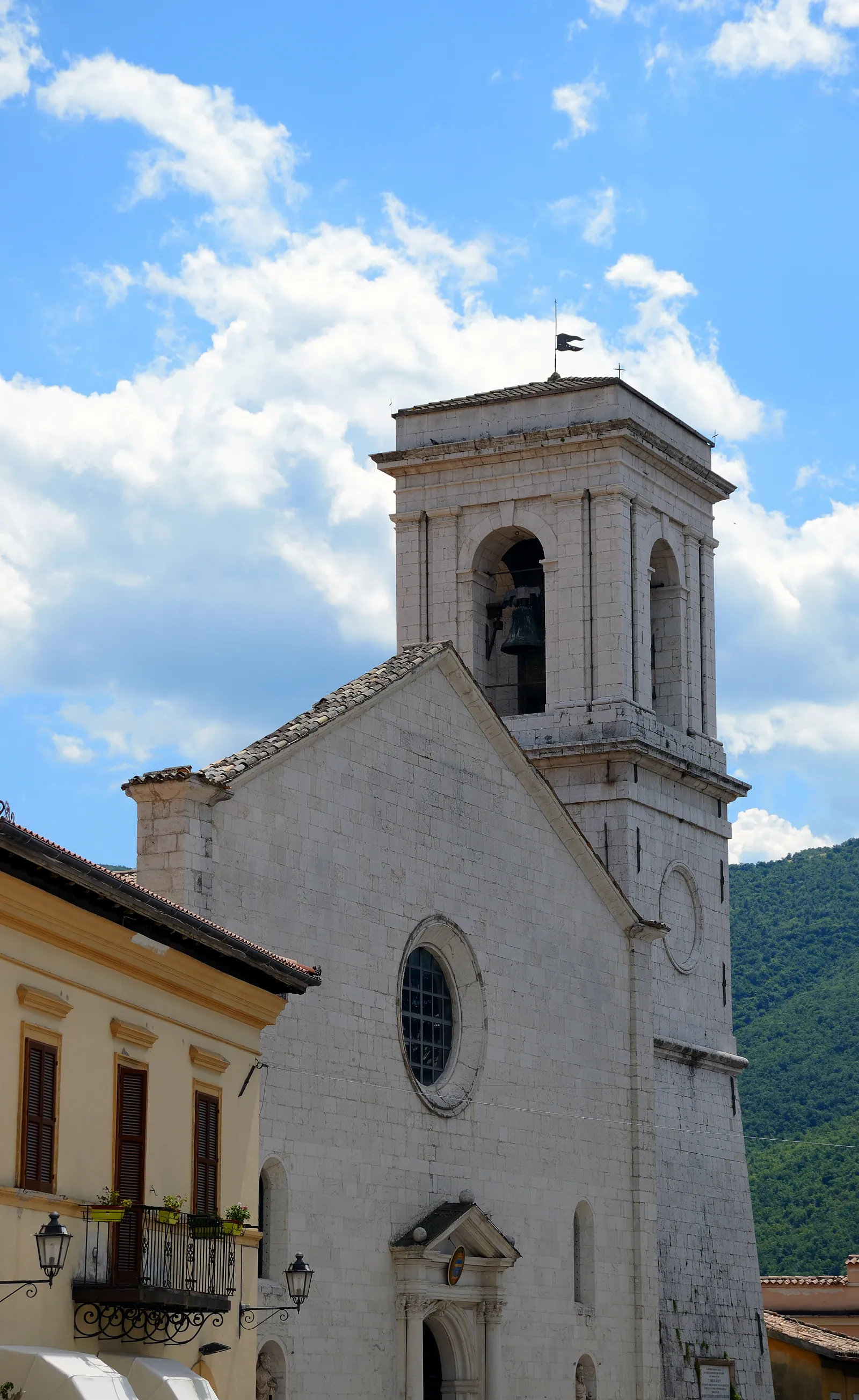
The Co-Cathedral of Santa Maria Argentea (Concattedrale di Santa Maria Argentea) is, together with the Basilica di San Benedetto, the duomo of Norcia, and is co-cathedral of the Archdiocese of Spoleto-Norcia. It stands in Piazza San Benedetto, next to the Castellina. The present church replaced the early medieval pieve, demolished in the 16th century to build the fortress. The earthquake of October 30, 2016 brought most of it down. Since September 2024 the building has been a reconstruction site.
Co-Cathedral of Santa Maria Argentea in Norcia
- Type
- Church
- Municipality
- Norcia (PG)
- Website
- fondoambiente.it
Source: site database, © OpenStreetMap contributors (ODbL).
On the map
Points from the site database. Map © OpenStreetMap contributors · Protomaps.
History of the Co-Cathedral of Santa Maria Argentea
Where the Castellina now stands there was a Roman temple dedicated to the goddess Fortuna Argentea. It was later converted to Christian worship, and the church's title refers back to that origin. The old pieve was demolished in the 16th century to make way for the fortress. In the second half of the 16th century the new church was built next to it.
Frequent earthquakes damaged it several times. In the 18th century it was rebuilt in Neoclassical forms, with three naves. It was the cathedral until John Paul II decided to return the bishop's seat to Spoleto. Since then it has held the title of co-cathedral.
What to see in the Co-Cathedral of Santa Maria Argentea
Before the earthquake, the gabled facade had a Neoclassical portal with a triangular pediment supported by two columns, a circular rose window and two niches with statues. On the left side was a Gothic portal from the old pieve.
Among the works inside, the 16th-century fresco of the Madonna and Child between Saints Benedict and Scholastica, attributed to the Sparapane workshop, stands out. It survived the collapse. The 1494 wooden crucifix by Giovanni Teutonico, on the other hand, was shattered by the earthquake. Its restoration had revealed traces of incense in the skull cap, a sign of its use in sacred plays. The organ built by Adriano Fedeli between 1743 and 1744 stood in the choir loft.
After the earthquake, two of the four bells were restored in 2017. They were installed on a bell tower built for the purpose at the Centro di Comunità di Santa Maria delle Grazie.
Visiting the Co-Cathedral of Santa Maria Argentea
The reconstruction site opened on September 7, 2024. The work is worth about 7.4 million euros. It cannot be taken for granted that the interior can be visited. Before arriving, it is best to ask about the state of the work, for example at the Norcia tourist office.
Where the Co-Cathedral of Santa Maria Argentea is located
The co-cathedral is in Norcia, in Umbria, on the south side of Piazza San Benedetto. It occupies a slightly secluded position compared with the other buildings on the square and stands next to the Castellina.
Around the Co-Cathedral of Santa Maria Argentea in Norcia
The Palazzo Comunale, the Castellina and the Basilica of San Benedetto in Norcia, reopened to the public nine years after the earthquake, also face the same square. The Castellina houses the Museo Civico e Diocesano and is undergoing restoration. Its underground rooms show the remains of the old pieve. Other sacred buildings in the area are listed on the page about the churches of the Sibillini Mountains.
Frequently asked questions
Is the co-cathedral of Norcia open to visitors?
Why is the church called Santa Maria Argentea?
What is the difference between cathedral and co-cathedral in Norcia?
What happened to the bells after the earthquake?
Nearby
What to see nearby
- Castellina Museum (Norcia)Castle or fortressunder 100 m
- under 100 m
- Civic Theater (Norcia)Theater or auditorium200 m
Where to stay
- Le Mura, NorciaGuesthouseunder 100 m
- Coccia Resort, NorciaVacation rentalunder 100 m
- under 100 m
Where to eat
- Caffè Parigi, NorciaBar and caféunder 100 m
- Officina, NorciaRestaurantunder 100 m
- Bar d'Angelisa, NorciaBar and caféunder 100 m
Straight-line distances.