


Pievefavera (Caldarola)
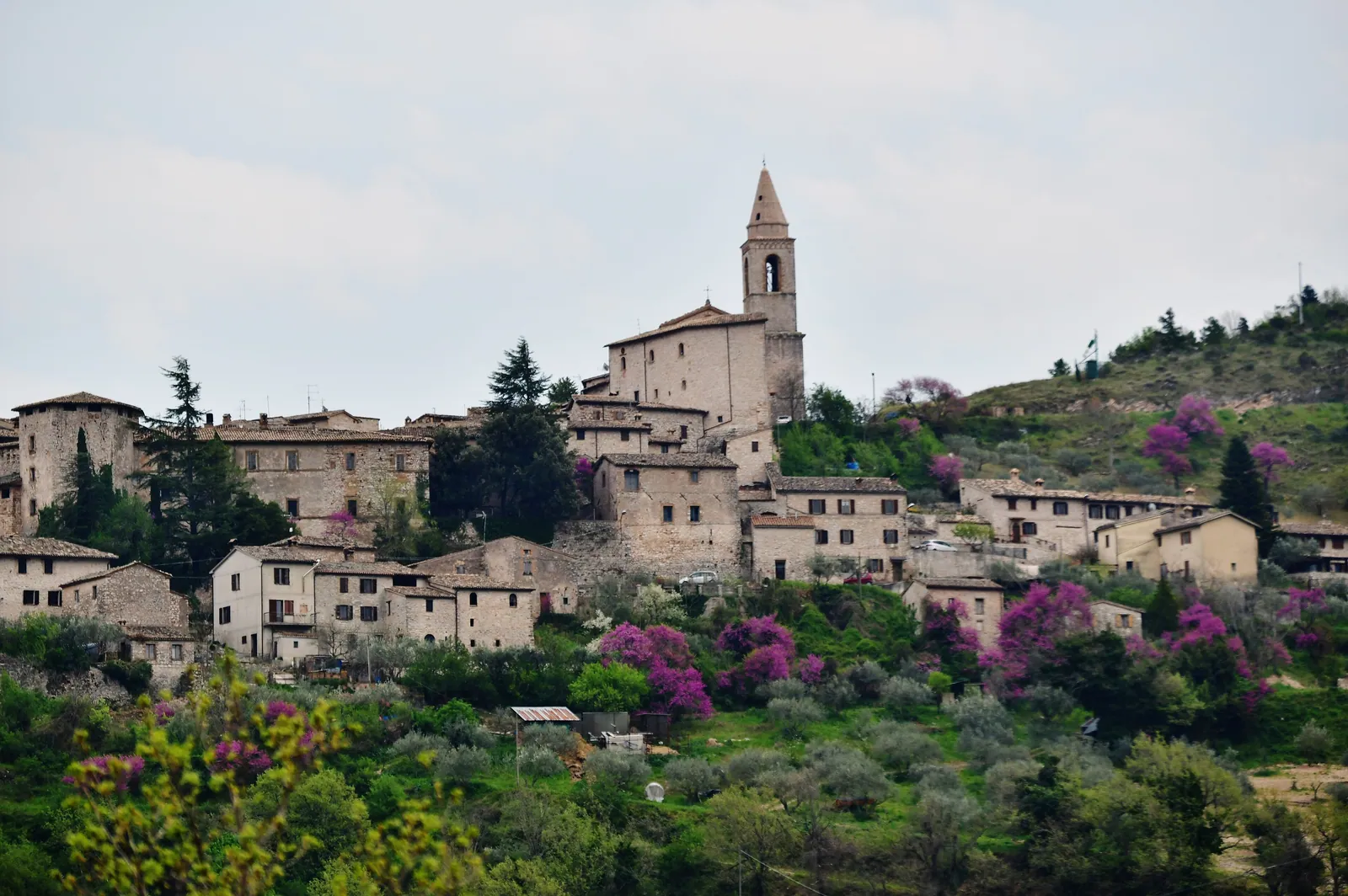
Pievefavera (Caldarola)
- Type
- Museum or art gallery
- Address
- Pievefavera, 62020 Caldarola MCCaldarola (MC)
Source: site database.
Pievefavera is a fortified village in the municipality of Caldarola, perched on a hill overlooking Lago di Caccamo and the Chienti valley. Of the hamlets facing the lake, it is the largest and most populated, and it keeps much of its ring of walls in white limestone.
The village grew up around an old pieve (parish church), from which it takes its name, and today it is one of the stops on the Cammino Francescano della Marca, a Franciscan walking route.
On the map
Points from the site database. Map © OpenStreetMap contributors · Protomaps.
History of Pievefavera in Caldarola
At the foot of the hill, in the Mercatale area, excavations in 1883 uncovered finds and a Roman-era tomb, suggesting an ancient settlement called Faveria. After the fall of the Empire, like many small mountain settlements, the village moved uphill, under the protection of its walls.
The core of the new settlement was the pieve, mentioned as plebs in parchments from 1170 on the properties of the Abbadia di Fiastra. In 1266 the parish priest Berardo Da Varano bought land to build north of the walls, while the last ring of walls dates from the 16th century.
What to see in Pievefavera
The walls surround almost the entire perimeter; only on the northwest side were they incorporated into the lordly palazzo and partly demolished. Five towers guarded their course: three with a square plan and two polygonal, at opposite corners. The main route still climbs from the lowest gate, to the north, up to the pieve, passing through three more gates that mark three centuries of expansion.
At the center of the castle stands the Romanesque Church of Santa Maria Assunta, with its ceiling frescoed in blue and an altarpiece. The polygonal tower near the church houses a lapidarium with ancient finds.
Visiting Pievefavera
The village is explored on foot, entering through the gates of the walls. Those walking the Cammino Francescano della Marca reach it on the stage from Polverina, climbing a gravel road toward the castle, which can be seen from afar in its commanding position.
Where Pievefavera is located
Pievefavera is in the municipality of Caldarola, in the province of Macerata, on the hill above the south shore of Lago di Caccamo. Below the village, near the shore, are the archaeological area of the Roman villa and the Antiquarium.
Around Pievefavera in Caldarola
Toward Caldarola lies Vestignano, mentioned as early as 969 among the possessions of the Abbazia di San Clemente a Casauria: it keeps a cylindrical tower and its 14th-century walls, with the 13th-century church of San Martino just outside them. During the Resistance the village was the seat of a partisan command.
In the opposite direction, the route of the Cammino descends to Valcimarra, a small village with a washhouse and fountain on its little square, and continues through the woods to the rock church of the Madonna del Sasso.
Nearby
What to see nearby
- 100 m
- Pievefavera Antiquarium (Caldarola)Museum or art gallery100 m
- Lago di CaccamoLake400 m
Where to stay
- Casa Vacanze Valleverde, CaldarolaVacation rental300 m
- 2.2 km
- 2.3 km
Where to eat
- Circolo A.C.L.I., CaldarolaBar and caféunder 100 m
- Trattoria, CaldarolaRestaurant300 m
- Chiosco Bar, CaldarolaBar and café300 m
Straight-line distances.