


Porta San Giacomo in Amandola
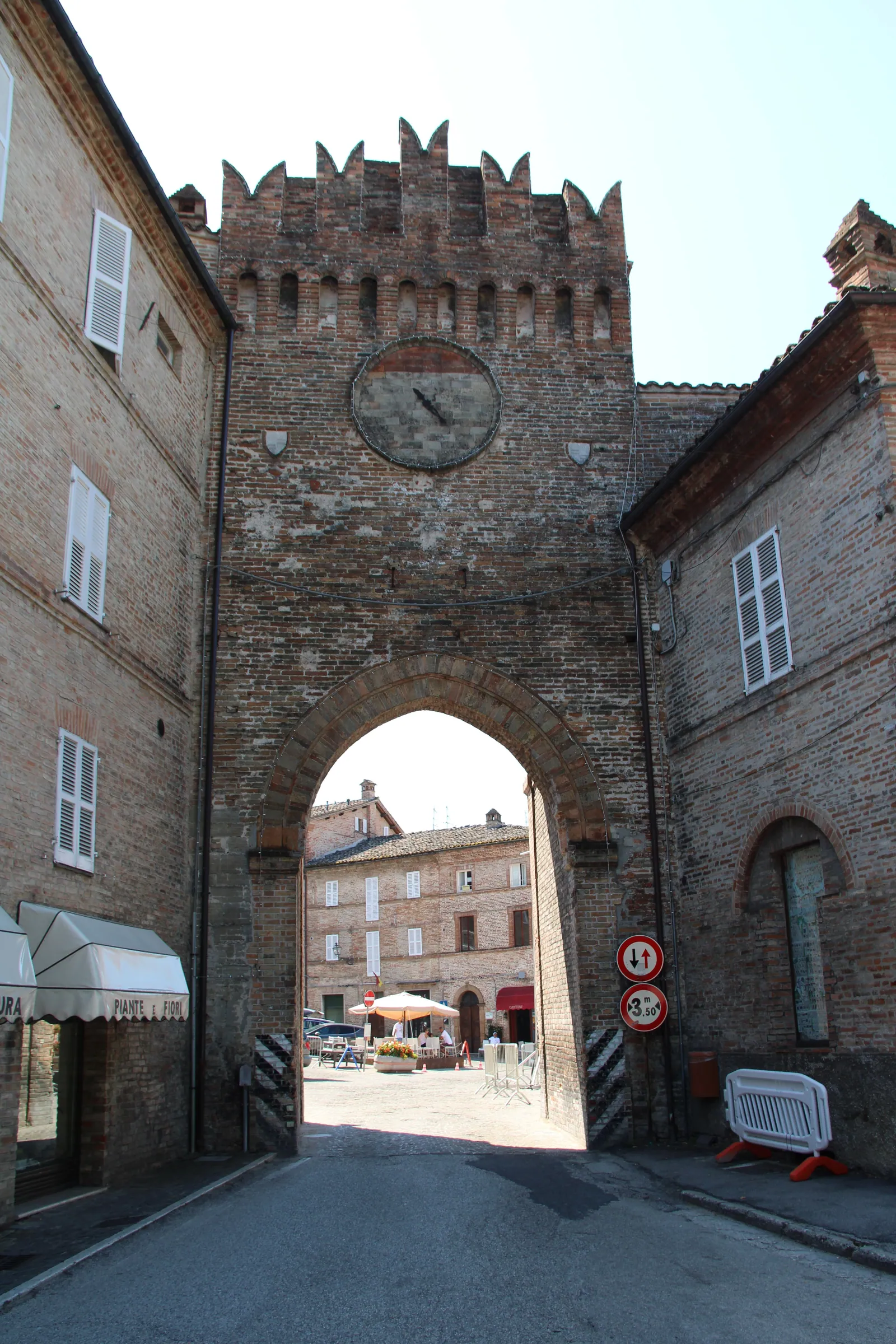
Porta San Giacomo is the Gothic entrance to the historic center of Amandola, in the Marche. It is the only one of the town's five old gates to have survived. Passing through it leads to Piazza Risorgimento in Amandola, the center of local life. It is recognizable by its pointed arch with a clock above and by its Ghibelline (swallowtail) battlements.
Porta San Giacomo in Amandola
- Type
- City walls and gates
- Address
- Via Fabio FilziAmandola (FM)
Source: site database, © OpenStreetMap contributors (ODbL).
On the map
Points from the site database. Map © OpenStreetMap contributors · Protomaps.
History of Porta San Giacomo in Amandola
Amandola became a free commune in 1248, when three castles joined together. Over time the town built a long circuit of walls, strengthened by towers and five fortified gates. Of these gates only Porta San Giacomo has survived to this day. Two 15th-century coats of arms appear on the structure.
What to see at Porta San Giacomo
Its Gothic character shows in the pointed arch, topped by a clock. Along the top runs a Ghibelline battlement, with machicolations between the corbels, the brackets that support the crown of the wall. The two 15th-century coats of arms complete the facade. The gate is also a real traffic passage. The road linking Comunanza to Sarnano and Macerata runs through it.
How to visit Porta San Giacomo
The gate is visited by walking through it into the historic center. It is listed as open to visitors, but it is worth checking times before setting out. There is an information point in the center, useful for planning the rest of the visit.
Where Porta San Giacomo is located
The gate is in Amandola, on the eastern side of the National Park of the Sibillini Mountains. The town's historic center spreads over three hills. Porta San Giacomo is the opening that leads into Piazza Risorgimento.
Around Porta San Giacomo
Beyond the gate, in Piazza Risorgimento, a flight of steps leads down to the Sanctuary of Beato Antonio. The building dates from the 14th-15th century and has a 1468 portal in a Gothic-inspired style with a Venetian flavor. The historic center also has the Museo del Paesaggio (landscape museum), housed in the former collegiate church. The church of San Francesco was closed after the 2016 earthquake: before visiting, check whether it has reopened. Climbing the lanes leads to the panoramic Piazza Umberto I, with the Torrione del Podestà and the La Fenice Theater in Amandola. By car, in about 10 minutes, it is possible to reach the Lago di San Ruffino, in the Tenna valley, with a nature trail.
To compare other fortified walls in the area, see the page on medieval walls and gates of the Sibillini.
Frequently asked questions
Is Porta San Giacomo the only surviving gate of Amandola?
Where does Porta San Giacomo lead?
How do you recognize Porta San Giacomo?
Nearby
What to see nearby
- Sanctuary of Beato Antonio (Amandola)Sanctuary or hermitageunder 100 m
- under 100 m
- Piazza Risorgimento (Amandola)Historic building or squareunder 100 m
Where to stay
- under 100 m
- Sibilroom, AmandolaGuesthouse100 m
- Villa Schinoppi, AmandolaTourist accommodation100 m
Where to eat
- under 100 m
- Pizzeria Sacchetti, AmandolaRestaurantunder 100 m
- Quadrani Mario Bar E Gelateria, AmandolaBar and caféunder 100 m
Straight-line distances.