


Piazza Risorgimento (Amandola)
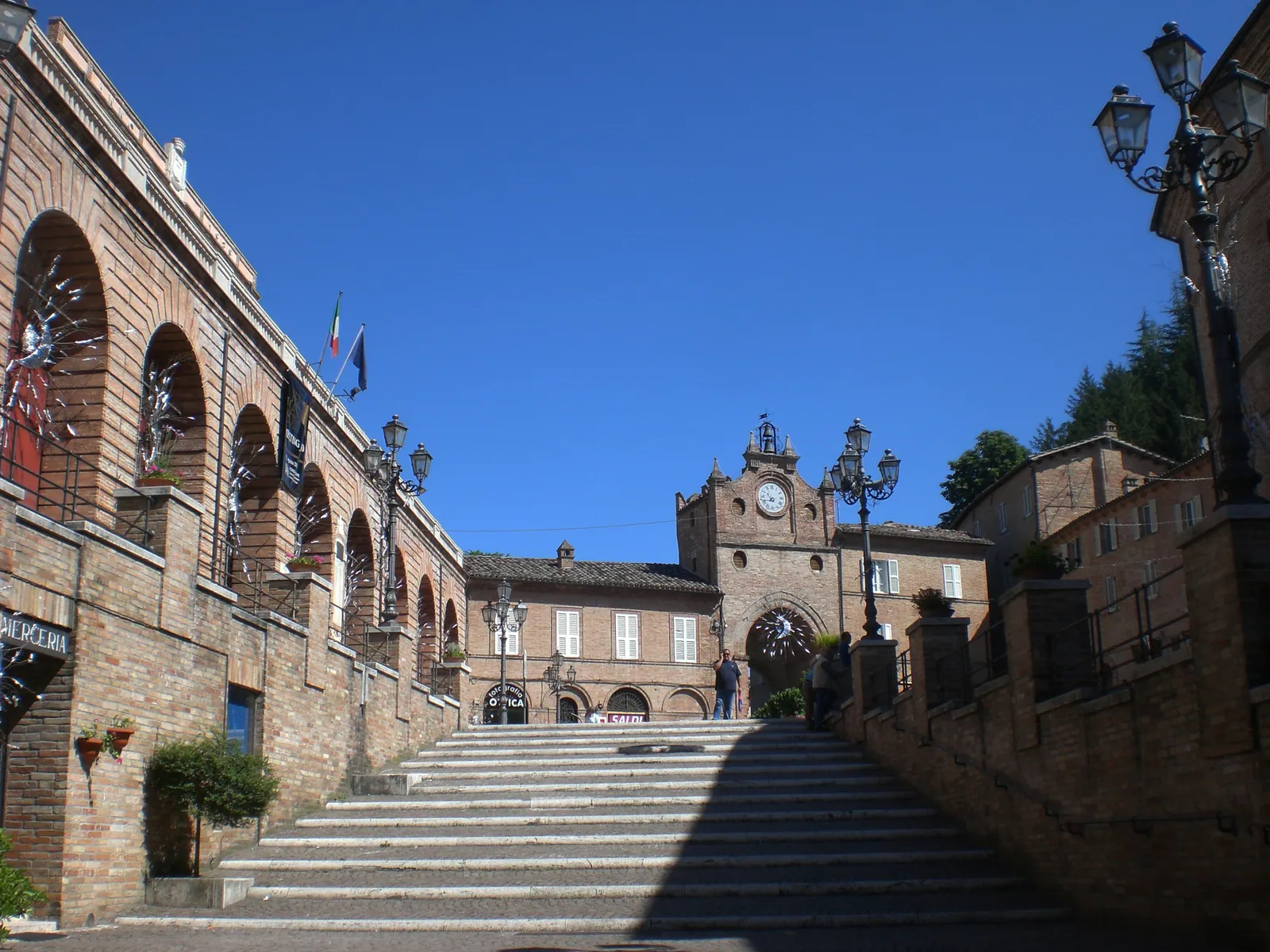
Piazza Risorgimento (Amandola)
- Type
- Historic building or square
- Municipality
- Amandola (FM)
Source: site database.
Piazza Risorgimento is the main square of Amandola, in the province of Fermo, and the usual starting point for a visit to the historic center. It is reached by passing through Porta di San Giacomo, the only one left of the five original gates. On the right, a long loggia forms the entrance to the Palazzo Comunale (town hall), while at the far end, a little lower down, stands the façade of the Sanctuary of Beato Antonio. The square is considered the center of Amandola and the starting point for sightseeing.
On the map
Points from the site database. Map © OpenStreetMap contributors · Protomaps.
History of Piazza Risorgimento in Amandola
The square took on its present appearance over time, partly through the demolition of some fine buildings. The entire architectural ensemble, including the sandstone paving, has been restored.
The setting is that of a municipality born in the 13th century: the Comune di Amandola was formed in 1248 by the union of three castles, Castel Leone, Marrubbione and Agello. The entrance to the square also has a history of rebuilding. Porta San Giacomo was torn down in 1836 to make way for the new Palazzo Comunale and rebuilt in 1863 with the same materials.
The square also keeps a memory of 1943. A memorial plaque recalls that here, on October 2, 1943, the infantryman Angelo Biondi was summarily executed. Biondi was born in Ceglie Messapica and is recognized as a fallen partisan fighter. His case was one of the first episodes of violence not only in the municipality of Amandola but in the whole province. A street in Amandola bears his name.
What to see in Piazza Risorgimento
Porta San Giacomo is the first feature encountered. It is built entirely of brick, with a pointed arch. It has two façades: the back one is original, with a pointed arch and battlements, while the one facing the square is Baroque. On the latter is a clock that previously belonged to the church of Sant'Agostino.
The Palazzo Comunale occupies the longest side of the square and is laid out on two levels. The loggia in front of the entrance houses shops.
The opposite side is dominated by the church of Sant'Agostino, also called the Santuario del Beato Antonio. To enter from the square you go down a flight of steps, rather than up as you might expect. The building was begun in the 14th century and enlarged in the early 15th century by the prior of the convent, Antonio Migliorati, beatified in 1759. The portal is in a Gothic-inspired style of Venetian influence. The bell tower has pointed mullioned windows and an octagonal spire.
Visiting Piazza Risorgimento
The square is an open space that can be visited freely. No tickets are needed, but the opening hours of the buildings overlooking it should be checked before setting out. The info point is under the portico of the main square. It offers information on how to get there, where to stay and what to do, from hiking to mountain biking and horseback riding. There are also cafés on the square.
The square is worth seeing year-round. Those who want to continue through the historic center can use it as a base, since the other places described below can be reached on foot from here.
Where Piazza Risorgimento is located
Piazza Risorgimento is in the historic center of Amandola. The town stands on the left bank of the Tenna river, on the eastern side of the national park of the Sibillini Mountains, at about 500 m above sea level. Amandola is about 35 km west of Fermo and about 25 km northwest of Ascoli Piceno.
Within the town, Porta San Giacomo is the entrance to the historic center and one of the gateways along the old walls. Passing through it leads onto the square.
Around Piazza Risorgimento in Amandola
A short distance away is Piazza Umberto I, also called Piazza Alta. It was the old platea comunis, once the hub of Amandola's social and religious life, and is dominated by the Torrione del Podestà. Along the way you also reach the historic Teatro La Fenice. More details are on the page about Piazza Umberto I and the Torrione del Podestà (Amandola). From that area a viewpoint opens onto the eastern side of the Sibillini Mountains.
The Park visitor center, devoted to discovering the area (Museo Antropogeografico), is housed in the former Collegiata; before the 2016 earthquake it was in the cloister of San Francesco. The convent of San Bernardino, or of the Capuchins, was built in 1540. 5 km from the historic center stands the abbey of Santi Vincenzo e Anastasio.
Other examples of urban spaces and civic architecture in the area are gathered in palaces and squares of the Sibillini.
Frequently asked questions
How do you enter Piazza Risorgimento in Amandola?
What does the plaque in Piazza Risorgimento commemorate?
Which buildings overlook Piazza Risorgimento?
Has Piazza Risorgimento been restored?
Nearby
What to see nearby
- under 100 m
- Sanctuary of Beato Antonio (Amandola)Sanctuary or hermitageunder 100 m
- Porta San Giacomo in AmandolaCity walls and gatesunder 100 m
Where to stay
- 100 m
- Villa Schinoppi, AmandolaTourist accommodation100 m
- Sibilroom, AmandolaGuesthouse100 m
Where to eat
- Pub La Fojetta, AmandolaPub and breweryunder 100 m
- Gran Caffè Belli, AmandolaBar and caféunder 100 m
- Pizzeria Sacchetti, AmandolaRestaurantunder 100 m
Straight-line distances.