


Ascoli Piceno: the city near the Sibillini
At a glance
- Municipality
- Ascoli Piceno
- Region
- Le Marche
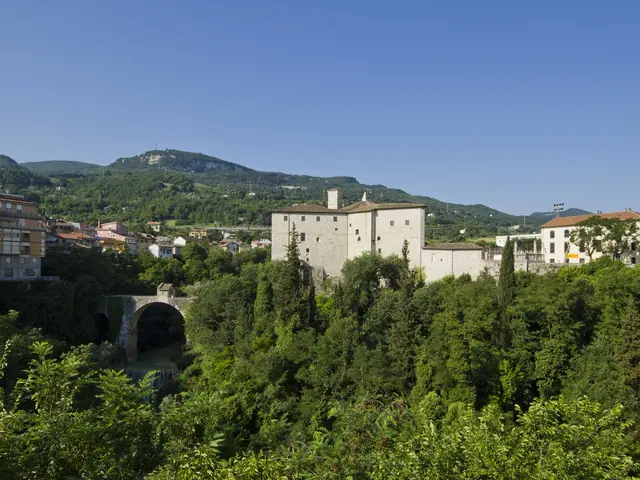
Visiting Ascoli Piceno in a day mainly means exploring on foot a compact historic center built almost entirely of travertine. The capital of the province of the same name in Le Marche stands at an elevation of 154 m, at the point where the Castellano stream flows into the Tronto river. It is enclosed by mountains on three sides: Montagna dell'Ascensione, Colle San Marco and Montagna dei Fiori. The Adriatic Sea is 28 km away. The Sibillini National Park in the Sibillini Mountains lies northwest of the city, and the Gran Sasso and Monti della Laga National Park to the south.
In the Middle Ages Ascoli had about two hundred towers belonging to noble families. Several examples still remain, which is why it is known as the City of a Hundred Towers. A tradition quoted by ancient authors says that its founders, a group of Sabines, were led by a woodpecker, the bird sacred to Mars. In Roman times the city became the main center of the Piceno area, thanks in part to its position on the Via Salaria. In 2026 the Ventidio Basso Theater became a UNESCO World Heritage Site together with nine other "condominium" theaters (theaters with boxes owned by private families) in central Italy.
On the map
Points from the site database. Map © OpenStreetMap contributors · Protomaps.
What to see in Ascoli Piceno
The center of Ascoli Piceno revolves around two neighboring squares, Piazza del Popolo and Piazza Arringo. The other points of interest are within easy walking distance.
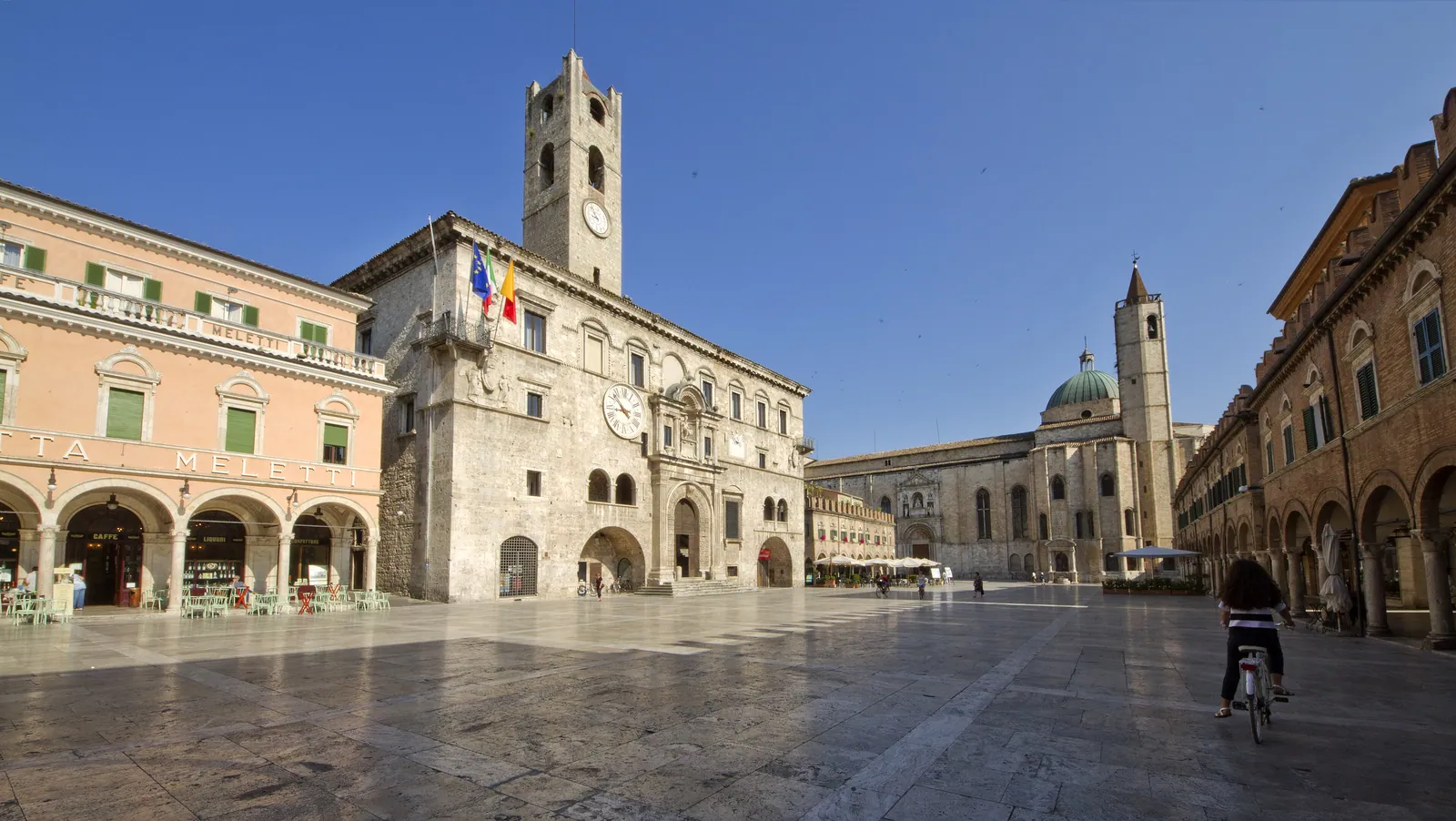
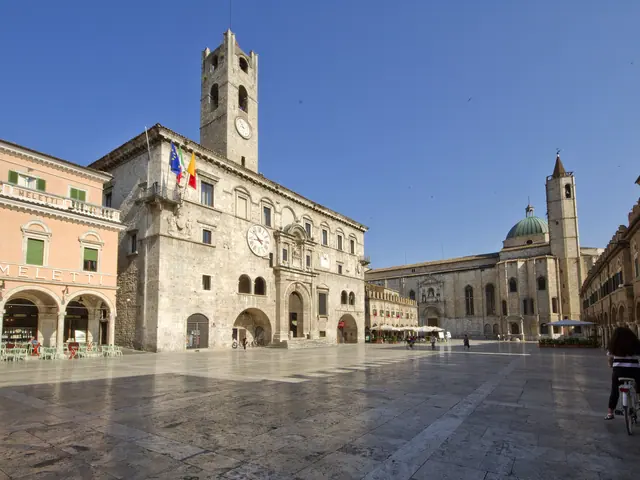
Piazza del Popolo, a Renaissance square, is the hub of the historic center. It took on its present form in the early 16th century. The paving and the buildings are in pale travertine, a local limestone that reflects sunlight and glows under the lights in the evening. Facing the square are the Palace of the Captains of the People in Ascoli Piceno, built between the 13th and 14th centuries, the church of San Francesco with the Loggia dei Mercanti, and a series of porticoes and loggias. These were built to hide the old medieval shops, which were not uniform. Above the Gothic portal of San Francesco is the monument to Pope Julius II, who freed Ascoli from the tyrants Astolfo and Gianfrancesco Guiderocchi. For the people of Ascoli it is the "city's living room": this is where they meet for coffee or an aperitif, and where Carnival and the Quintana take place.
Piazza Arringo is the oldest monumental square in the city and was the center of civil and religious power. Here you find:
- the Duomo di Sant'Emidio, the cathedral, which holds a polyptych by Carlo Crivelli and has a crypt with modern mosaics;
- the Baptistery of San Giovanni, a Romanesque baptistery;
- the Palazzo dell'Arengo, home of the Civic Art Gallery in Ascoli Piceno, the civic art gallery, with works by Titian and Guido Reni and a collection of local ceramics;
- the Palazzo Episcopale, which houses the Diocesan Museum, the diocesan museum.
Sant'Emidio is the city's patron saint and is venerated as a protector against earthquakes. His feast day is August 5.
The Teatro Ventidio Basso is a short walk from Piazza del Popolo, opposite the Great Cloister of San Francesco, the main cloister of San Francesco. It was built between 1839 and 1846 on the remains of the old church of San Francesco alle Grazie. It opened on March 27, 1846 with Giuseppe Verdi's "I Lombardi alla prima crociata". With 842 seats, it is the largest historic theater in the province. The theater closed for restoration in 1979 and reopened in 1994. On July 26, 2026 it was inscribed on the UNESCO World Heritage List. It is named after Publius Ventidius Bassus, a Roman general born in Ascoli. On the Tronto side, the Roman bridge of Porta Solestà is also worth a stop.
In summer the city hosts the Quintana, a reenactment of medieval origin with two jousts. The first is run on the second Saturday of July, at night, in honor of the Madonna della Pace. The second is run on the first Sunday of August, in honor of Sant'Emidio. Before each joust the historical parade winds through Piazza del Popolo, Piazza Arringo and Corso Mazzini. The parade can be followed freely through the streets of the center, while a ticket is needed to watch the joust from the stands of the Campo dei Giochi. The individual churches and museums are described on the page things to do in Ascoli Piceno.
Nature and trails near Ascoli Piceno
The mountains can be reached directly from the city. South of the center rise Colle San Marco (694 m) and Montagna dei Fiori (1,814 m). A paved road climbs the northern side of Montagna dei Fiori and in about 9 km leads to the Colle San Marco plateau, made up of meadows surrounded by woods.
The most complete route is the loop of the Eremi del San Marco (the San Marco hermitages), waymarked by the CAI (Italian Alpine Club):
- Start and finish: a parking lot in the city, at an elevation of 176 m.
- Length and time: 16.5 km, about 5 and a half hours.
- Elevation gain: 936 m up and the same down.
- Difficulty: E (hiking trail).
- Recommended period: all year round, when there is no snow.
The trail climbs through chestnut woods up to the rock called Dito del Diavolo (the Devil's Finger, 680 m). It then passes the ruins of the monastery of San Lorenzo, founded by the Benedictines in 750. Further on it reaches the cave of Beato Corrado, the Hermitage of San Marco, a hermitage built into the rock, and the Sentiero della Memoria. The latter climbs from Colle San Marco toward Colle Giammatura and Monte Vena Rossa and crosses the sites of the 1943-1944 clashes between local partisans and German troops. Trail 401 links Colle San Marco to the city, ending at Porta Cartara. The full loop is suitable only for fit hikers, and care is needed on the descent as well.
Before setting off, it is worth checking the weather and the condition of the trails. Other natural destinations are collected on the page near the Sibillini Mountains.
Where to stay in Ascoli Piceno
To extend the visit beyond a day, there are places to stay both in the city and in the surrounding area. The full list is on the page Ascoli Piceno hotels and where to stay. During the weeks of the Quintana, which draws visitors from all over Italy and abroad, it is best to book a few weeks or even a few months ahead.
Where to eat in Ascoli Piceno
At the table, the signature dish is olive all'ascolana: pitted green olives stuffed with meat, breaded and fried. They are the basis of the fritto misto all'ascolana (mixed fried platter) and are often served as an appetizer with a local white wine. In the historic cafés of Piazza del Popolo people drink anisetta, an anise liqueur, served with the "mosca" (fly), a coffee bean. Among the desserts is frustingo, an ancient sweet made with dried fruit and figs. Addresses and tips are on the page Ascoli Piceno restaurants.
Ascoli Piceno local products
The product most closely linked to the city is the Oliva Ascolana del Piceno DOP (Protected Designation of Origin). It is a green table olive of the Ascolana Tenera variety, grown in the area since Roman times. It comes in three types: in brine, in natural brine and stuffed. The production area includes 89 municipalities in the provinces of Ascoli Piceno and Fermo and in the province of Teramo, in Abruzzo. The olives are usually picked by hand, by "brucatura" (stripping the branches), between September 1 and October 20. They are then treated to remove their natural bitterness. Ascoli also has a long tradition of ceramics, documented by the collection of the Pinacoteca Civica. The shops are collected on the page on Ascoli Piceno local products and shops.
Weather and how to get to Ascoli Piceno
The climate of Ascoli Piceno is sub-Apennine, because the city lies close to large mountain ranges:
- Winter: damp and cool, with frequent night frosts. When Balkan air currents arrive it snows in the city too, sometimes heavily, as in February 2012 and January 2017.
- Summer: hot with little rain, mostly from afternoon thunderstorms that are sometimes violent. On the hottest days temperatures reach 37-38 °C, but in the evening breezes coming down from the Apennines cool the valley.
- Average temperatures: about 5-6 °C in January and 24-25 °C in July.
- Fog: very rare in the city.
By car, the Via Salaria (state road 4) links Ascoli to Rome. The Ascoli-Mare expressway leads toward the coast and Porto d'Ascoli. By train, Ascoli is the terminus of the line from San Benedetto del Tronto, the Adriatic station where long-distance trains stop. From the station the center can be reached on foot or by shuttle. There are no direct trains from Rome: at least one change is needed and the journey takes more than five hours. By bus from Rome it takes about three hours.
The historic center has limited traffic zones, and street parking in the central areas is paid (blue lines). There are two parking garages: Torricella, near Piazza Arringo, and Ex Gil, north of the center across the Tronto. From there you continue on foot.
In this section
4 results
 Things to Do in Ascoli Piceno86 places to stay
 Where to stay in Ascoli Piceno94 places to stay
 Where to eat in Ascoli Piceno66 places
 Ascoli Piceno local products and food shops23 places
No results with these filters.