


Palace of the Captains of the People
The Palace of the Captains of the People (Palazzo dei Capitani del Popolo) in Ascoli Piceno faces Piazza del Popolo, next to a historic café and beneath a crenellated medieval tower. It was built between the 13th and the 14th century and took on its present Renaissance appearance between 1518 and 1520. It was the seat of the Capitano del popolo (Captain of the People), then of the Podestà, the Papal Governors and finally the municipal offices. Its walls bear more than thirty inscriptions, which is why it has been called «a great book of stone».
In 2026 the palace is a building site. Seismic upgrading work is under way on the palace and on the archaeological area beneath it, both damaged by the 2016-2017 earthquake sequence. Before going, it is worth checking whether the interior can be visited (see below).
Palace of the Captains of the People
- Type
- Castle or fortress
- Address
- Piazza el PopoloAscoli Piceno (AP)
- Phone
- 0736298775
- turismo@comune.ascolipiceno.it
Source: site database, © OpenStreetMap contributors (ODbL).
On the map
Points from the site database. Map © OpenStreetMap contributors · Protomaps.
History of the Palace of the Captains of the People
At the end of the 13th century the palace housed the Capitano del popolo, the figure who led the militia and held legislative power. Later it also hosted the Podestà, with executive, judicial and police powers. It was built when Ascoli reached its greatest commercial expansion and the Palazzo del Comune was no longer enough for the new needs.
In 1482 the Consiglio degli Anziani (Council of Elders) left the Palazzo dell'Arengo and began work to renovate and enlarge the building. The work slowed for lack of funds between 1484 and 1514, while Ascoli was fighting Fermo. Between 1518 and 1520 the building took on its present form, with a papal contribution of 1100 ducats for the rear facade.
Christmas 1535 marked a dramatic turning point. Some rebels from the Guiderocchi, Malaspina and Parisani families barricaded themselves in the palace, and the papal commissioner Giovan Battista Quieti had it set on fire. The building burned for two days, and in 1536 a new renovation began.
From 1564 the palace was the seat of the Papal Governors, and the Legates of Rome remained there until 1860. In 1866 it became State property, in 1875 it passed to the Province and in 1902 to the Comune. During the Fascist period it was the party headquarters and was named the "Casa del Littorio". Consolidation work was carried out in 1968, and between 1980 and 1987 the recovery of the entire complex was completed.
What to see in the Palace of the Captains of the People
The main facade on Piazza del Popolo has at its center the portal by Ferrone (Lazzaro di Francesco), completed in 1546. Above it stands the monument to Pope Paul III, carved by the Florentine Simone Cioli, which the people of Ascoli erected in gratitude to the pontiff who had restored peace and returned 11 castles to the city. On either side of the portal are two small loggias with 15th-century mullioned windows. Higher up are seven 16th-century windows and two small corner balconies.
The rear facade, on Via del Trivio, was designed by Cola dell'Amatrice between 1518 and 1520, with travertine portals and projecting windows. To the left of the main front rises the 13th-century tower, adapted as a bell tower. It has a square plan, battlements and a spire, and holds two bells. The larger one is called Pacifica and was recast in 1547.
The more than thirty inscriptions, dating from the 14th to the 17th century, are carved on travertine blocks inside and outside the building. They commemorate popes, governors and artists, including Paul III, Pius V and Cola d'Amatrice.
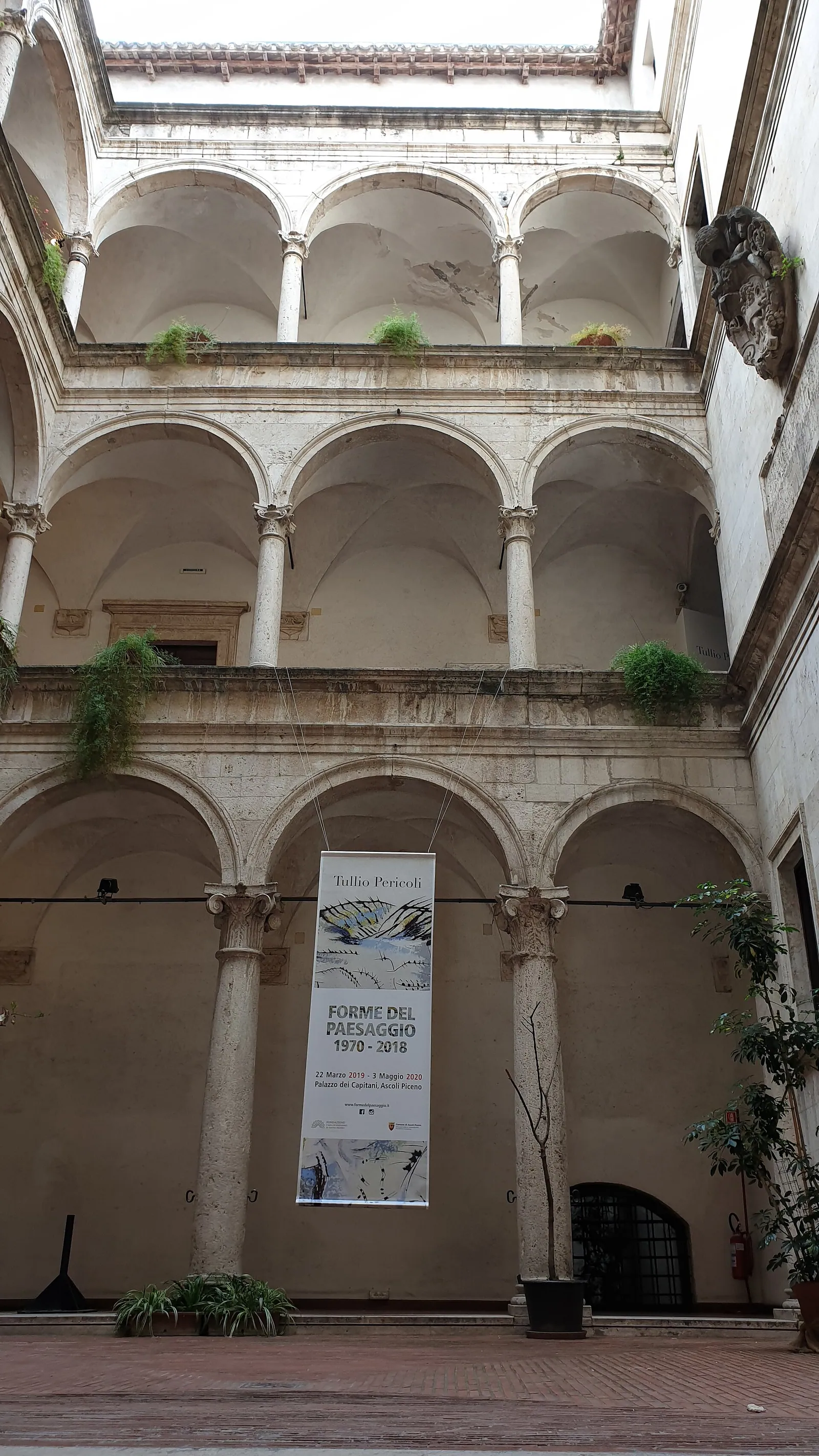
Inside, the Renaissance courtyard, by Camillo Merli (1549-1551), rises on three tiers of superimposed loggias with travertine columns. The rooms include the Sala della Ragione, the Sala dei Savi, the Sala degli Stemmi and the Sala Massy. The Sala della Ragione, former seat of the Consiglio dei Cento (Council of One Hundred), preserves a 15th-century fresco that some attribute to Pietro Alemanno. The false ceiling has twelve panels painted on wood in the 18th and 19th centuries. The Sala degli Stemmi (Hall of Coats of Arms), on the third floor, takes its name from the frescoed band along the walls.
On the ground floor there is an archaeological route starting from the Roman Republican period, made possible by excavations in the 1980s. A walkway runs along the perimeter of the excavations, showing superimposed structures from the Republican, Imperial and medieval periods.
How to visit the Palace of the Captains of the People
During the work the interior may not be open to visitors. When work began, the municipal offices, including the theater box office, were moved to Palazzo Arengo, in a temporary arrangement expected to last at least a year and a half. Cultural events inside the building have been suspended, and city council meetings are held at the Province.
By April 2026 scaffolding had been put up in the cloister and at the back, and work was moving on to the tower. The project also covers the roof, the Loggia dei Merli, the west facade and the archaeological area. The palace can still be admired from outside, from Piazza del Popolo. To find out whether it is possible to go in, it is best to ask the municipal tourist office beforehand.
Where the Palace of the Captains of the People is
The palace is in Ascoli Piceno, in the historic center, on the side of Piazza del Popolo where a historic Art Nouveau (liberty style) café also stands. The café is on the same side of the square. The square is a pedestrian area, so it is best to leave the car in a parking lot before arriving. The back of the building faces Via del Trivio.
Near the Palace of the Captains of the People
Piazza del Popolo, which the palace faces, is the city's "salotto buono" (elegant drawing room). To continue the visit, the page things to do in Ascoli Piceno gathers the main monuments. Dedicated pages include the Cathedral of Sant'Emidio in Ascoli Piceno, the Baptistery of San Giovanni and the Roman Amphitheater of Ascoli Piceno.
Frequently asked questions
Is the Palace of the Captains of the People open to the public?
When was the Palace of the Captains of the People built?
Why is there scaffolding on the palace?
What is on the ground floor of the Palazzo dei Capitani?
Nearby
What to see nearby
- Lazzaro Morelli AediculeWayside shrineunder 100 m
- under 100 m
- under 100 m
Where to stay
- L'Attichetto in Ascoli PicenoTourist accommodationunder 100 m
- Re house in Ascoli PicenoB&B or guesthouseunder 100 m
- under 100 m
Where to eat
- Il Vinattiere, Ascoli PicenoRestaurantunder 100 m
- 180 in Ascoli PicenoFast food and street foodunder 100 m
- Bottega Panichi 1943 in Ascoli PicenoFast food and street foodunder 100 m
Straight-line distances.