


Quintana di Ascoli, Ascoli Piceno
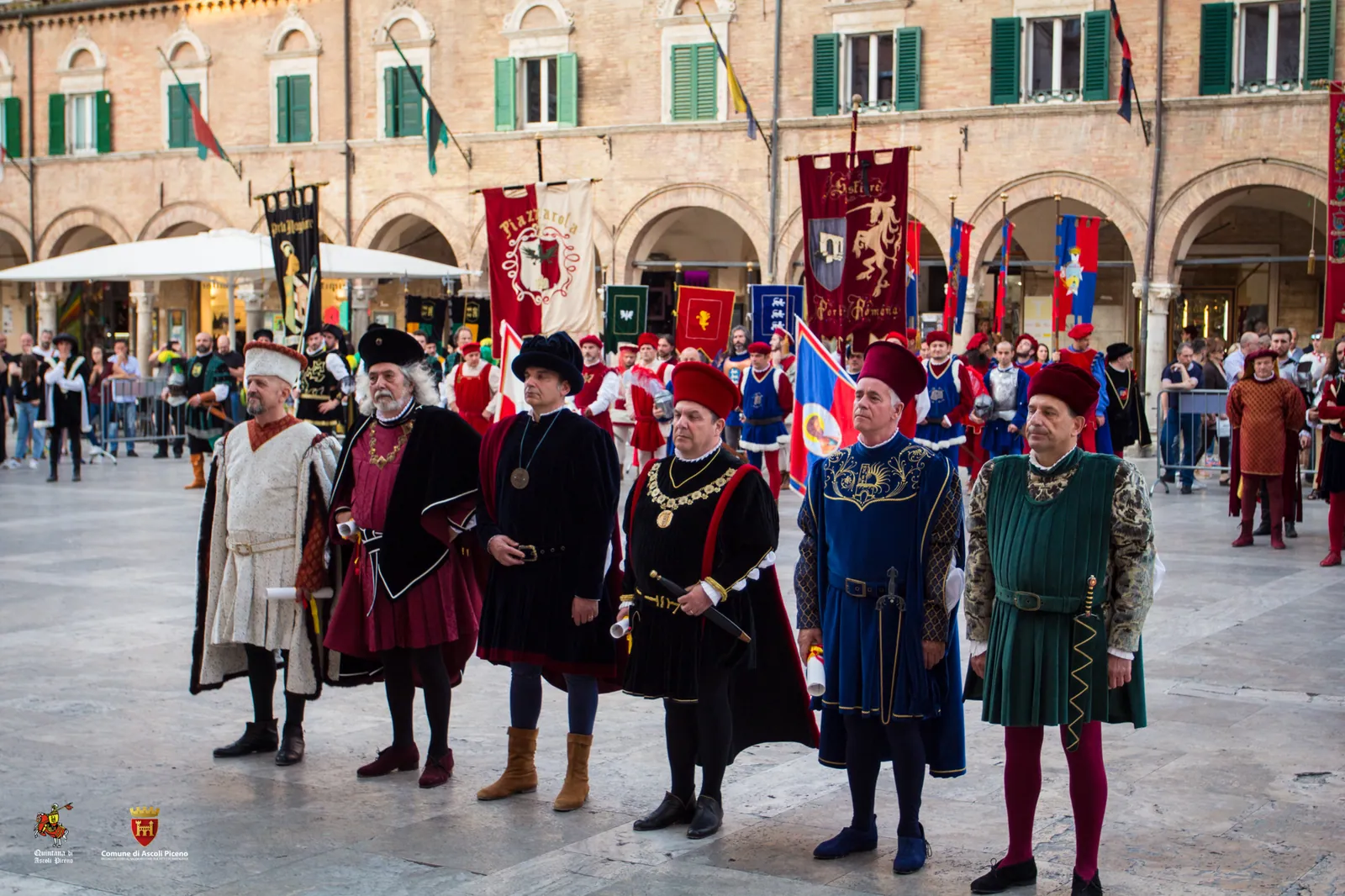
The Quintana di Ascoli is the medieval-origin jousting tournament of Ascoli Piceno. Knights from the city's six sestieri (districts) gallop against the "moro", a dummy of a Saracen, to strike the shield it holds with their lance and win the Palio. The joust is run twice a year: the July edition is dedicated to the Madonna della Pace and takes place on the evening of the second Saturday. The one "della tradizione" (of tradition) is held on the afternoon of the first Sunday of August, for the feast of Sant'Emidio, the city's patron saint.
The stage is the Campo dei Giochi. It is a sports ground in the historic center, between Malatesta Fort in Ascoli Piceno and the Church of San Vittore. Before each joust the historic parade crosses the city with about 1,500 participants in 15th-century costume. The Middle Ages are not just a backdrop: the Statuti Ascolani (Ascoli Statutes) drawn up in 1377 show that even then the tournament closed the celebrations of Sant'Emidio on 5 August.
On the map
Points from the site database. Map © OpenStreetMap contributors · Protomaps.
History of the Quintana di Ascoli
The name comes from the Roman military camp. The via quintana separated the fifth and sixth maniples and was used for training: a «palus» 6 feet high was planted there, against which legionaries practiced with sword and javelin. In the Middle Ages the exercise became a test of skill on horseback: riders galloped with the lance against a post covered first by a barrel, then by the figure of an enemy with a shield, at first fixed and later revolving, called the «saracino» or «moro». The barrel appears in a fresco in the Sibillini, at Santa Maria di Mevale near Visso, dated 1492. According to another tradition the roots are even older: some trace them to the 9th century, when the Saracens invaded the territory of the Picenes, which would explain the bust of the moro, the enemy of the faith.
In the Middle Ages the Quintana closed the patron saint's festivities and was run in Piazza Arringo. Taking part were knights from the city's magnate oligarchy and others who came from various places at the invitation of the people of Ascoli. The contests opened with the giostra dell'anello (ring joust): the lance had to be threaded through a ring hanging from a post in the center of the square. The ring was silver, weighed four ounces, had a diameter of about 10 cm and was also the winner's prize. This joust was held at least until 1541.
The revival came after World War II. The modern edition has been run since 1955. Among those who helped revive it were the historians Don Carlo Cardarelli, Carlo Baiocchi and Don Giuseppe Fabiani, the industrialist Nazzareno Peci and the lawyer Giulio Franchi. To divide the city into sestieri, the division of the 1381 urban land register was revived: the four gates (Porta Maggiore, Porta Romana, Porta Solestà, Porta Tufilla), the central sestiere dedicated to the patron saint (Sant'Emidio) and that of the upper part (Piazzarola). The July joust has been a permanent part of the calendar since 1997.
What to see at the Quintana di Ascoli
At the center of everything is the joust. The course is a figure-eight track bordered by hedges: the horse's hooves must not touch or cross them, or points are lost. The contest is divided into three rounds of three charges each, for a total of nine attacks per knight. The target has five concentric bands: the center is worth 100 points, then 80, 60, 40 and 20. Speed also counts. The base is 300 points for 55 net seconds: two points are gained for every tenth of a second saved and two are lost for every tenth over. Beyond 60 seconds no score is awarded. In the first modern editions the Saracen rotated under the blow of the lance and, if the knight was too slow, struck him from behind with its flail.
Before the contest there is a good-luck ritual. The six jousters pay homage to their ladies, who tie a handkerchief in the sestiere's colors to the lance. The knight then wears it tied to his arm throughout the joust. Each sestiere has its colors: Sant'Emidio red and green, Piazzarola white and red, Porta Romana red and blue, Porta Solestà yellow and blue, Porta Tufilla in Ascoli Piceno red and black, Porta Maggiore black and green.
The historic parade alone is worth the day. At the head marches the serving mayor as the Magnifico Messere, followed by the Magistrature, that is, the city councilors and other dignitaries. Then come the delegations of the castles and lands once subject to Ascoli, including Arquata del Tronto, Montemonaco, Acquasanta Terme and Roccafluvione. The sestieri close the parade, in the order of the previous year's joust ranking. In the July 2026 parade there were seventeen castellane (castle delegations), with the debut of the new castle of Palmiano. The costumes are inspired by the paintings of Crivelli and the artists active in Ascoli in the 15th century.
The Palio, the banner awarded to the winning sestiere, is also a work of art. Each year a different artist makes it. In 2026 the July banner was by the Ascoli artist Ado Brandimarte, and the August one by the fashion designer Antonio Marras, with antique fabrics, gold and silver thread embroidery and recycled materials.
How to watch the Quintana di Ascoli
The Quintana is not a place to visit on any day: it is a cycle of events that fills the summer. The program runs from early July to early August, and the high points are the two jousts at the Campo dei Giochi. In 2026 the season began as early as June with the Palio degli Arcieri (archers' contest). The calendar also includes the Giuramento dei Consoli (Oath of the Consuls), the Lettura del Bando (Reading of the Proclamation), the Palio degli Sbandieratori e Musici (flag-wavers and musicians), the Saluto alla Madonna della Pace and the Offerta dei Ceri (Offering of the Candles). The Saluto alla Madonna della Pace and the Offerta dei Ceri are also the occasions when the knights' starting order is drawn.
Many events need no ticket. The presentation of the Palio, the reading of the challenge proclamation, the Offerta dei Ceri and the historic parade can be followed freely in the squares and along the streets of the center. To watch the joust from the stands of the Campo dei Giochi, however, a ticket is required, available at the ticket office in the center or online. Seats are divided into central stands, side stands and curves.
The city is very crowded, so it pays to move early. For the parade it is best to arrive early and choose a spot calmly among Piazza Ventidio Basso, Via del Trivio, Piazza Roma and Piazza del Popolo in Ascoli Piceno. Those who want to attend the main days would do well to book both tickets and accommodation in good time. On joust days public transportation may change: for the August 2026 joust, for example, urban and suburban lines followed modified routes.
The July and August editions have a different atmosphere. The first is run in the evening, with the parade at sunset. The second is run in the afternoon and is linked to the patron saint's feast. Out of season the Campo dei Giochi hosts other events: in September the "Città di Ascoli" show jumping competition is held.
Where the Quintana di Ascoli is held
The jousts of the Quintana di Ascoli are run at the Ferruccio Corradino Squarcia stadium, known as the Campo dei Giochi or Campo dei Giochi di Ponte Majore, in the historic center of Ascoli Piceno. The stadium was built in 1925 in front of Forte Malatesta for Ascoli's soccer matches. It remained the team's stadium until 1962 and has hosted the Quintana since 1955. From the main squares, Piazza del Popolo and Piazza Arringo, the ground is easy to reach on foot.
The parade has a set route: it starts from Piazza Ventidio Basso, crosses the streets of the center, always passes through Piazza del Popolo and arrives at the "Campo de li Giochi".
Ascoli Piceno is well connected. The train links it to the Adriatic coast and San Benedetto del Tronto, an expressway leads to Porto d'Ascoli and the Salaria runs all the way to Rome. The city is also a gateway to the mountains: it borders two national parks, that of the Sibillini Mountains to the northwest and that of the Monti della Laga to the south.
Near the Quintana di Ascoli
The spaces of the Quintana coincide with the main places of Ascoli. Piazza Arringo, where the medieval joust was run, was the administrative and religious center of the city. Facing it are the Cathedral, the baptistery, the bishop's palace and the Palazzo dell'Arengo. The Battistero di San Giovanni is on the east side of the square, next to the Cathedral of Sant'Emidio in Ascoli Piceno. It is an example of Ascoli Romanesque and has been a national monument since 1890.
A few steps away is Piazza del Popolo, the city's Renaissance square, through which the parade always passes. Next to the Campo dei Giochi are Forte Malatesta and the church of San Vittore. Walking between one event and the next, the travertine stands out: many buildings in the historic center are built of this local stone. The towers can be seen too: according to tradition there were about two hundred in the Middle Ages, and today about fifty remain. The full list of monuments is on the page things to do in Ascoli Piceno.
Frequently asked questions
When is the Quintana di Ascoli held?
Do you need a ticket to see the Quintana di Ascoli?
How does the joust scoring work?
Who won the Quintana di Ascoli in 2026?
Nearby
What to see nearby
- under 100 m
- Palace of the Captains of the PeopleCastle or fortressunder 100 m
- Civic Art GalleryMuseum or art gallery100 m
Where to stay
- under 100 m
- L'Attichetto in Ascoli PicenoTourist accommodationunder 100 m
- under 100 m
Where to eat
- Osti.Nati fish & wine, Ascoli PicenoRestaurantunder 100 m
- Pizzeria Ascolana, Ascoli PicenoFast food and street foodunder 100 m
- 180 in Ascoli PicenoFast food and street foodunder 100 m
Straight-line distances.