


Civic Art Gallery
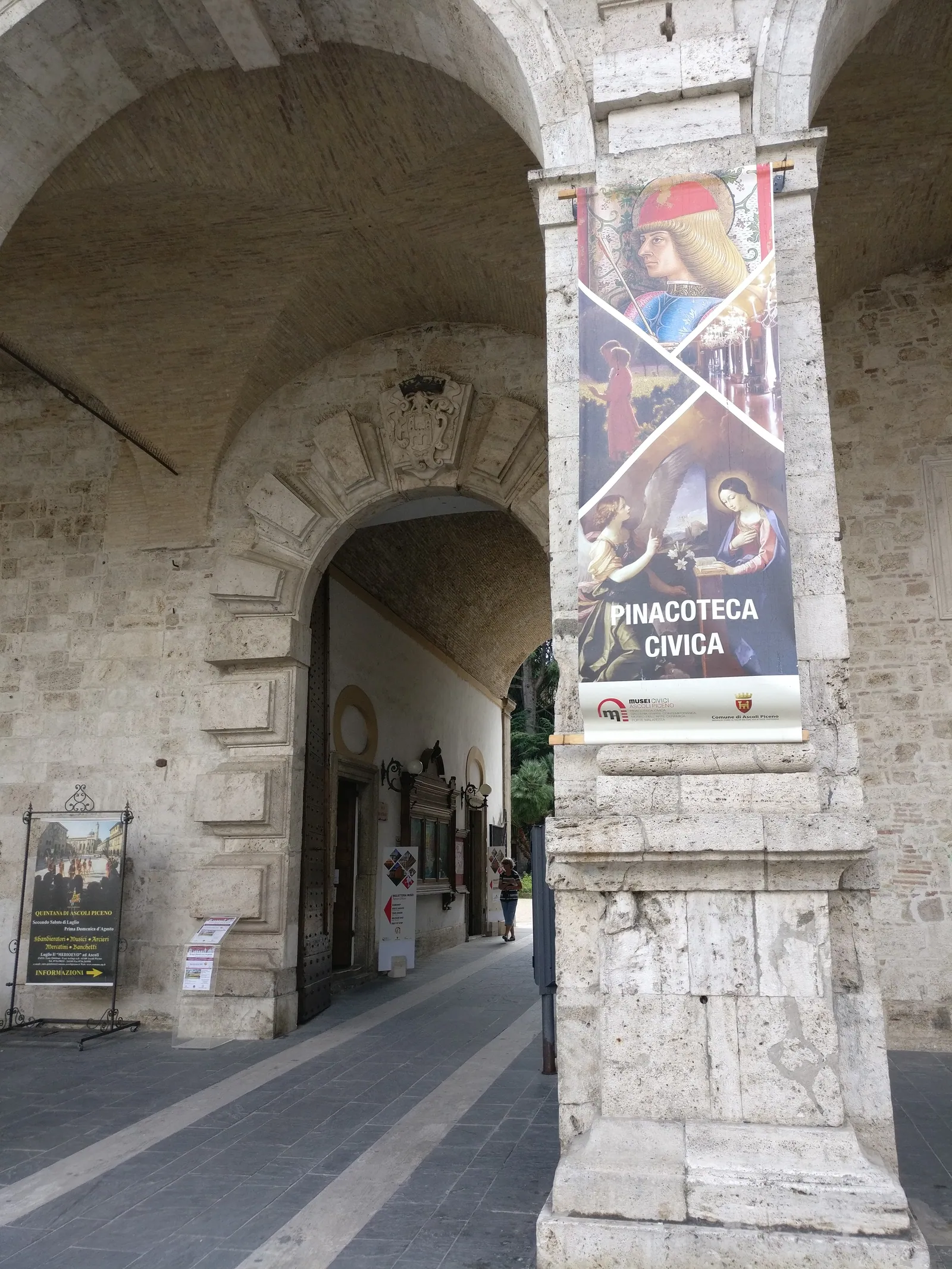
The Civic Art Gallery (Pinacoteca Civica) of Ascoli Piceno occupies part of the Palazzo dell'Arengo, in Piazza Arringo, and is considered one of the most important in the Marche region. The museum opened on August 4, 1861. Its 15 rooms hold more than 800 works from the 13th to the 20th century: paintings, sculptures, detached frescoes, coins, ceramics, musical instruments and miniatures. Among the best-known pieces are two triptychs by Carlo Crivelli, Titian's Stigmata of Saint Francis and the cope of Pope Nicholas IV, a 13th-century English embroidery.
Civic Art Gallery
- Type
- Museum or art gallery
- Address
- Piazza Arringo 7, 63100 Ascoli PicenoAscoli Piceno (AP)
- Hours
Jul–Aug · Mon–Sun, holidays 10:00–19:00 Apr–Jun · Tue–Sun, holidays 10:00–19:00 Sep–Mar · Tue–Fri 10:00–13:00, 15:00–18:00 Sep–Mar · Sat, Sun, holidays 11:00–18:00 - Phone
- 0736 298213
- info@ascolimusei.it
Source: site database, © OpenStreetMap contributors (ODbL).
On the map
Points from the site database. Map © OpenStreetMap contributors · Protomaps.
History of the Civic Art Gallery in Ascoli Piceno
The museum was founded in 1861 on the initiative of the Ascoli artists Giorgio Paci and Giulio Gabrielli. They started from an older civic collection, gathered from the last quarter of the 18th century by the prelate Alessandro Maria Odoardi along the lines of a Wunderkammer (cabinet of curiosities), with paintings, late Gothic goldsmith's work and even Egyptian papyri. Paci and Gabrielli added many religious works from suppressed churches and convents, whose property had passed to the State after the Valerio decree.
Over time the layout was revised several times. The furniture of the family of the Counts Sgariglia arrived, then the Antonio Ceci collection, acquired in 1924, and that of Ernesto Verrucci.
The cope of Nicholas IV has a story of its own. The pope, a native of Ascoli, gave it to the Cathedral on July 28, 1288. It was stolen on August 6, 1902 and reappeared in 1904 at the South Kensington Museum in London, where it was on display as the property of the banker John Pierpont Morgan, who had bought it without knowing where it came from. On learning its history, Morgan returned it free of charge to the Italian State on July 28, 1907. Since then it has been in the custody of the Comune di Ascoli.
What to see in the Civic Art Gallery in Ascoli Piceno
The route spreads over two floors and opens with the Sala Ventidio Basso, with canvases from different periods and 19th-century sculptures. The rooms keep period furnishings, Venetian mirrors and Murano glass chandeliers.
In the Sala della Vittoria, which in the Middle Ages housed the General Council and later the first municipal theater, the works of Cola dell'Amatrice dominate, including the Institution of the Eucharist and the Polittico di San Bartolomeo delle Piagge of 1509, together with the Equestrian Monument of Vittorio Emanuele II by Nicola Cantalamessa Papotti, donated by the artist in 1885.
The Sala del Piviale holds the cope of Nicholas IV, measuring 159 by 340 cm, a rare example of opus anglicanum with figures embroidered in silk. Next to it are the two triptychs by Carlo Crivelli from San Vito di Valle Castellana, in the province of Teramo, and some polyptychs by Pietro Alemanno.
The Sala di Tiziano brings together the Annunciation by Pietro Alemanno, commissioned in 1484, with the 15th-century plan of Ascoli, Titian's Stigmata of Saint Francis, from around 1570, and the Madonna del Rosario by Simone De Magistris, from 1592. The Galleria holds the Annunciation by Guido Reni (1629) and the Death of Saint Joseph by Luca Giordano (1677). Then come the Sala Ceci, with the ceiling painted by Domenico Ferri in 1895, the Sala di Cecco, the Sala del Pastorello and the Sala Fior di Vita, with the Passeggiata amorosa (Lovers' Stroll) by Giuseppe Pellizza da Volpedo (1901).
On the third floor are 19th-century portraits of women, the triptych I cavalli del Sole (The Horses of the Sun) by Adolfo De Carolis, the sketches by Lazzaro and Giuseppe Giosafatti and, in the Sala Pasqualini, a collection of stringed instruments from the 18th to the 20th century. The museum also holds ceramics from Castelli, Doccia and Meissen and drawings by Guercino, Pietro da Cortona and Pier Leone Ghezzi; since 2007 the Ascoli majolica has been in the Museum of Ceramic Art in Ascoli Piceno.
How to visit the Civic Art Gallery in Ascoli Piceno
The visit follows 15 rooms across the second and third floors; access is up the grand staircase of the Palazzo dell'Arengo. For the main attractions, such as the Crivelli triptychs, the cope and the canvases by Titian, Reni and Cola dell'Amatrice, the second floor is enough; the third floor is of interest to those who love the 19th century, sculpture and musical instruments. The museum offers audio guides, tactile routes, Braille panels and spaces designed for people with motor and sensory disabilities. Opening days and hours and contacts are in the information box on the page.
Where the Civic Art Gallery in Ascoli Piceno is
The Civic Art Gallery is in the historic center of Ascoli Piceno, in the Palazzo dell'Arengo, the town hall, facing Piazza Arringo. The museum occupies the entire north wing and part of the west wing of the palace, on the second and third floors.
Near the Civic Art Gallery in Ascoli Piceno
The same square is overlooked by the Cathedral of Sant'Emidio in Ascoli Piceno and the Baptistery of San Giovanni. To build an itinerary in the city, the page things to do in Ascoli Piceno gathers the other stops.
Frequently asked questions
How many rooms does the Civic Art Gallery of Ascoli Piceno have?
What are the most important works in the Pinacoteca?
What is the story of the cope of Nicholas IV?
Is the Pinacoteca accessible to people with disabilities?
Nearby
What to see nearby
- National Archaeological Museum of Ascoli PicenoMuseum or art galleryunder 100 m
- 100 m
- 100 m
Where to stay
- Beds Migliori, Ascoli PicenoB&B or guesthouseunder 100 m
- Il Duomo B&B in Ascoli PicenoB&B or guesthouseunder 100 m
- under 100 m
Where to eat
- Maclé Salsamenteria, Ascoli PicenoRestaurantunder 100 m
- under 100 m
- Qui Si Gode, Ascoli PicenoIce cream shop100 m
Straight-line distances.