


Piazza del Popolo in Ascoli Piceno: history and visiting tips
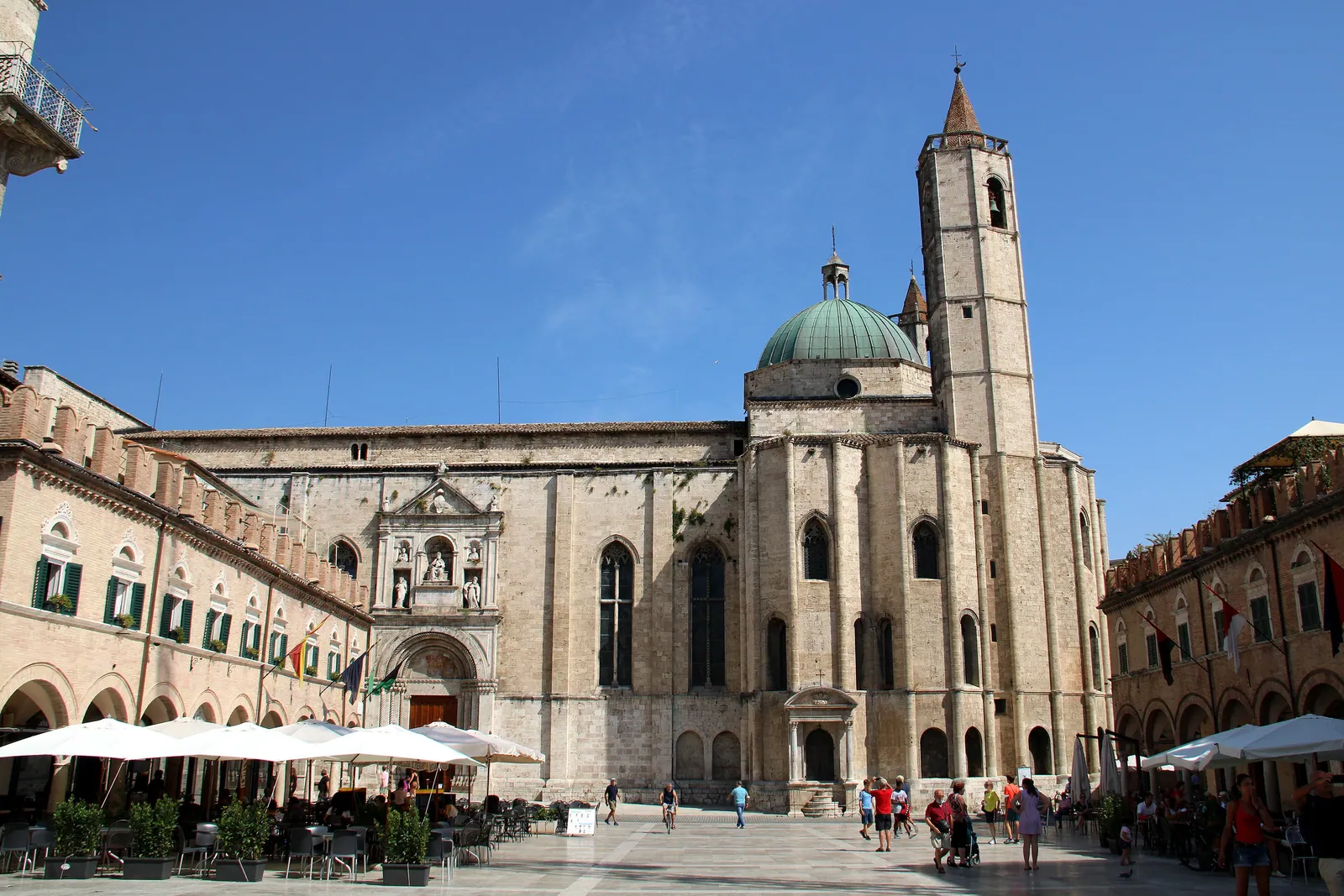
Piazza del Popolo in Ascoli Piceno is a pedestrian Renaissance square, considered the heart of the historic center and the city's "salotto" (drawing room). It is rectangular, measures about 29 × 87 meters (about 2,500 m²) and is paved entirely with travertine slabs. The name comes from the Palace of the Captains of the People in Ascoli Piceno, which with its crenellated medieval tower occupies the central part of the west side. The north side adjoins the Gothic flank of the church of San Francesco.
It is where the people of Ascoli meet and stroll. It is also home to some historic shops and serves as the setting for the Carnival, the Quintana and the city's main music and theater performances.
On the map
Points from the site database. Map © OpenStreetMap contributors · Protomaps.
History of Piazza del Popolo in Ascoli Piceno
Over the centuries the square has also been called platea superior, platea magna and "delle scaje". The last name recalls the travertine chips produced by stonemasons during the construction of the church of San Francesco, which covered the area.
Its origins are uncertain. According to some, the Roman Forum stood here, because the area is close to the intersection of the two main axes of the ancient city. The large opus spicatum (herringbone) paving visible in the archaeological area of the Palazzo dei Capitani suggests a market area instead. In the Middle Ages the space was smaller and surrounded by tower houses with shops on the ground floor.
From the middle of the 14th century the square expanded northward, with the gradual demolition of the houses on the side of the church of San Francesco, then under construction. From square it became rectangular. In the second half of the 15th century, by then free of medieval houses, it was paved with regular travertine slabs.
Its present appearance dates from the early 16th century. In 1509 the governor Raniero de' Ranieri, on the orders of Julius II, had porticoes built on three sides at public expense. They have reddish brick vaults and travertine columns. Private owners were then allowed to build above the colonnade, but with precise rules: a single floor, the same height, the same materials and a single type of window, framed with rounded pediments and palmettes. The design was long attributed to Bernardino di Pietro da Carona. Today the more likely author is thought to be Alberto da Piacenza, a pupil of Bramante. The Ghibelline (swallowtail) battlements were added later.
What to see in Piazza del Popolo in Ascoli Piceno
The Palazzo dei Capitani del Popolo was built between the 13th and 14th centuries by joining older buildings. The portal of the main facade is topped by a monument to Pope Paul III, while the rear front on Via del Trivio was redesigned by Cola dell'Amatrice. Inside are a Renaissance courtyard and, on the ground floor, an archaeological area. In 2026 the palazzo and the archaeological area are undergoing seismic upgrading work.
The church of San Francesco, Gothic in layout, was begun in 1258 and consecrated in 1371. On its right flank, toward the square, is the aedicule attributed to Lazzaro Morelli but made by Silvio Giosafatti. Built against the church is the Loggia dei Mercanti, with five arches, built at the expense of the powerful wool guild. On the church wall inside the loggia is a plaque with the measurements of the bricks to be used in the city.
Other details to look for:
- The south side, taller than the others, had a loggia that was closed in the first half of the 19th century. In 1904 Pio Nardini decorated it in monochrome with grotesques and medallions, one of which bears the city's coat of arms.
- On the railing around the bell tower of San Francesco there is a marble sculpture, probably medieval, considered a symbol of good luck.
- In the rain the polished travertine creates a mirror effect.
How to visit Piazza del Popolo in Ascoli Piceno
The square is always freely accessible on foot, in any season. A 2023 municipal ordinance bans vehicle traffic in Piazza del Popolo every day, around the clock (24 hours). The only exception is authorized residents of the pedestrian area, for brief loading and unloading. It is therefore best to leave the car outside the pedestrian area and arrive on foot.
The archaeological area of the Palazzo dei Capitani is not freely accessible. It is affected by the seismic upgrading work on the palazzo: before going, it is best to check with the Comune whether it can be visited. A suspended walkway runs along the perimeter of the excavations, which lie about 1.80 m below street level. 12 building phases can be identified, from the Roman Republican period to the Middle Ages.
The Carnival and the Quintana are the two most important events linked to the square. For concerts and shows it is worth checking the events calendar before setting out.
Where Piazza del Popolo in Ascoli Piceno is
The square is in the historic center of Ascoli Piceno, between Corso Giuseppe Mazzini and Via del Trivio. It is a short distance from the intersection of the cardo and decumanus of the Roman city. Along the west side stands the Palazzo dei Capitani del Popolo, while the church of San Francesco faces it from the north. The other sides are closed by small Renaissance palaces with porticoes and loggias.
Near Piazza del Popolo in Ascoli Piceno
A short distance away opens Piazza Arringo, the city's oldest administrative and religious center. Facing it are the cathedral, the baptistery, the Palazzo dell'Arengo and the bishop's palace. Since the Middle Ages the two squares have stood almost in opposition, one religious and institutional, the other civic and commercial. More places to pair with a visit to the square are on the page things to do in Ascoli Piceno.
Frequently asked questions
Can you drive into Piazza del Popolo?
Why is the square called "del Popolo"?
Which films were shot in Piazza del Popolo?
Can you visit the archaeological area under the Palazzo dei Capitani?
Nearby
What to see nearby
- under 100 m
- Palace of the Captains of the PeopleCastle or fortressunder 100 m
- Civic Art GalleryMuseum or art gallery100 m
Where to stay
- under 100 m
- L'Attichetto in Ascoli PicenoTourist accommodationunder 100 m
- under 100 m
Where to eat
- Osti.Nati fish & wine, Ascoli PicenoRestaurantunder 100 m
- Pizzeria Ascolana, Ascoli PicenoFast food and street foodunder 100 m
- 180 in Ascoli PicenoFast food and street foodunder 100 m
Straight-line distances.