


Porta Tufilla, Ascoli Piceno
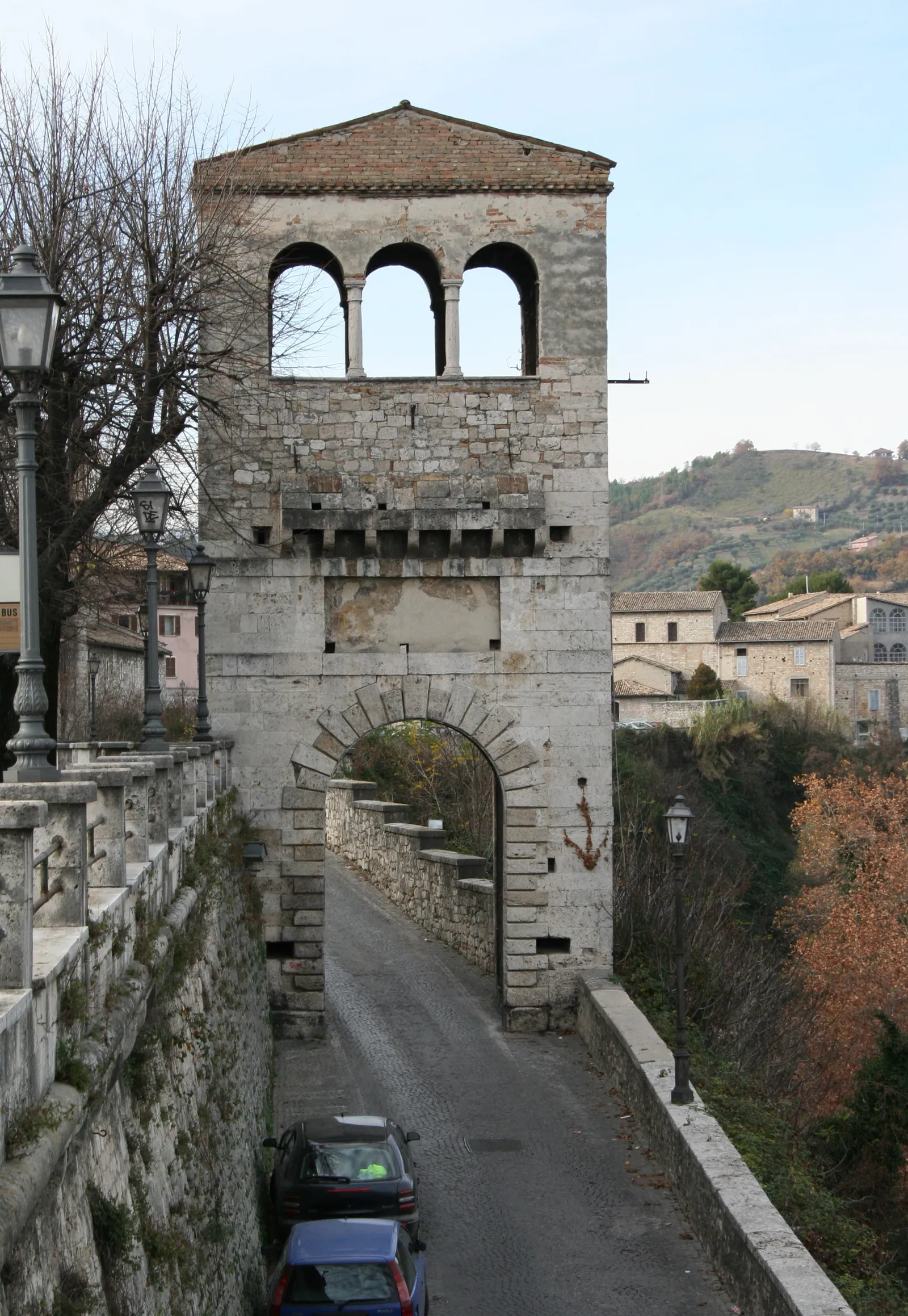
Porta Tufilla is one of the gates of Ascoli Piceno. It opens onto the Lungotronto, with one side running along the Tronto river. It is a 16th-century travertine tower, with a round arch and a three-arched guard loggia. It was designed by the Ascoli architect Camillo Merli, who rebuilt an older medieval gate. It gives its name to one of the six sestieri (districts) of the Quintana di Ascoli.
Porta Tufilla, Ascoli Piceno
- Type
- City walls and gates
- Municipality
- Ascoli Piceno (AP)
Source: site database, © OpenStreetMap contributors (ODbL).
On the map
Points from the site database. Map © OpenStreetMap contributors · Protomaps.
History of Porta Tufilla in Ascoli Piceno
The medieval gate stood in a commanding position on the access road from the north, protecting that side of the city. In the past it was damaged in the assault by the Guelph faction of the "macchinanti", later defeated by the Ghibellines. Later, after its destruction, it was decided to rebuild it. The project was entrusted to Camillo Merli. The work took place between 1552 and 1555, and an inscription on the stringcourse bears the date 1555.
The name comes from a rock bank at the base of the opening, on the right bank of the Tronto. The people of Ascoli called it tufo (tuff), even though it is sandstone.
What to see at Porta Tufilla in Ascoli Piceno
The building is simple: a single round arch, topped by the guard loggia with bases and capitals. Between the top of the arch and the machicolations, in a framed rectangular space, are traces of a votive fresco, recently restored. On the east side are the stone machicolations, defensive structures already outdated when the gate was built. On the street side, high up, a small door gives access to the interior rooms and the loggia. A second entrance, on the inner facade, is now walled up.
How to visit Porta Tufilla in Ascoli Piceno
The gate is admired from outside, walking along the Lungotronto. It is of interest all year round. During the two summer dates of the Giostra cavalleresca (jousting tournament), in July and August, the sestiere displays its colors, red and black. Before counting on a visit to the interior rooms, it is best to ask locally.
Where Porta Tufilla in Ascoli Piceno is
The gate is in Ascoli Piceno, on the Lungotronto, in the northeastern part of the city. Its side runs along the Tronto river, which here is crossed by the Ponte Nuovo and the Ponte Tufillo. From the gate a gentle slope leads up toward Rua delle Stelle, a route that follows the right bank of the river.
Near Porta Tufilla in Ascoli Piceno
A short distance away stands the Church of Santa Maria Intervineas in Ascoli Piceno, which keeps a miraculous image of the Virgin. The Ponte Tufillo, also called Ponte Vecchio and today Ponte di Sant'Antonio, crosses the Tronto and links Porta Maggiore to Campo Parignano. It was first built in 1097. Outside the gate, on the Campo Parignano plateau, are Sant'Antonio Abate, formerly Santa Maria in Sistella, and the Roman bridge of Sant'Antonio. More places in the city are on the page things to do in Ascoli Piceno.
Frequently asked questions
Who built Porta Tufilla, and when?
Why is it called Porta Tufilla?
What is the Sestiere Porta Tufilla?
Can you go inside Porta Tufilla?
Nearby
What to see nearby
- 200 m
- 200 m
- Bust of the Venerable Francesco Antonio MarcucciMonument or memorial200 m
Where to stay
- under 100 m
- 100 m
- Rifugio Collina del Sacro Cuore in Ascoli PicenoMountain hut100 m
Where to eat
- under 100 m
- Io e Alessia, Ascoli PicenoRestaurant100 m
- 200 m
Straight-line distances.