


Great Cloister of San Francesco (Ascoli Piceno)
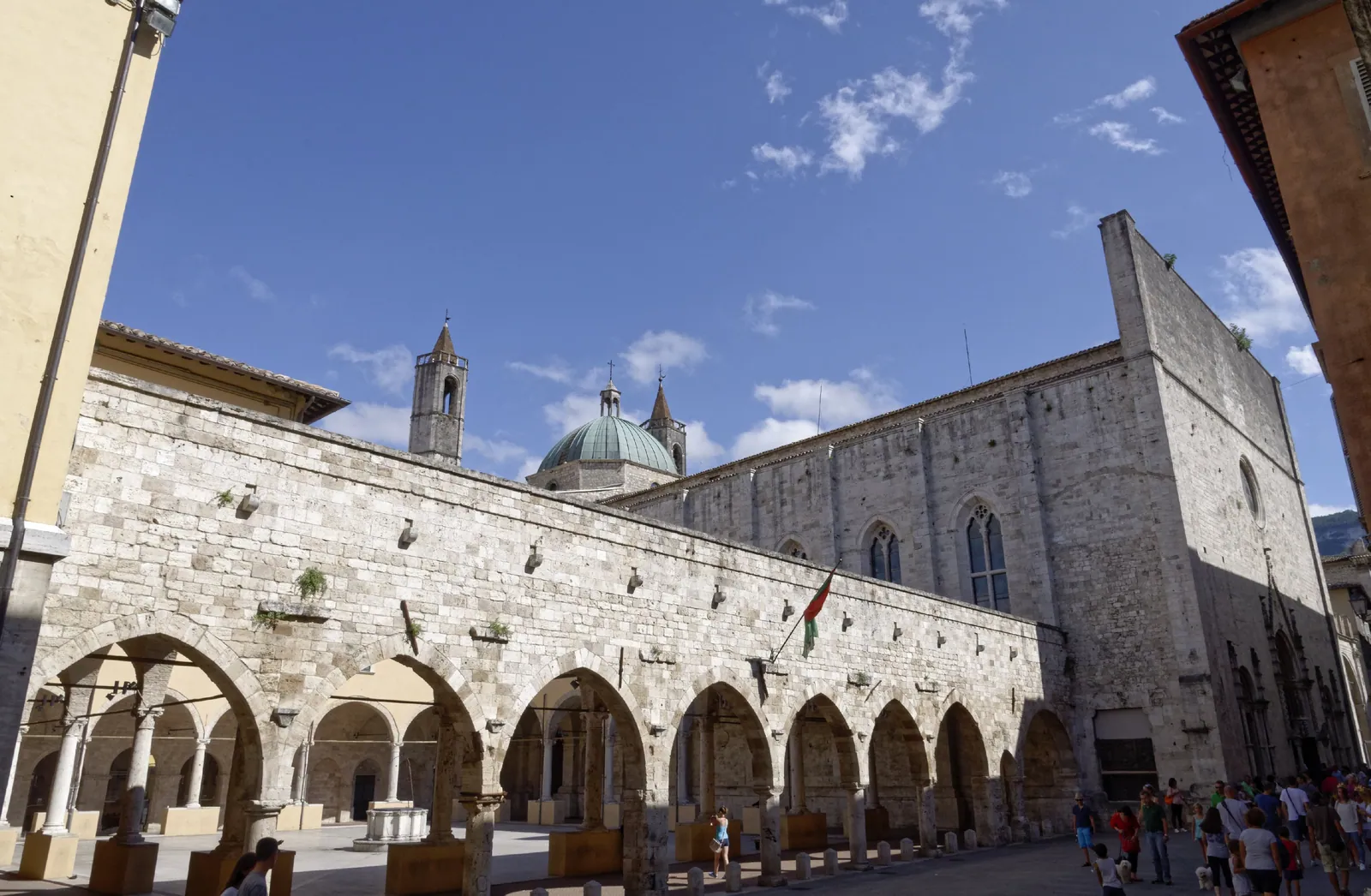
Great Cloister of San Francesco (Ascoli Piceno)
- Type
- Monastery or abbey
- Address
- Via del TrivioAscoli Piceno (AP)
Source: site database.
The Great Cloister of San Francesco (Chiostro Maggiore di San Francesco) in Ascoli Piceno is a square cloister with porticoes on four sides, next to the church of San Francesco and a short distance from Piazza del Popolo in Ascoli Piceno. It is built of travertine and masonry. Work began in 1565 and ended in the 1620s. It has 20 round arches, five on each side, resting on Corinthian columns. In the middle is a 14th-century well.
Locals mostly call it Piazza della Verdura or Piazza delle Erbe (vegetable or herb square). For many decades it has hosted the produce market. On the east side is the Sala Cola dell'Amatrice, with frescoes painted around 1520.
On the map
Points from the site database. Map © OpenStreetMap contributors · Protomaps.
History of the Great Cloister of San Francesco
The cloister is part of the Franciscan convent, which together with the church and the Chiostro Minore forms a single complex. For centuries, until 1800, the convent housed a Studio Generale, a center of learning in theology, philosophy, letters, sciences and arts. An oval plaque on the portico records that Nicholas IV, the first Franciscan pope and a native of Ascoli, and Sixtus V came from this convent, where they began their studies.
Construction began in 1565 thanks to a bequest from the Ascoli nobleman Giulio Antonio Santucci. The north side was completed thanks to the generosity of Giovan Vincenzo Cataldi, another member of the city's aristocracy. The work was carried out by the Lombard masters Giacomo di Giovanni and Giovanni Angelo di Marco da Bonera and was completed in the 1620s.
The 14th-century portico on the via del Trivio side was originally closed. In the 1930s it was opened to connect the cloister directly to the street. The loggias were rearranged from 1937 onward. After the suppression of the religious orders (August 1861), the convent housed offices and schools in 1868. In 1873 it became a military district, the "Nuova Caserma di San Francesco" (New San Francesco Barracks).
The hall on the east side has changed function several times. It was first the friars' Chapter House and then, in the 16th century, the Oratorio del Corpus Domini, decorated by Cola dell'Amatrice. Later it served as the barracks' armory and as the municipal fish market. In 1872 Giulio Cantalamessa inspected the space between the old and new ceilings, recognized the value of the paintings and suggested detaching them. After a restoration commissioned by the municipality, the hall was given back to the city in March 2012.
What to see in the Great Cloister of San Francesco
The first feature is the 14th-century portico in front of the cloister. It has Gothic arches, supported by composite columns and by pillars with octagonal and square bases. Inside, the Renaissance arcade shows its twenty arches on Corinthian columns. In the middle is the 14th-century well. Its exterior is decorated with rectangular panels and twisted Gothic-style colonnettes, similar to the motifs of the central portal of the church of San Francesco. In the northeast corner is a small fountain.
The Sala Cola dell'Amatrice, or Oratorio di San Francesco, is reached directly from the cloister. During the restoration, decorations from 1704 by the school of Tommaso Nardini came to light in the lunettes facing the cloister. Fragments of the frames that surrounded the frescoes attributed to Cola dell'Amatrice also emerged. The walls tell episodes from the Old Testament linked to King Nebuchadnezzar and to other figures whose experiences resembled those of Christ. The hall displays five paintings by Cola dell'Amatrice, which belonged to the Oratorio del Corpus Domini and were kept for a time in another room of the convent. The original altarpiece, the Communion of the Apostles, is instead in the Civic Art Gallery.
The cloister also plays a part in the city's festivals. On the evening before the August Quintana, one of the historical parades sets off from the space in front of the cloister, on the via del Trivio side. The parade reaches the cathedral churchyard in Piazza Arringo for the Offerta dei Ceri (Offering of the Candles) ceremony.
Visiting the Great Cloister of San Francesco
The cloister is a public space, open for strolling and used as a passage between the city and Piazza del Popolo. In addition to the produce market, every third weekend of the month it hosts the Mercatino dell'Antiquariato (antiques market). Those who want to admire the arches with more open space can take the days and times of the produce market into account when choosing when to go.
From the cloister there is direct access to the Sala Cola dell'Amatrice, in the east wing of the former convent. The cloister is best visited together with the church of San Francesco next door. Opening hours and access conditions may change, so it is worth checking them before visiting.
Where the Great Cloister of San Francesco is
The cloister is in the historic center of Ascoli Piceno, in a four-sided space between via del Trivio and via d'Ancaria. It is near Piazza del Popolo and opposite the Ventidio Basso Theater. The west side of the church of San Francesco borders the cloister. The most direct entrance is from the portico on via del Trivio, opened in the 1930s.
Around the Great Cloister of San Francesco
The first point of interest is the church of San Francesco, which faces Piazza del Popolo. Construction began in 1258 and the church was consecrated in 1371. On its east side is the Loggia dei Mercanti (Merchants' Loggia), from 1513, with five arches. Opposite the cloister, on via del Trivio, is the Teatro Ventidio Basso. The Pinacoteca Civica holds the altarpiece of the Communion of the Apostles, once in the Oratory. To plan a wider itinerary, the page on things to do in Ascoli Piceno gathers the city's other places of interest.
Frequently asked questions
Why is the Great Cloister of San Francesco called Piazza della Verdura?
When is the market held in the cloister of San Francesco?
What can be seen in the Sala Cola dell'Amatrice?
Which notable figures are linked to the convent of San Francesco?
Nearby
What to see nearby
- Lazzaro Morelli AediculeWayside shrineunder 100 m
- Ventidio Basso Theater (Ascoli Piceno)Theater or auditoriumunder 100 m
- Bust of the Venerable Francesco Antonio MarcucciMonument or memorialunder 100 m
Where to stay
- under 100 m
- under 100 m
- 100 m
Where to eat
- C'era Una Volta in Ascoli PicenoRestaurantunder 100 m
- Andrè gelato shop in Ascoli PicenoIce cream shopunder 100 m
- La Locandiera, Ascoli PicenoRestaurantunder 100 m
Straight-line distances.