


Church of Santa Maria Intervineas (Ascoli Piceno)
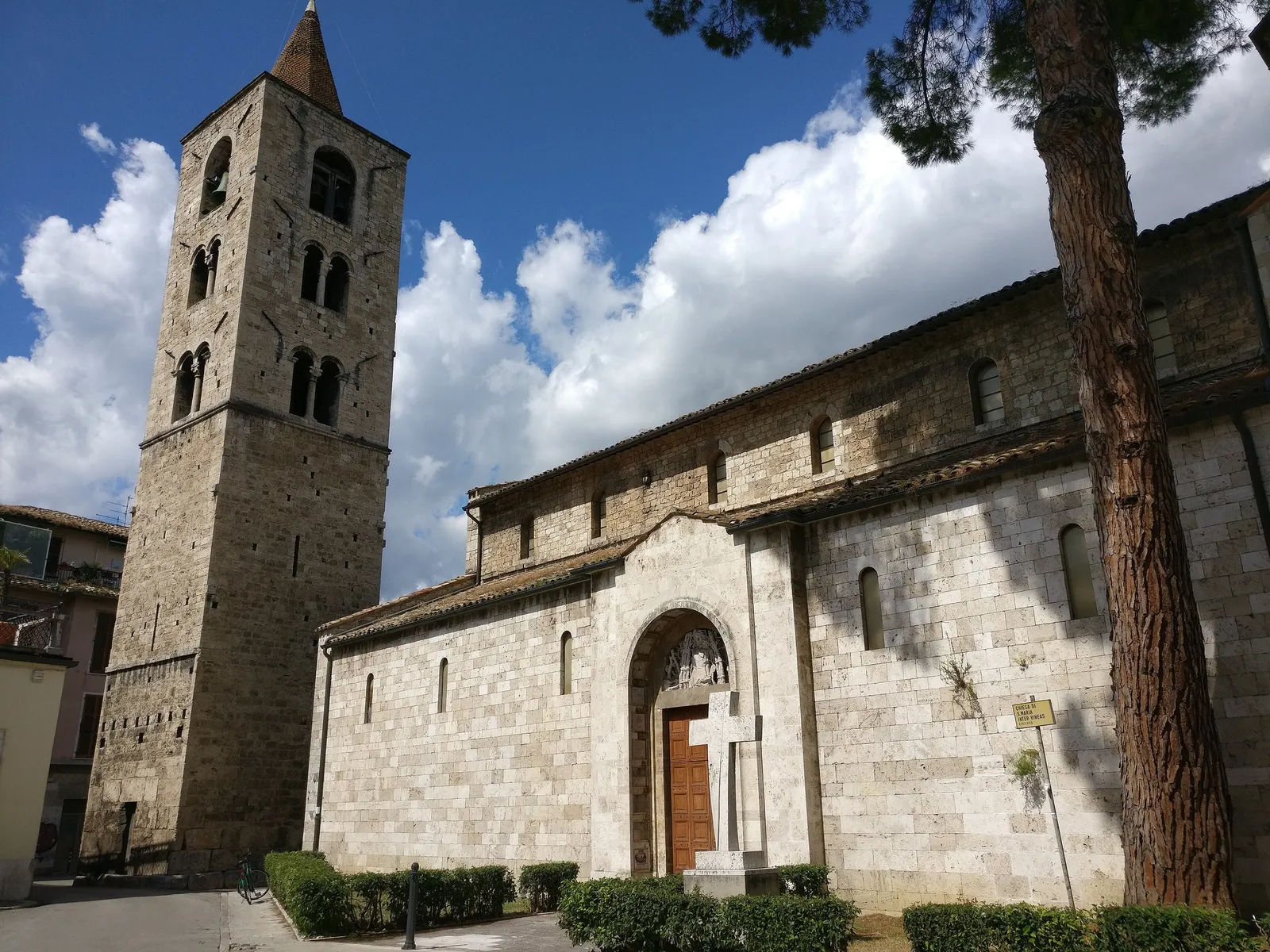
Church of Santa Maria Intervineas (Ascoli Piceno)
- Type
- Church
- Address
- Lungo tronto Emidio BartolemeiAscoli Piceno (AP)
- Phone
- 0736253045
- iat.ascolipiceno@regione.marche.it
Source: site database, © OpenStreetMap contributors (ODbL).
The Church of Santa Maria Intervineas (Chiesa di Santa Maria Intervineas) stands in the historic center of Ascoli Piceno, in the quarter that bears its name, on the banks of the Tronto river. It is a late Romanesque and Gothic building made of travertine blocks. It looks like a fortress church, austere and almost free of decoration. Beside it stands a detached bell tower, converted from an old noble family tower. Inside is a Renaissance monument to the humanist Cola Pizzuti.
On the map
Points from the site database. Map © OpenStreetMap contributors · Protomaps.
History of the Church of Santa Maria Intervineas
The first mention dates from the diploma of 996 with which Otto III granted privileges to Bishop Adamo. That document mentions a pieve (parish church) dedicated to the Virgin, under the jurisdiction of the Cathedral Chapter. According to tradition, the site was already home to a Marian cult in the 5th century, linked to the discovery of an image of the Madonna in a wayside shrine among the vineyards.
The present building was remodeled in the 13th century. Its position on the cliff above the river caused stability problems, and in the 19th century the two side aisles were demolished. They were rebuilt between 1950 and 1954, and the church reopened for worship when the work was finished. Since 1967 it has no longer been a parish church.
What to see in the Church of Santa Maria Intervineas
The exterior is plain. The gabled facade has no decoration apart from the pointed-arch portal. The apses are partly hidden by later buildings and have arrow slits in the lower part of the walls.
The interior has three naves, with alternating pillars and columns. The 20th-century restoration uncovered traces of frescoes from the late 13th and early 14th centuries. Among them are a Madonna Enthroned with Child between San Giovanni Evangelista and the Archangel Michael weighing souls, and a Last Supper.
The most unusual piece is the monument to Cola Pizzuti, who died in 1476. It is on the inner facade wall, near the main entrance. It is a Gothic-Renaissance travertine tabernacle from the second half of the 15th century, resting on four twisted columns supported by lions. The cross vault has decorations with the Evangelists and the Cardinal Virtues, attributed to followers of Pietro Alemanno.
The bell tower rests on a base of reused Roman blocks. The arrow slits and corner projections suggest it also had a military use, as a watchtower.
Visiting the Church of Santa Maria Intervineas
Before visiting, it is worth checking whether the interior is open. The exterior is also worth a stop, especially for the detached bell tower and the side facade.
Where the Church of Santa Maria Intervineas is
The church is in the historic center of Ascoli Piceno, in the northwest part of the old city, near a bend of the Tronto. The right side facade faces piazza Santa Maria Intervineas, while the second entrance closes off corso Trento e Trieste.
Around the Church of Santa Maria Intervineas
On the same square stands the so-called "bifora di Carlo Magno" (Charlemagne's mullioned window), the only surviving part of the original 12th-century town hall. The church is part of the route of Ascoli's Romanesque churches together with the Church of Santi Vincenzo e Anastasio. Other sights in the city are on the page about things to do in Ascoli Piceno.
Frequently asked questions
Why is the church called Intervineas?
What is the "bifora di Carlo Magno" near the church?
Is the bell tower part of the church?
Can the interior of the church be visited?
Nearby
What to see nearby
- Bust of the Venerable Francesco Antonio MarcucciMonument or memorialunder 100 m
- 200 m
- Porta Tufilla, Ascoli PicenoCity walls and gates200 m
Where to stay
- 100 m
- Il Casseretto in Ascoli PicenoGuesthouse100 m
- 100 m
Where to eat
- Beer Coyote pub in Ascoli PicenoPub and breweryunder 100 m
- Piccolo Teatro, Ascoli PicenoRestaurantunder 100 m
- Caffè Bistrò in Ascoli PicenoBar and caféunder 100 m
Straight-line distances.