


Church of San Vittore (Ascoli Piceno)
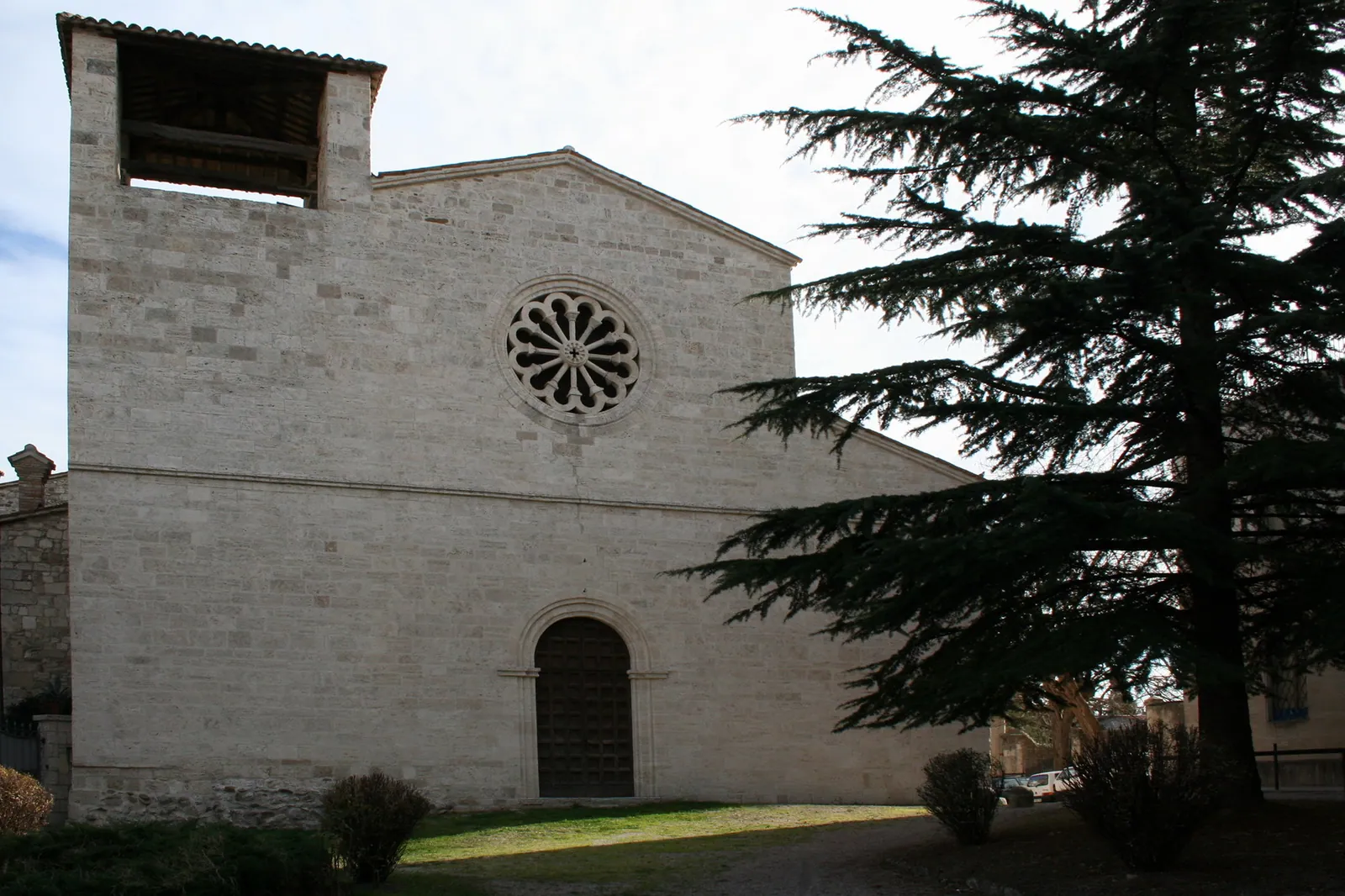
Church of San Vittore (Ascoli Piceno)
- Type
- Church
- Address
- Largo Ludovico CattaneoAscoli Piceno (AP)
- Phone
- 0736252883
- e.nevigari@ap.chiesacattolica.it
Source: site database, © OpenStreetMap contributors (ODbL).
The Church of San Vittore (Chiesa di San Vittore) in Ascoli Piceno is a Romanesque building of squared travertine blocks in the central part of the city, a few steps from Malatesta Fort in Ascoli Piceno. The facade is sober. It has a rose window with spokes of small columns, a portal with a curved (falcato) arch and a low bell tower on the left. Inside are three naves with a timber truss ceiling, and beneath the sacristy is the crypt of Sant'Eustachio. After a long restoration, the church reopened on July 5, 2026.
On the map
Points from the site database. Map © OpenStreetMap contributors · Protomaps.
History of the Church of San Vittore
The first documented records date from 966. In that year Bishop Adamo included the church in the metropolitan chapter of Ascoli. From the early Middle Ages it was described as the "Pieve di San Vittore", a term that appears in a diploma of Otto III. The title of pieve indicates that baptism was administered here for the corresponding urban district.
Its present appearance comes from the restoration begun in the mid-13th century, when the city was rebuilding after the damage caused by the troops of Frederick II in 1242. In 1502 lightning struck the church and cut off the top of the bell tower. Further conservation work, between 1924 and 1932, gave the interior back its 1695 appearance.
What to see in the Church of San Vittore
Outside, the eye-catching features are the travertine facade and the rose window, remade in 1924. At the base of the bell tower is a small chapel, which probably housed the baptismal font. On the wall of the right side there are faint traces of frescoes "alla greca maniera" (in the Greek manner), dating from between 1250 and 1270, in which San Giovanni Evangelista can still be made out.
The interior has three naves without vaults. The transept is raised by three steps and ends in a pentagonal apse. The frescoes were commissioned by wealthy worshippers, which is why the Madonna Enthroned with Child appears so often. Among the figures, San Vittore Papa stands out, possibly by Giacomo da Campli. Some frescoes have been detached and are kept in the chapel of the Palazzo Vescovile (Bishop's Palace) and in the Diocesan Museum.
The crypt of Sant'Eustachio has an irregular polygonal plan and is reached through an outside door, not from inside the church. It was used as an ossuary, stayed closed for centuries and was reopened in 1929. It holds a fresco cycle on the legend of the saint.
Visiting the Church of San Vittore
The church became accessible again to worshippers and visitors when it reopened on July 5, 2026, at the end of a recovery and restoration project. The work was funded by the Otto per mille, the Struttura Commissariale and the Ufficio Speciale per la Ricostruzione of the Marche Region. It is worth checking opening hours before visiting, including whether the crypt is open.
Where the Church of San Vittore is
The church stands in the central part of Ascoli Piceno, very close to Forte Malatesta. Its right side was once flanked by the urban stretch of the consular road Via Salaria, which led to the Ponte di Cecco.
Around the Church of San Vittore
Forte Malatesta, reinforced by Galeotto I Malatesta in 1349, stands on an area once occupied by a Roman bath complex. In the left nave of San Vittore there is a travertine block from the early Imperial age, with a light relief of leafy scrolls, attributed to that building.
Ascoli has sixteen Romanesque churches, plus the Baptistery. To continue, visit the Baptistery of San Giovanni or the Church of Santi Vincenzo e Anastasio. More ideas are on the page about things to do in Ascoli Piceno.
Frequently asked questions
Is the Church of San Vittore open again after the restoration?
When was the Church of San Vittore built?
How do you get into the crypt of Sant'Eustachio?
Why is the bell tower of San Vittore so low?
Nearby
What to see nearby
- Monument to Cecco d'AscoliMonument or memorial200 m
- 200 m
- Pimu Picenworld Museum, Ascoli PicenoMuseum or art gallery200 m
Where to stay
- under 100 m
- Bed and Breakfast Rosa Spina, Ascoli PicenoB&B or guesthouseunder 100 m
- A Casa Di Leo, Ascoli PicenoTourist accommodationunder 100 m
Where to eat
- Il Ruspante, Ascoli PicenoRestaurant100 m
- Osteria Pecora Nera, Ascoli PicenoRestaurant200 m
- 200 m
Straight-line distances.