


Hermitage of San Marco
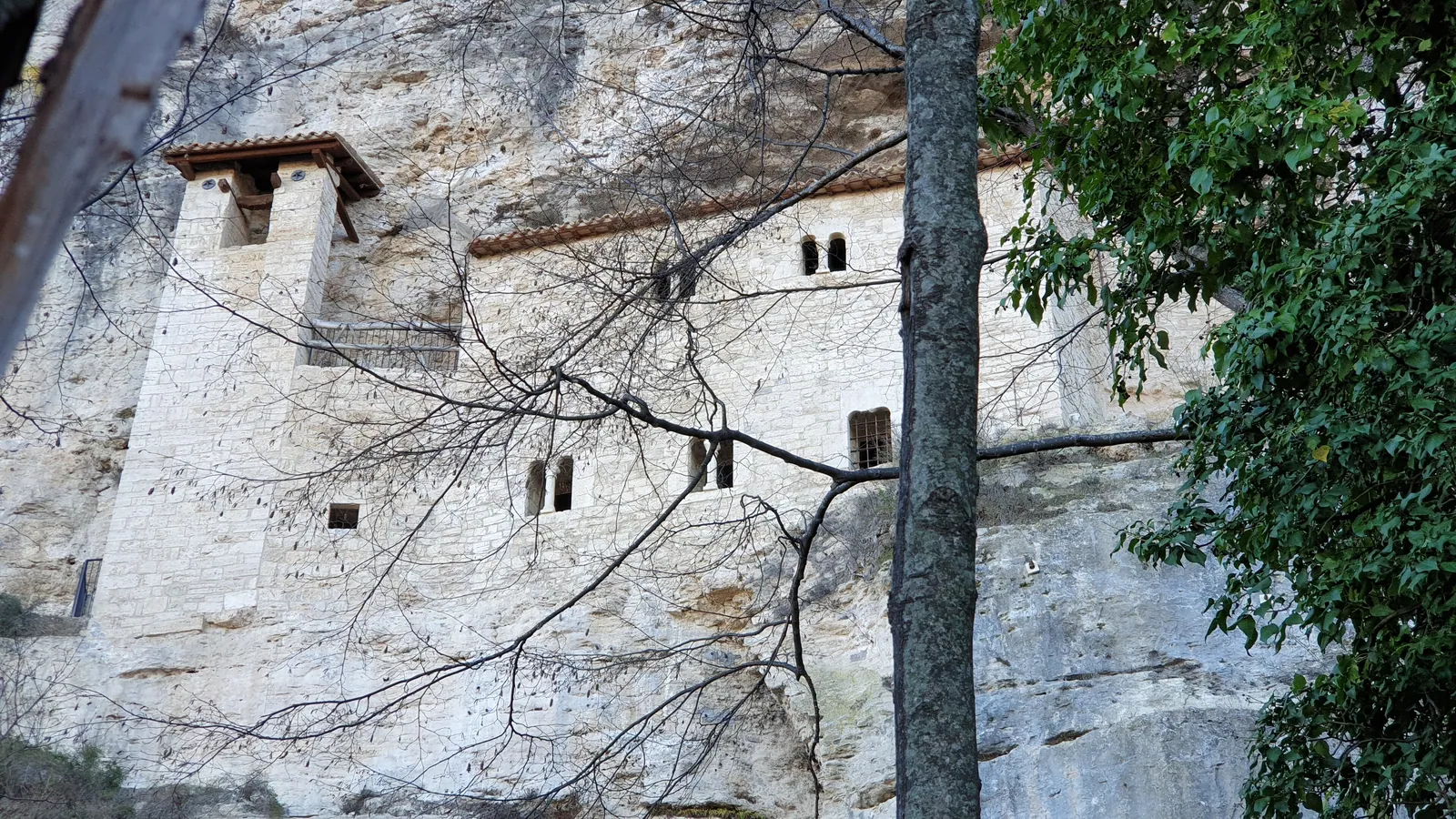
Hermitage of San Marco
- Type
- Church
- Municipality
- Ascoli Piceno (AP)
- Hours
Mar–Oct · Sat, Sun, holidays 10:00–16:00
Source: site database, © OpenStreetMap contributors (ODbL).
The Hermitage of San Marco (Eremo di San Marco) in Ascoli Piceno is a hermitage south of the town, clinging to the rock face of Colle San Marco, near the hamlet of Piagge. It is built of travertine blocks according to the canons of Romanesque art and is dedicated to Saint Mark the Evangelist. It can be seen from Piazza del Popolo in Ascoli Piceno and from above it overlooks the Valle del Tronto, with a view that reaches the Adriatic. The building is owned by the municipality and was restored in 2016.
On the map
Points from the site database. Map © OpenStreetMap contributors · Protomaps.
History of the Hermitage of San Marco
The earliest records date to the beginning of the 13th century, when a community of Cistercian monks settled here. A bequest in a will from 1253 already mentions the monastery. In 1289 Pope Nicholas IV granted, by papal bull, a plenary indulgence to penitents who visited it on the feast of Saint Mark.
In 1387 Bishop Antonio Archeoni suppressed the monastery and entrusted its patronage to the Sgariglia family. In 1410 the Sgariglia turned it into a small church, with the bell tower, the access stairway and the altar. After the parish church of San Bartolomeo was built in Piagge in 1474, the hermitage began to decline. At the end of the 19th century it suffered acts of vandalism. In 1908 mayor Garzia Civico had conservation work carried out. The complete restoration, with consolidation to the rock, dates from 2016.
What to see at the Hermitage of San Marco
The facade combines the bell tower, on the left, with a front featuring two tiers of mullioned windows: three windows on the lower level and two on the upper. The interior is divided into two cavities, one above the other. The lower one has a barrel-vaulted ceiling with traces of frescoes, including red eight-pointed stars. The upper one, carved out of the cave, holds three 15th-century arcosolium tombs of the Tibaldeschi family, with a coat of arms. From the mullioned windows the view looks toward Ascoli Piceno and Monte dell'Ascensione.
The hermitage is reached by a stone stairway that crosses the ravine like a bridge. It was designed by the engineer Enrico Cesari and paid for by the Comune of Ascoli with funds from the Opera Pia Sgariglia.
How to visit the Hermitage of San Marco
The walk starts from Piagge and continues on foot along a trail through the woods. The route is easy and suitable for everyone, but some stretches are slippery. Proper footwear is needed and it is a good idea to bring some water.
Today the hermitage is looked after by the Templari Cattolici d'Italia, who handle the openings. Before setting out, it is best to check opening days with the association.
Where the Hermitage of San Marco is
The hermitage stands on Colle San Marco, south of the center of Ascoli Piceno, near the hamlet of Piagge. The starting point for the climb is Piagge.
Near the Hermitage of San Marco
From the hermitage, Piazza del Popolo and the Chiesa di San Francesco in the historic center of Ascoli can be picked out. To round out the day in town, see the page about things to do in Ascoli Piceno.
Frequently asked questions
Can the inside of the Hermitage of San Marco be visited?
Is the trail to the hermitage difficult?
Who lived at the Hermitage of San Marco?
Can Ascoli Piceno be seen from the hermitage?
Nearby
What to see nearby
- Fornacetta, Ascoli PicenoRuins or archaeological site400 m
- Church of San BartolomeoChurch400 m
- Convent of San Lorenzo (Ascoli Piceno)Ruins or archaeological site600 m
Where to stay
- 500 m
- 1.2 km
- 1.7 km
Where to eat
- Ristorante Cubanito Bailòn, Ascoli PicenoRestaurant with farm stay, 4 rooms1000 m
- Ristorante Nannì, Ascoli PicenoRestaurant1.5 km
- Macelleria Spina Emanuele, Ascoli PicenoButcher and pork products2.2 km
Straight-line distances.