


La Fenice Theater in Amandola
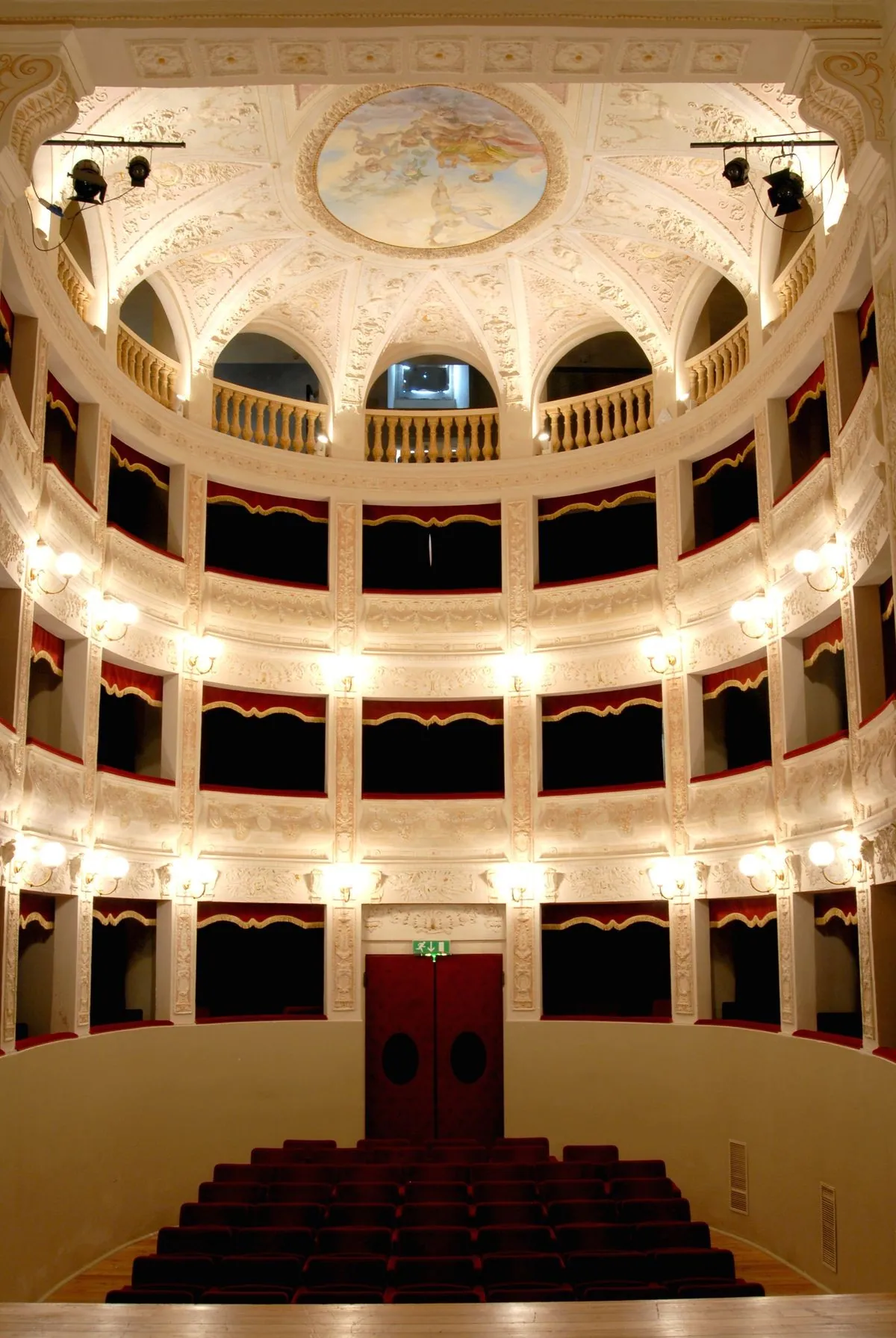
The La Fenice Theater (Teatro La Fenice) in Amandola is the town's historic theater, in the province of Fermo. It stands inside the old Palazzo Comunale (town hall). It has an elliptical plan and three tiers of boxes, topped by an upper gallery. The vault carries neoclassical decoration with Art Nouveau (Liberty) touches. Today the theater cannot be visited. It has been unsafe for use and closed since the earthquake of August 2016.
It is still possible to reach the upper square of Amandola and see the building from the outside. Around it are the historic center and its churches.
La Fenice Theater in Amandola
- Type
- Theater or auditorium
- Address
- Via Roma 2Amandola (FM)
- Phone
- 0736840731
- Website
- comune.amandola.fm.it
Source: site database, © OpenStreetMap contributors (ODbL).
On the map
Points from the site database. Map © OpenStreetMap contributors · Protomaps.
History of the La Fenice Theater in Amandola
In Amandola, theatrical performances are documented at least since the 16th century. They were episodes from sacred texts, such as the Passion of Jesus, or lives of saints. Some documents record that in 1588 the first performance of S. Caterina (Saint Catherine) was staged there. A hall for performances was located in the Palazzo Pretoriale. At the end of the 17th century, the need arose for a larger building better suited to new ways of staging. Later, town council resolutions and restoration work show that the town's administrators also cared about the theater.
The present form is mostly due to the 19th century. In 1811 the amateur dramatic society that had run the theater until then was replaced by a consortium of owners. Each member paid a share of the expenses and in return had the use of a box, assigned by lot at the start of the season. After a series of restorations, the theater opened as the “Teatro dei Sigg. Condomini La Fenice”. In 1819 architect Antonio Cecchi designed an extension with a front block containing the lobby and an upper hall. In 1823 the collapse of a roof truss over the stage damaged sets, machinery and decoration. The restoration was carried out the following year to a design by Carlo Maggi.
In 1944 the building housed Polish troops. Later the owners' consortium was dissolved and ownership passed to the municipality. The theater then remained closed for a long time. A restoration that began in 1991 went on for years. The 2016 earthquake then halted activity once again.
What to see in the La Fenice Theater
The defining feature of the hall is its elliptical plan. It follows the innovations of the great 19th-century Italian theaters, such as the Teatro dell'Aquila in Fermo. The three tiers have 10 boxes on the first tier and 11 on the second and third. Above them is an upper gallery with arches and railings with small piers. In all, there are about 120 seats.
The decoration is concentrated on the vault. Near the proscenium there is stucco work with festoons, putti and medallions in a neoclassical style with Art Nouveau influences. There are also allegories of Comedy and Music, and in the center the figure of Music beneath the Genius. The artist is Vincenzo Pascucci, from Amandola, who also painted the hall's decoration. The stage scenery, by Michelesi, a set designer from Ascoli, was left unfinished.
None of this can currently be seen from inside.
How to visit the La Fenice Theater in Amandola
The theater cannot be visited. The building is unsafe for use. The closure is tied to the earthquake of August 2016. The theater is among the landmark buildings scheduled for public reconstruction, after the former Casa del Fascio. There is no reopening date yet. Before planning a trip, it is worth checking with the Comune di Amandola, which publishes contacts and updates.
In summer, look out for the Festival Ars Amando. It is a traveling event with shows in the squares and theaters of the municipality.
Where the La Fenice Theater is
The theater stands in the upper part of town. Piazza Umberto I, known as the piazza alta (upper square), is the old social and religious heart of Amandola and is also home to the Torrione del Podestà, the magistrate's tower. Opposite the church of San Francesco, Via Roma descends, a very steep street. Near the end of the climb is Largo del Teatro, in front of the theater entrance.
Amandola is a small medieval town at about 500 m above sea level, on the eastern side of the Sibillini Mountains National Park. The square area is affected by work to restore infrastructure. In 2025 the regional conference approved the feasibility study for restoring the public works of the historic center. The work covers Piazza Umberto I, the nearby green areas, the two tree-lined avenues and the parking lot. There may therefore be some disruption in the area.
Around the La Fenice Theater in Amandola
The churches and museums of the center are clustered around the upper square. The church of Sant'Agostino, or Sanctuary of Beato Antonio, dates from the 14th-15th century. It has a Gothic portal of Venetian inspiration and a bell tower attributed to Pietro Lombardo. The church of San Francesco has a portal and frescoes at the base of the bell tower. Before the 2016 earthquake, its cloister housed the anthropogeographic museum and the museum of rural life. After the earthquake the anthropogeographic museum moved to the former 18th-century Collegiata, where it is now presented as the Museo del Paesaggio (Landscape Museum).
The churches of the Beato Antonio and San Francesco, with the cloister, are part of the post-earthquake reconstruction work. Before including them in a visit, it is worth checking that they are accessible.
Outside town, about 10 km away, is the Romanesque Abbazia dei Santi Ruffino e Vitale, founded in the Middle Ages by the Benedictines, near the Tenna River. To compare several theaters in the area, see the historic theaters of the Sibillini, including the Vittoria Theater in Sarnano and the Teatro Comunale Giacomo Leopardi in San Ginesio.
Frequently asked questions
Can the theater in Amandola be visited?
How many seats does the La Fenice Theater have?
Who decorated the theater's vault?
When did the La Fenice Theater open?
Nearby
What to see nearby
- Piazza Umberto I and the Podestà Tower (Amandola)Historic building or squareunder 100 m
- under 100 m
- Anthropogeographical Museum (Amandola)Museum or art galleryunder 100 m
Where to stay
- 100 m
- Sibilroom, AmandolaGuesthouse200 m
- Villa Schinoppi, AmandolaTourist accommodation200 m
Where to eat
- Fattoria Corradini, AmandolaFarm shop200 m
- 200 m
- 200 m
Straight-line distances.