


Pescara del Tronto (Arquata del Tronto)
At a glance
- Municipality
- Arquata del Tronto
- Province
- Ascoli Piceno
- Region
- Le Marche
Pescara del Tronto is a hamlet of Arquata del Tronto, in the province of Ascoli Piceno. It is 4 km from the main village of the municipality and stands at 743 m above sea level. The village lies in the upper Tronto valley, on the high ground to the left of the river, among woods and pastures. Its territory straddles the Sibillini Mountains National Park to the north and the Gran Sasso e Monti della Laga National Park to the south.
Visitors should know that the historic village no longer exists. The earthquake of August 24, 2016 (magnitude 6.0) destroyed almost all the houses, and the shock of 30 October (magnitude 6.5) brought down the few buildings still standing. Ten years after the earthquake, reconstruction is still far off and some residents live in temporary prefab houses. A visit is therefore above all a place of remembrance, to be combined with hikes in the valley. For a broader picture of the municipality there is the page Arquata del Tronto: things to see and do.
On the map
Points from the site database. Map © OpenStreetMap contributors · Protomaps.
What to see in Pescara del Tronto
No historic center remains to visit in the old village. After the earthquake, almost the entire historic core was destroyed and the other buildings were damaged and unsafe. The Church of Santa Croce was also completely destroyed. Before the earthquake it was formed by the union of two churches: the older one and an oratory dedicated to the Madonna del Soccorso, built around 1600 next to the first. The image of the Christ recovered from the rubble and displayed at the funeral of the Piceno victims on 27 August went around the world.
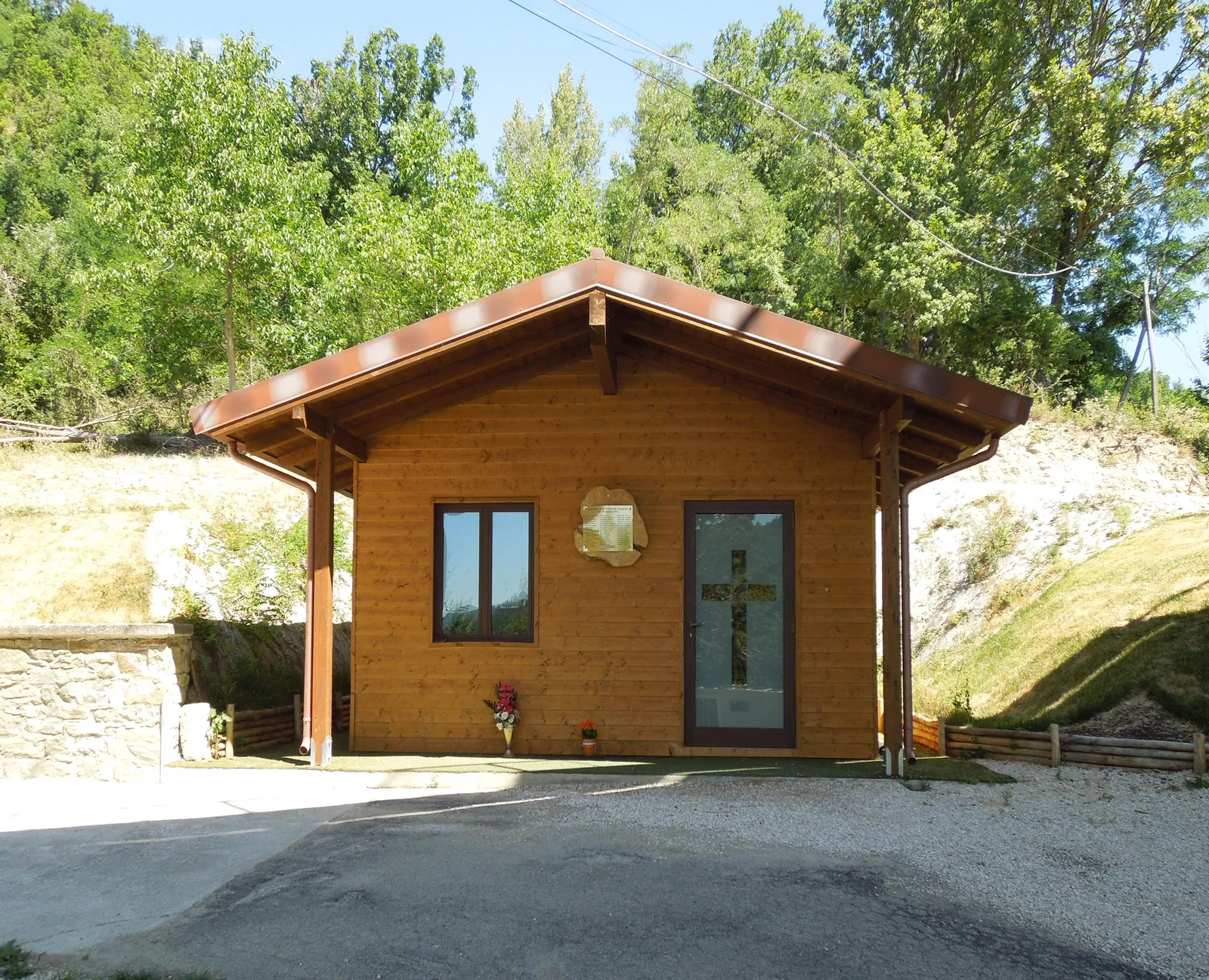
A place for quiet reflection is the new cemetery chapel. Its construction was the first project completed after the earthquake. At the entrance, a plaque lists the names of the victims. The 13th-century processional cross survived; it belonged to the parish's sacred furnishings and is considered among the best-preserved metal crosses in the Marche.
Reconstruction is moving slowly. At the end of August 2026 a services conference approved the zoning variant and the project for hydraulic risk mitigation works, preliminary steps toward the new housing development. On 23 and August 24, 2026 the village hosted the events for the tenth anniversary of the earthquake. Today the village lives around the SAE area, the emergency housing set up after the earthquake. For other places in the municipality there is the page about things to do in Arquata del Tronto.
Nature and trails near Pescara del Tronto
The European long-distance path E1 runs through the village. The Arquata section of the E1 links, among other places, Pretare, Camartina, Pescara del Tronto, Tufo and Capodacqua, and continues toward Accumoli.
The easiest local route is the Pescara–Vezzano loop. It starts from the SAE area, reaches Vezzano along the Tronto, climbs through the woods to Spelonga and comes back down to Pescara. From the SAE area, follow the Salaria toward Ascoli Piceno for about 500 meters. Then cross the small bridge on the right and continue on an almost level dirt track along the river. The Pescara–Vezzano section is 2.10 km long, with 33 m of elevation gain, and is waymarked as trail no. 379. On the descent the gravel track is steep and requires care. After the earthquake Vezzano was declared a red zone and could not be visited, so it is worth checking the condition of the route before setting out. On the way back, the SAE area has places to eat and a drinking water fountain.
Among the routes around Arquata there are others linking Pescara to Tufo, to Spelonga and to Pretare by way of Camartina. In Roman times the Salaria passed through here: from Pescara del Tronto the road continued toward the statio (way station) of Surpicano, near Arquata.
Where to stay in Pescara del Tronto
No accommodation is documented in the hamlet, which was destroyed by the earthquake. For an overnight stay it is best to look at what the whole municipality offers, listed on the page about where to stay in Arquata del Tronto.
Where to eat in Pescara del Tronto
The SAE area of Pescara del Tronto has places to eat and other businesses. Other addresses in the municipality are on the page about restaurants in Arquata del Tronto.
Local products of Pescara del Tronto
Pescara del Tronto has no local products of its own on record. For specialties and shops in the area, see the page on Arquata del Tronto local products and shops.
Weather and how to get to Pescara del Tronto
The climate is that of the middle mountains, with mild springs and summers and snowy winters. The area can be visited at any time of year.
The SS4 Salaria runs alongside the SAE village and leads on one side toward Amatrice, Rieti and Rome, on the other toward Ascoli Piceno and the Adriatic. From the A14 highway, take the San Benedetto del Tronto exit. Coming from Ascoli, after Trisungo the SS685 delle Tre Valli Umbre leads to Norcia and Spoleto. Near Pescara the SS4 has a single carriageway, because of the protection works against the landslide coming down from the hillside. The SP129 links the village to Arquata del Tronto and Tufo.
The village has no rail service. The nearest station is Ascoli Piceno. There is a bus stop at the SAE area. It is worth checking connections before setting out.