


Montefalcone Appennino: what to see and do
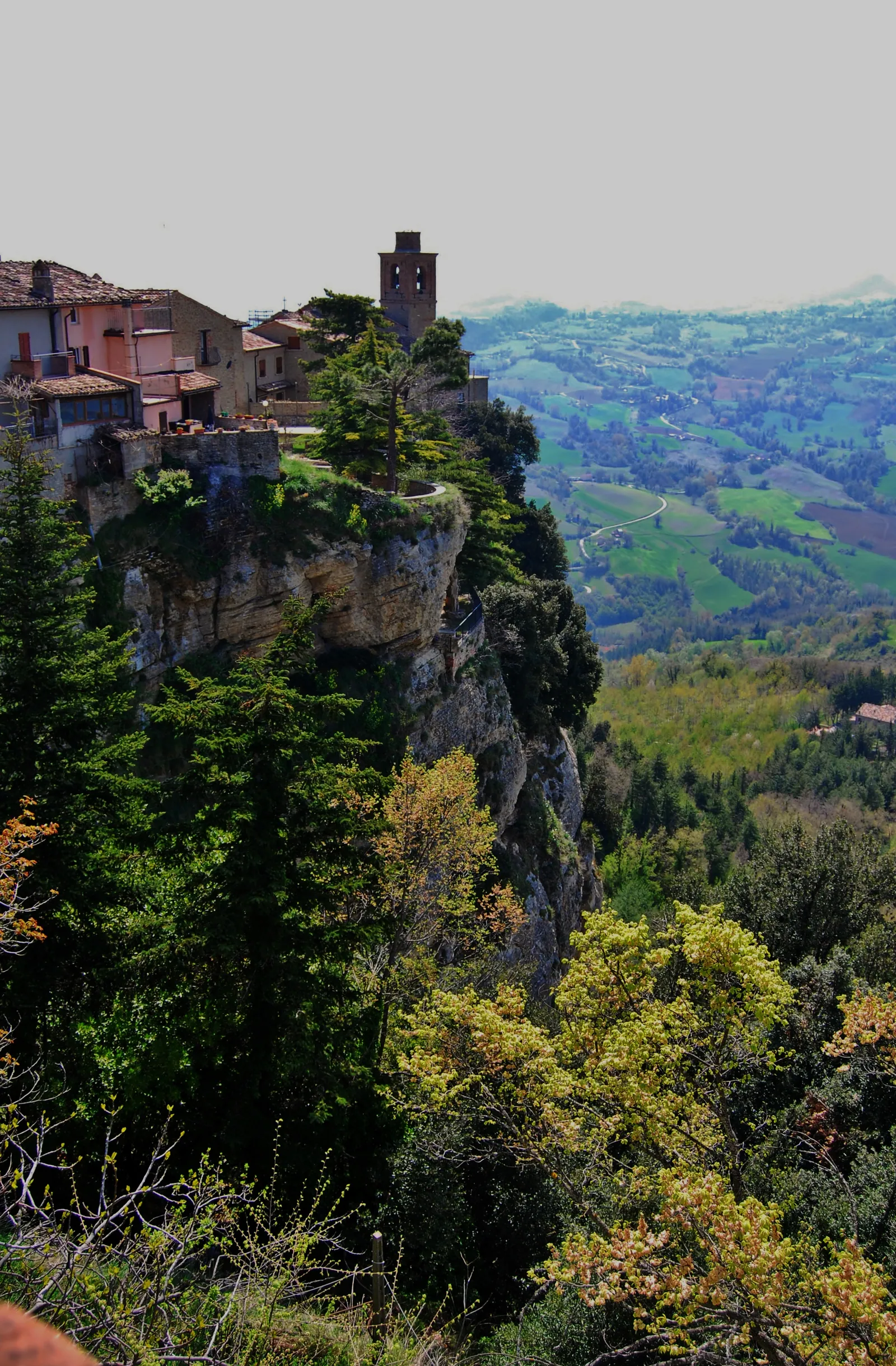
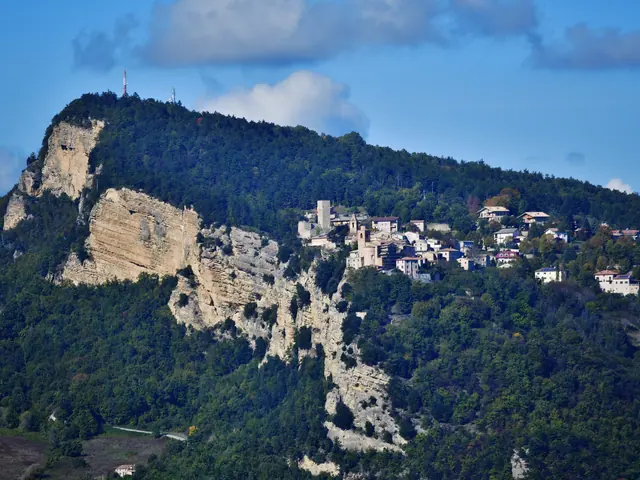
Montefalcone Appennino is a small village in the province of Fermo, in the Marche, built on top of a cliff between the Aso and Tenna valleys, at 757 meters above sea level. To the west the cliff drops sheer for a few hundred meters onto the fields below. From its edge the Sibillini Mountains and the Monti della Laga can be seen and, on the clearest days, the horizon reaches the Maiella, the Gran Sasso and the Adriatic Sea. The name comes from the falcons (falchi) that nested on the summit of the mountain. The village is made of brick and stone buildings along narrow, winding streets, and the rock it stands on is full of marine fossils: in a remote past this area was covered by the sea.
The written history of Montefalcone Appennino begins with documents from 705 and 930 linked to the Farfa abbey's fief of Santa Vittoria in Matenano. Under the monks of Farfa the town had a fortress and a school for clerics. In 1214 it became a free commune. Disputed between Ascoli and Fermo, in 1355 it passed to the Papal States and in the 15th century it was controlled by the Orsini family. Between 1922 and 1924 the painter Osvaldo Licini lived here.
At a glance
- Municipality
- Montefalcone Appennino
- Province
- Fermo
- Region
- Le Marche
On the map
Points from the site database. Map © OpenStreetMap contributors · Protomaps.
What to see in Montefalcone Appennino
The main stops on a visit to Montefalcone Appennino are the Palazzo Felici museum complex, the remains of the Rocca (fortress), the churches of the historic center and the view from the cliff. Several religious buildings were damaged by the 2016 earthquake and some are still undergoing work.
Palazzo Felici houses the fossil and mineral museum and the Alamanno museum. The museum complex reopened in May 2024, after work to upgrade its systems and safety. The fossil museum was founded in 1996 and holds about 500 local finds of marine fauna from the Lower Pliocene, already studied in 1880 by Alessandro Mascarini: crustaceans of the genus Balanus, sixty species of mollusks, echinoderms, shark teeth and fossilized leaves. There are also pieces from other parts of the world, including mammoth tusks, parts of the skeleton of a cave bear from the Pyrenees and a dinosaur egg found in China. The mineral section has about 1,200 specimens and includes a cave set up to observe mineral fluorescence. One room displays the polyptych of the Madonna and Child with Saints, painted by Pietro Alemanno between 1475 and 1480 for the church of San Giovanni Battista and restored. It still has its original wooden frame, the work of Giovanni di Stefano da Montelparo. The palazzo also houses an Ecomuseum devoted to the folk knowledge of the Fermo area and an Environmental Education Center. Outside is the Giardino Tronelli, considered one of the first Italian roof gardens. The museum opens mainly in the summer months, so check the opening times before setting out.
The Rocca overlooks the village from above, on a rocky spur. A few towers of the castle survive. It was built as a lookout tower by the Farfa monks and fortified by the people of Fermo in the 13th century. Together with the falcon, the Rocca is the symbol of Montefalcone Appennino.
The church of San Michele Arcangelo is the parish church of the village, dedicated to the patron saint. It is documented from 1332 under the name of Sant'Angelo in Castello. The present building was built between 1821 and 1824 with a bequest of 3,000 Roman scudi from Livio Palmoni, coachman of Pope Pius VII. It has Neo-Romanesque forms and a Greek-cross plan with three altars. On the high altar is the canvas of Saint Michael painted by Giuseppe Toscani in 1947; Toscani also frescoed the vault and walls in 1949-50. Another altar holds an 18th-century Saint Eurosia attributed to Antonio Liozzi.
The church of San Pietro in Penne dates from the 14th century and was declared unsafe after the 2016-2017 earthquake. In September 2025 the repair and seismic upgrading work was in its final phase. The village also has the church of Santa Maria delle Scalelle, built above a tunnel dug in the 1830s, and the chapel of the Orsini Princes, dedicated to Saint Anthony of Padua.
In the locality of Luogo di Sasso, about one kilometer outside the village toward Smerillo, is the church of San Giovanni Battista. It is part of the convent complex of San Giovanni in Selva, of Benedictine origin and passed to the Franciscans in 1223. According to tradition Saint Francis stayed here. In June 2026 the church was undergoing repair and seismic upgrading work. A fuller description of the monuments is on the page things to do in Montefalcone Appennino.
Nature and trails near Montefalcone Appennino
The best-known hike starts from Montefalcone Appennino and crosses the woods to the nearby village of Smerillo. The one-way route is about 3.9 km, with modest elevation gain. It is easy, although there are uphill stretches: comfortable shoes and a minimum of fitness are needed. Other paths cross it, but they end up joining again. To return, the paved road can be used, about 3 km that take half an hour on foot. Altogether it is a half-day outing.
In one stretch the path runs right along the edge of the cliff. The passage is safe, but those who suffer from vertigo should know beforehand. The vertical wall exceeds 200 meters, is rich in fossils and is crossed by a nature trail. The Montefalcone Appennino woods are a protected floristic area. The nature trail offers views of the Sibillini at several points, among chestnut trees and Mediterranean scrub.
There is also a longer loop that starts from Smerillo, passes through the Fessa, follows the nature trail and the wooded ridge and reaches the Rocca di Montefalcone: about 7.2 km and 270 meters of elevation gain, graded as easy. The Fessa is a deep, narrow crack in the rock, rich in Tertiary fossils. In the past it was closed for safety work, so check whether it is accessible. The Cammino dei Cappuccini walking route also passes through the village, with a stage from Montefalcone Appennino to Rotella. Before setting out, check the weather: after rain the woodland trails can be slippery.
Where to stay in Montefalcone Appennino
The places to stay, with descriptions and services, are gathered on the page where to stay in Montefalcone Appennino. For the Sapori d'Autunno weekend in October, book well in advance: in 2019 the festival drew about 10,000 visitors, a huge number for such a small village. To combine the visit with other villages in the area, more itineraries are in the section Sibillini Mountains villages.
Where to eat in Montefalcone Appennino
The most awaited moment for local food is Sapori d'Autunno: for two days wooden stalls along the streets of the historic center serve traditional dishes. The most recent editions were held in October. The menu includes polenta with meat sauce and with truffle, pasta alla norcina, truffled legume soup, arrosticini (skewers) and grilled meats, roasted chestnuts, roast "pupi" and chestnut sweets with vino cotto (cooked wine). At other times of the year, check opening days and closures of the village's restaurants in advance.
Local products of Montefalcone Appennino
The local products of Montefalcone Appennino are those of the woods and of autumn: truffles, mushrooms, chestnuts and the mela rosa dei Sibillini, a small pink apple. In the area several bakeries also sell local specialties. During Sapori d'Autunno a market of local products and crafts offers truffles, cheeses, walnuts, chestnuts, pink apples and honey. The festival reached its twenty-fourth edition in 2022, when the program included music and falconry shows, a tribute to the falcon that gives the village its name.
Weather and how to get to Montefalcone Appennino
Montefalcone Appennino is reached by car from the A14 highway. From the Pedaso exit, take the direction for Pescara, go through Pedaso and Rubbianello and continue inland up to the village. Alternatively, exit at Porto San Giorgio and follow the road for Santa Vittoria in Matenano, then for Montefalcone. From Ascoli Piceno, about 30 km away, take the SP235, the SS4 and the SP237 toward Comunanza, then climb to Montefalcone. Those who want to stop along the way will find the town guide on the page Comunanza: what to see and do.
The nearest train stations are Pedaso and Porto San Giorgio-Fermo. There are bus connections from Porto San Giorgio. The reference airports are Ancona-Falconara and Pescara.
The village is at 757 meters, on an exposed ridge. Clear days are the best for the view, which from the terrace and the edge of the cliff reaches the Sibillini. In winter it is wise to check the forecast and road conditions before traveling.
In this section
2 results
 Things to Do in Montefalcone Appennino1 places
- Where to Stay in Montefalcone Appennino6 places to stay
No results with these filters.