


Things to do in Montegallo
Montegallo is a mountain municipality in the Marche Apennines, within Sibillini National Park in the Sibillini Mountains. It lies on the northeastern slopes of Monte Vettore, on both sides of the upper course of the Fluvione river. Anyone looking for things to do in Montegallo will not find a single center. The sights are scattered among the hamlets: churches of monastic origin, a tower house, a museum of rural life and the remains of a Franciscan hermitage.
The history of the place begins with a castle. According to tradition, Montegallo was built in the 8th century under the name Castello di Santa Maria in Gallo. It was a fortified hilltop village with mighty walls, a church and a large bell gable that for four centuries gathered the people of the whole valley. In 1500 the inhabitants moved farther down the valley and, reusing much of the castle's sandstone, founded the present hamlet of Balzo, the municipal seat.
The places
9 results
 Church of San Bernardino (Montegallo)Church · Montegallo
- ChurchChurch of San Giovanni Battista (Montegallo)Church · Montegallo
- ChurchChurch of Santa Maria in Lapide in MontegalloChurch · Montegallo
- Museum or art gallery"Stefano Cardarelli" Museum of Rural Life (Montegallo)Museum or art gallery · Montegallo
- Ruins or archaeological siteRuins of the Hermitage of San Francesco in MontegalloRuins or archaeological site · Montegallo
- ChurchSan Michele Arcangelo in Montegallo (Castro)Church · Montegallo
- Castle or fortressDovecote TowerCastle or fortress · Montegallo
- PeakIl PizzoPeak · Montegallo
- PeakSasso d'AndrèPeak · Montegallo
No results with these filters.
On the map
Points from the site database. Map © OpenStreetMap contributors · Protomaps.
Things to do in Montegallo: the lay of the land
The municipality is spread across many hamlets, and it is best to plan the visit by groups of nearby places. The main village is Balzo, also known as Castello di Balzo. This is where the civic buildings and the Palazzetto Branconi are concentrated. Balzo is also home to the 17th-century town hall building and the churches of San Bernardino and Sant'Angelo.
Fonditore is the hamlet where the Franciscan Blessed Marco was born, and a tower house dominates the village. In the hamlet of the same name stands the church of Santa Maria in Lapide. The building lies along the Rio stream, the main tributary of the Fluvione. Uscerno has the Museo della Civiltà Contadina (museum of rural life). Corbara is a hamlet built against massive tuff boulders, and a little higher up stands the old convent dedicated to San Francesco. Above Colle stands the church of Santa Maria in Pantano, badly damaged by the 2016 earthquake.
The hamlets of Castro, Colleluce and Astorara are also worth a visit. Monte Vettore is the backdrop to the whole route.
Things to do in Montegallo: the top sights
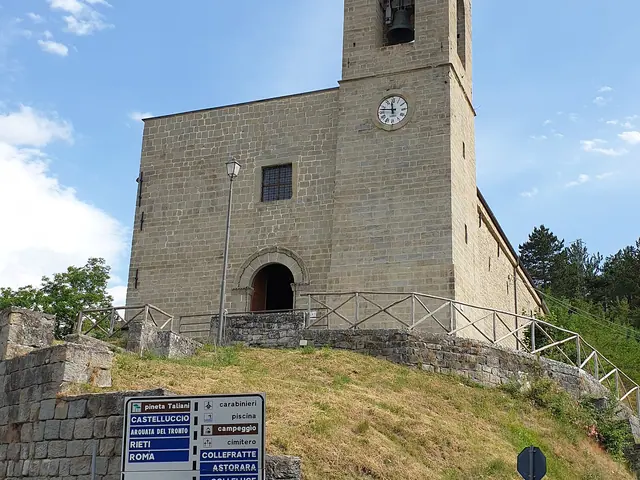
Balzo and Piazza Taliani. The main village is best explored on foot, starting from the square. To the right of Piazza Taliani stands a circular building called the Rotonda, dated 1883. On the left are the town hall and, next to it, Palazzo Taliani, from 1834. The Palazzetto Branconi was built in 1640 and today houses the Casa del Parco (visitor center) of Sibillini National Park and the Centro di Educazione Ambientale (environmental education center). Also in Balzo is the Church of San Bernardino.
Church of Santa Maria in Lapide. It is the oldest and best-documented monument in the municipality. Its origins date to a period between the 8th and 9th centuries, when the area was under the control of the monks of Farfa. The name Sancta Maria in Lapide referred to the whole land of Montegallo from the 8th to the 14th century.
Its present appearance is mainly due to a Renaissance rebuilding. A major renovation began toward the end of the 15th century. The start of the work is dated to 1491, the date given by an inscription in the transept. The plan became a Latin cross and few elements of the old decoration survived. Of the oldest structure there remain the square central core, with a dome on an octagonal drum, and the bell gable. The drum is topped by a stone gallery supported by large corbels. Slits and brackets designed for surveillance and defense are visible. Inside there are a 9th-century crypt and a bronze bell from 1400 with Gothic inscriptions.
Ten years after the 2016 earthquake, restoration of the building has arrived. Before going, check whether it is possible to go inside.
Tower house of Fonditore. The tower house dominates the village of Fonditore. The village is also the birthplace of Blessed Marco, a Franciscan friar.
Museo della Civiltà Contadina in Uscerno. It is a small collection of tools of the rural culture found throughout the Sibillini Mountains. Uscerno is worth a stroll beyond the museum too. There is a doorway with an ancient symbolic inscription, and roses carved on the village's lintels and doorways form a dense constellation. The village is associated with the chestnut festival.
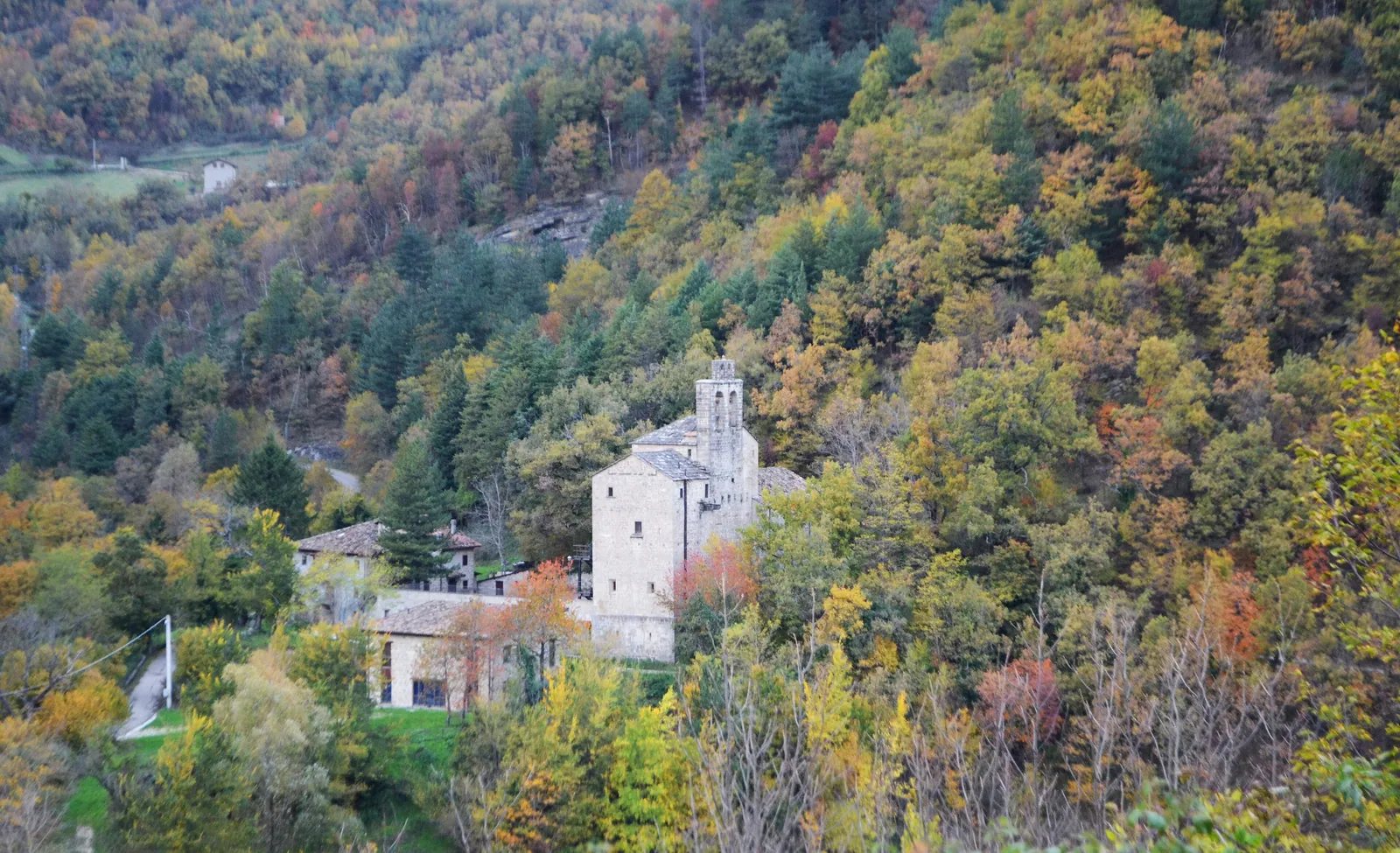
Eremo di San Francesco, above Corbara. It was a small Franciscan convent dating from the early days of the order. It was suppressed by Pope Innocent X in 1652 and has belonged to the parish ever since. It stands on a panoramic knoll overlooking the Fluvione valley, and the well from which the friars drew water still survives. On the walls of an inner room remain biblical and spiritual inscriptions left by Don Quintino Sicuro, who lived there as a hermit from 1949 to 1954. In the same years Don Quintino built the Stations of the Cross along the steep path that climbs from Corbara to the hermitage. The complex, however, is dilapidated and part of the convent has collapsed: these are ruins, to be viewed with caution.
Santa Maria in Pantano above Colle. The Romanesque church, which tradition dates to the late 8th century and which is documented from 1039, stands at 1,159 m, a 30-40 minute walk from Colle di Montegallo, and held frescoes, including the Sibilla Agrippina and the Nativity. It was badly damaged by the October 30, 2016 shock, and in 2025 the repair work was approved: before visiting, check its status. The frescoes, from the 17th century and attributed to Martino Bonfini, depicted sacred subjects and the Sibyls.
Other sights have their own page: the church of San Giovanni Battista, San Michele Arcangelo, the dovecote tower, Il Pizzo and Sasso d'Andrè. For walking, there are the Balzo - Corbara trail and the fir-wood loop (anello abetito).
Things to do in Montegallo: visiting tips
How much time you need. The sights are spread over a wide area. It is therefore best to choose one or two hamlets at a time: for example Balzo and Fonditore with Santa Maria in Lapide, or Uscerno. Corbara and the hermitage require a climb on foot.
Check opening times. Ten years after the 2016 earthquake, the hamlets still have churches, frescoes, hermitages and old houses waiting to be protected. Some buildings may therefore be closed or unsafe. Before setting out, check the opening and accessibility of the churches and the museum. Those heading to Uscerno for the museum should inquire in advance, since it is a small collection without fixed opening days.
Trails and seasons. The area is suited to a stay all year round, but hiking changes with the season. In the Park, hiking trails can be walked from spring to autumn, while in winter the peaks are snow-covered and can be explored on skis. The Sentiero Natura Montegallo nature trail, titled «In compagnia del torrente» («In the company of the stream»), can be walked except for the damaged bridge over the Fluvione and has not yet been maintained. Check the weather before every outing at altitude.
Food and lodging. Local products include chestnuts and honey, to which a festival in Balzo was dedicated in the past. For a stay of several days, the list of places to stay is on the page where to stay in Montegallo.