


Basilica of San Venanzio (Camerino)
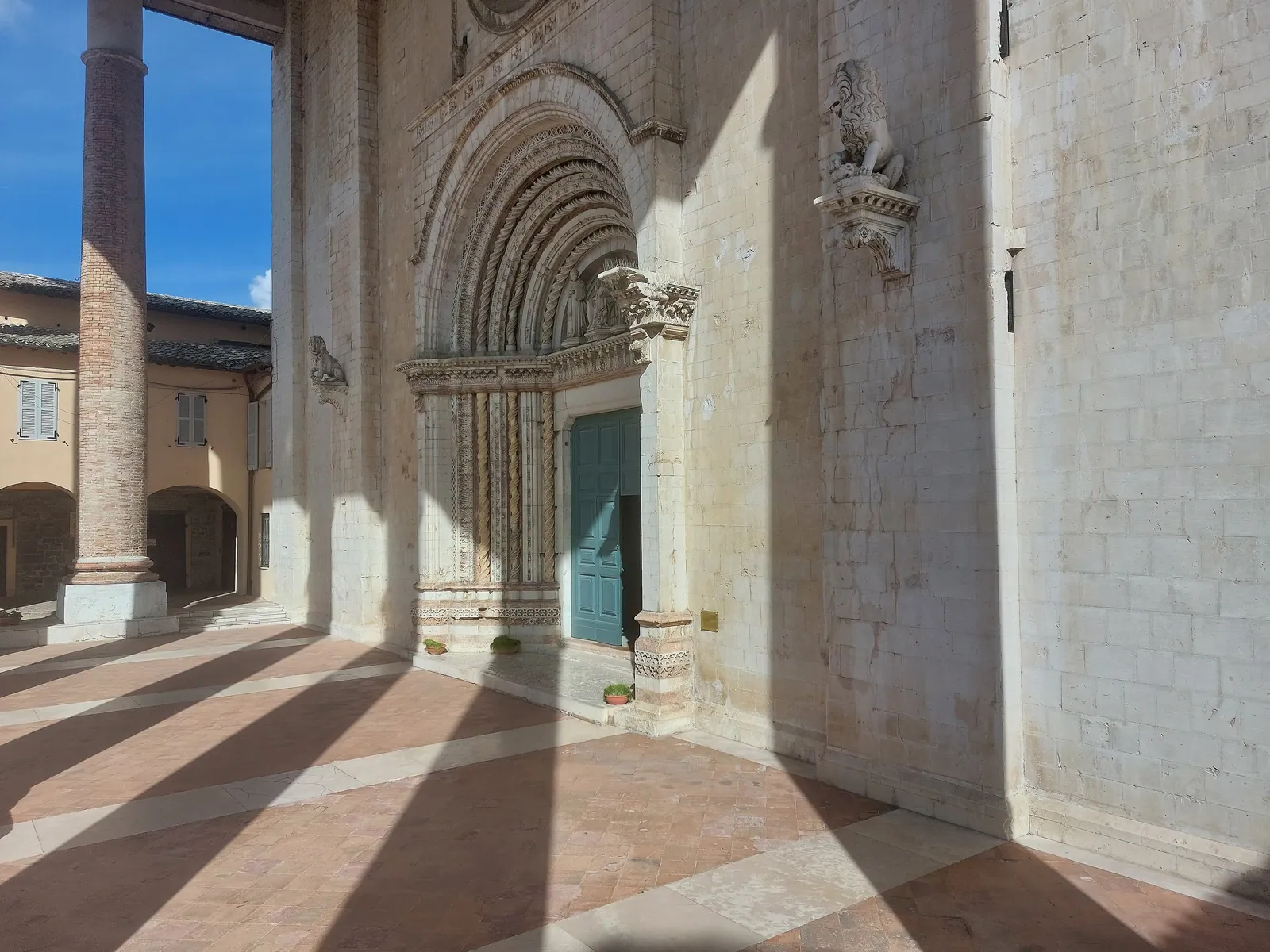
Basilica of San Venanzio (Camerino)
- Type
- Church
- Municipality
- CamerinoCamerino (MC)
- Phone
- +39 0737 431401 (Comune)
Source: site database, © OpenStreetMap contributors (ODbL).
The Basilica of San Venanzio (Basilica di San Venanzio) in Camerino is the church dedicated to the town's patron saint, whose feast falls on 18 May. The interior is neoclassical, the result of the reconstruction after the 1799 earthquake. Still standing, however, are the medieval facade with its mid-14th-century portal and, in the crypt, the saint's tomb chest (arca). The 2016 earthquake made it unsafe for use: closed from August 24, 2016, it reopened on December 15, 2019.
On the map
Points from the site database. Map © OpenStreetMap contributors · Protomaps.
The history of the Basilica of San Venanzio
The church's origins date back to the late Roman period, around the 3rd century AD. The building stood outside the walls and was enclosed within the new circuit commissioned by Giovanni Varano in 1384. In the 15th century the reconstruction was led by Polidoro di Stefano da Perugia, with the Lombard master builders Alberto di Pietro and Baldassarre di Paolo.
In 1558, during work on the choir, the saint's relics were found. The medieval apse was demolished and the crypt enlarged to a design by Domenico Fontana. Between 1673 and 1677 Bernardino Bianchini built the hemispherical dome. After the 1799 earthquake the architect Luigi Poletti oversaw the consolidation and 19th-century rebuilding. In November 1950 Pope Pius XII raised the church to a minor basilica.
What to see at the Basilica of San Venanzio
In front of the medieval facade, set back by about ten meters, is the neoclassical pronaos with six columns. The portal has twisted columns alternating with polygonal pillars. In style it is akin to that of Orvieto Cathedral. The sculptures of the lunette recall the art of Andrea Pisano and his son Nino.
Inside are the silver statue of the saint, the work of the silversmith Tommaso Politi, the altarpiece by Turchi, the sacristies and the museum. The crypt holds the 13th-century silver urn and the saint's 14th-century tomb chest.
How to visit the Basilica of San Venanzio
The basilica is a place of worship and a parish seat. After the closure that followed the earthquake, it reopened for worship. The restoration, funded by the Fondazione Arvedi Buschini of Cremona with 1.8 million euros, took eight months. It is best to check opening hours and services before visiting. The box on this page gives the practical details.
Where the Basilica of San Venanzio is located
The basilica is in Camerino, in the province of Macerata. The town stands at 661 m above sea level, on a hill between the Chienti and Potenza valleys, with the Sibillini Mountains to the south. The church is on the northeast edge of the historic center.
Around the Basilica of San Venanzio
In Camerino you can visit the Palazzo Arcivescovile (archbishop's palace), which houses the Museo Diocesano. The former convent of San Domenico is home to the Pinacoteca civica (civic art gallery) and the Museo civico (civic museum). Among the monuments are the Ducal Palace and the Rocca Borgesca, a fortress built by Cesare Borgia in 1503. Outside the town, at Renacavata, stands the Capuchin convent, considered the cradle of the order. Other churches in the area are on the page on the churches of the Sibillini Mountains.
Frequently asked questions
When did the basilica reopen after the earthquake?
What is kept in the basilica's crypt?
Who was San Venanzio and when is his feast day?
Was the basilica rebuilt after the 1799 earthquake?
Nearby
What to see nearby
- 300 m
- Porta Boncompagni in CamerinoCity walls and gates400 m
- Civic and Diocesan Museums (Camerino)Museum or art gallery500 m
Where to stay
- 300 m
- Foresteria Unicam in CamerinoB&B or guesthouse300 m
- 600 m
Where to eat
- Bar Micarelli Giorgio in CamerinoBar and café200 m
- Free Masons Tavern 1970 in CamerinoBar and café200 m
- Bar Rosa Blu in CamerinoBar and café200 m
Straight-line distances.