


Ducal Palace (Camerino)
Ducal Palace (Camerino)
- Type
- Museum or art gallery
- Municipality
- Camerino (MC)
Source: site database, © OpenStreetMap contributors (ODbL).
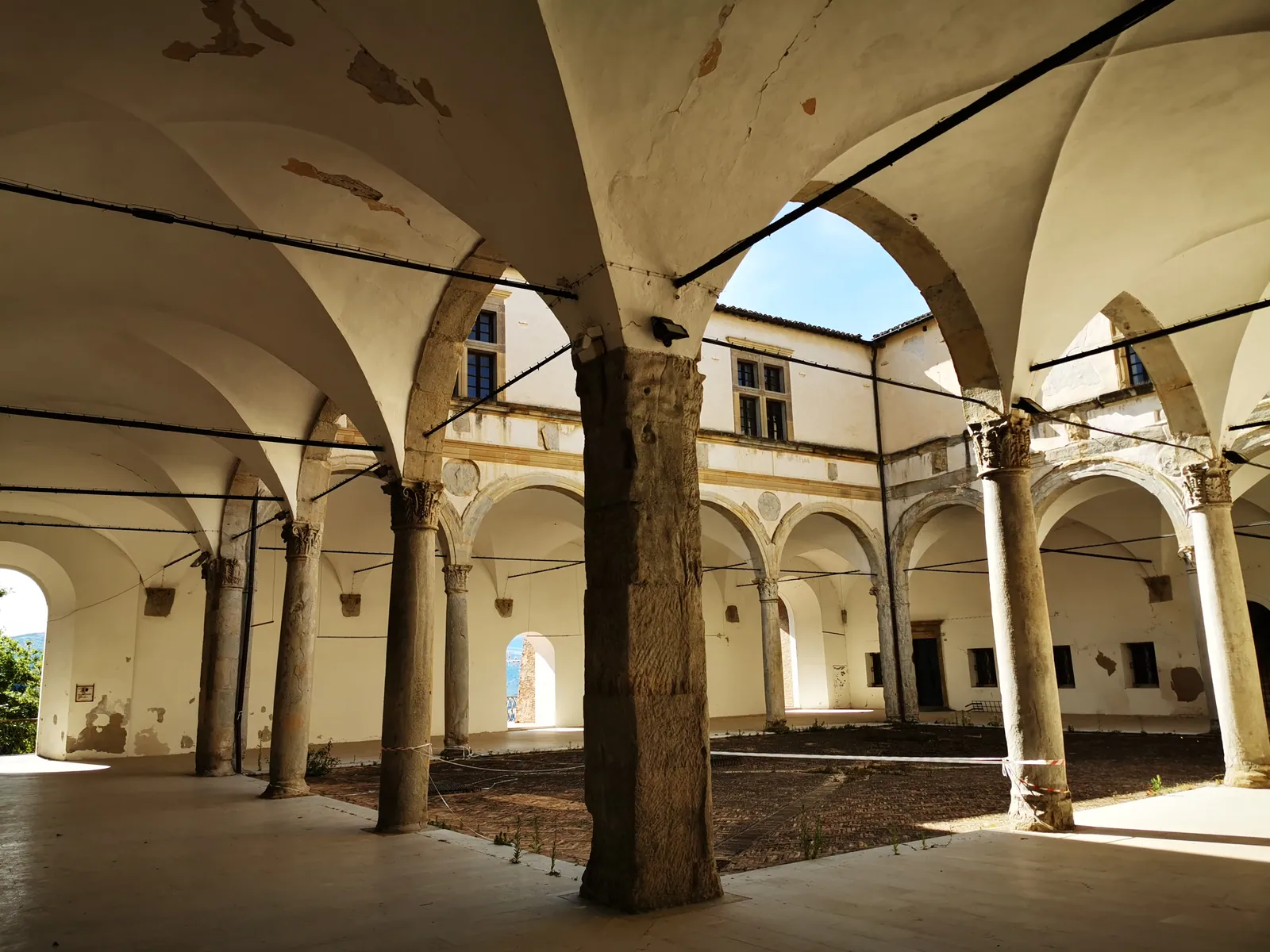
The Ducal Palace (Palazzo Ducale) in Camerino is a Renaissance monument, once the residence of the lords and dukes of Camerino and now home to the Università degli Studi (the university). Since the 2016 earthquake the building has been unsafe and cannot be visited. Around the four-sided portico courtyard are rooms with 15th-century frescoes, and a balcony on the walls offers a wide view of the Sibillini Mountains.
Before planning a stop in Camerino, keep in mind that almost the entire town center was seriously damaged by the earthquake. The palazzo nonetheless remains a key reference for understanding the history of the town and of the Da Varano dynasty.
On the map
Points from the site database. Map © OpenStreetMap contributors · Protomaps.
History of the Ducal Palace in Camerino
The building has an original section that was remodeled at the end of the 14th century. In the second half of the 15th century it was enlarged and completed in Renaissance style on commission from Giulio Cesare da Varano, lord of the town.
The last Da Varano to live there were Giulio Cesare with his wife Giovanna Malatesta, then Duke Giovanni Maria with Duchess Caterina Cybo and their daughter Giulia. With Giulia the dynasty died out.
Until 1997 the palazzo housed the Biblioteca Comunale Valentiniana, the town library founded by Sebastiano Valentini in 1802. It was important for a collection of about 60,000 volumes, 200 manuscripts and as many incunabula. After the earthquake the library's new home was set up near the San Paolo district.
What to see in the Ducal Palace
The heart of the building is the four-sided portico courtyard, perhaps the work of Baccio Pontelli, the great military architect. The rooms open around the courtyard. Among them, the Sala degli Sposi stands out, decorated with 15th-century frescoes.
In the basement are the Sala della Muta, used as a university lecture hall, and some rooms for exhibitions and conferences.
The balcony on the walls is a structure of masonry and wrought iron, built against the palazzo, overhanging the walls just above the botanical garden. It was built between 1913 and 1916, during work to reinforce the southeast façade, on the idea of engineer Giambattista Salvi, head of the town's technical office. It cost about 2,750 lire of the time, the equivalent of about seven thousand euros today. Because of the Great War, no inauguration ceremony was held. The balcony was closed after the 1997 earthquake and reopened on May 10, 2007. From there the view sweeps over the Sibillini Mountains and the countryside around Camerino.
Visiting the Ducal Palace
The Ducal Palace cannot currently be visited. Since the 2016 earthquake the building has been unsafe, and it remains closed while reconstruction work continues. In 2025 the procedure was launched to award the work for repairing the damage and seismically improving the palazzo, and in 2026 the work began.
Before traveling, it is best to find out about the status of the work and access to the historic center.
Where the Ducal Palace is located
The palazzo stands in Camerino, in the Marche region, in the historic center, on one side of Piazza Cavour. It faces the archbishop's palace. In the center of the square stands the statue of Pope Sixtus V.
The side facing the valley overlooks the walls. Just below the balcony lies the botanical garden.
Around the Ducal Palace in Camerino
The palazzo is part of an itinerary devoted to the Da Varano lordship. The same route includes the Varano Fortress, the Rocca Borgesca, the Rocca d'Ajello, the Filippo Marchetti Theater, the botanical garden, the Mulino Bottacchiari, the Capuchin church and convent at Renacavata and the Auditorium Benedetto XIII. Since the earthquake damaged much of the town, check in advance which of these places are accessible. Before visiting the University's Museo delle Scienze (science museum), check whether its exhibition venue is open.
For other cultural stops in town, see the page on the Civic and Diocesan Museums in Camerino. A broader overview is on the page about museums in the Sibillini Mountains.
For a spring visit, note that in the second half of May Camerino hosts the historical reenactment of the Corsa alla Spada e Palio. The event coincides with the feast of the patron saint, San Venanzio, on 18 May.
Frequently asked questions
Can the Ducal Palace in Camerino be visited?
Who built the Ducal Palace in Camerino?
What happened to the Biblioteca Valentiniana in Camerino?
When was the balcony on the walls of the Ducal Palace built?
Nearby
What to see nearby
- Diocesan Museum of CamerinoMuseum or art galleryunder 100 m
- under 100 m
- Filippo Marchetti Theater in CamerinoTheater or auditoriumunder 100 m
Where to stay
- 200 m
- Foresteria Unicam in CamerinoB&B or guesthouse300 m
- Affittacamere Leopardi 59, CamerinoGuesthouse400 m
Where to eat
- Noè Errante in CamerinoRestaurant100 m
- Forever Bar in CamerinoBar and café100 m
- Pizzero in CamerinoFast food and street food300 m
Straight-line distances.