


Church of Santi Pietro e Paolo (Smerillo)
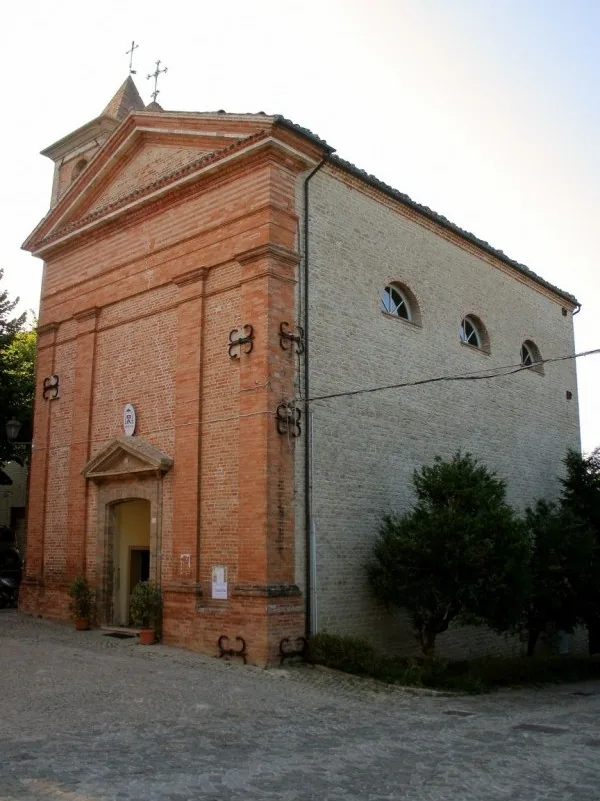
The Church of Santi Pietro e Paolo (Chiesa dei Santi Pietro e Paolo) in Smerillo is the village's parish church, in the historic center, and faces the square that bears its name. Dedicated to the patron saints of Smerillo, it reopened for worship on Saturday August 29, 2026, after the restoration and consolidation work made necessary by the 2016 earthquake. Smerillo stands at about 806 m above sea level, on a rocky spur halfway between the Sibillini Mountains and the Adriatic Sea.
Church of Santi Pietro e Paolo (Smerillo)
- Type
- Church
- Address
- Piazzale San PietroSmerillo (FM)
Source: site database, © OpenStreetMap contributors (ODbL).
On the map
Points from the site database. Map © OpenStreetMap contributors · Protomaps.
History of the Church of Santi Pietro e Paolo in Smerillo
The building is medieval in origin. A plaque records that the bell tower was built in 1474 at the expense of Giovanni Falcuzio. The church dates from the 15th century but does not keep its original form: it was entirely rebuilt in the 19th century after the roof collapsed.
The 2016 earthquake badly damaged it. In the village all the places of worship were unsafe, and the community held its services in the Sala degli Artisti, made available by the town hall. Work began in January 2025 and was completed on August 25, 2026.
What to see in the Church of Santi Pietro e Paolo
The facade is gabled and the interior has a single central nave. Inside is a wooden crucifix, an object of popular devotion.
The restoration covered the apse, sacristy, bell tower, roof and facade, as well as masonry, window and door frames, finishes and decoration. The bell tower was consolidated with a metal frame. The bell system has also been restored and now works.
How to visit the Church of Santi Pietro e Paolo
The church is open again and in use as a parish church, so a visit should be fitted around services. Times are best requested from the parish before the visit. For other places of worship in the area, the list is on the page on churches of the Sibillini Mountains. There are also other churches with the same dedication: the Church of Santi Pietro e Paolo (Arquata del Tronto) and the Church of Santi Pietro e Paolo (Pieve Torina).
Where the Church of Santi Pietro e Paolo is located
The church is in the historic center of Smerillo, a municipality in the province of Fermo, in the Marche region. The village has 329 inhabitants and is part of the Unione montana dei Sibillini (Sibillini mountain union). In ecclesiastical terms it belongs to the Archdiocese of Fermo, in the vicariate of Amandola.
Around the Church of Santi Pietro e Paolo in Smerillo
The village is called the "tetto delle Marche" (roof of the Marche) for its panoramic position, which takes in the Gran Sasso, the Sibillini Mountains, Monte Conero and the sea. Of the medieval castle, the ruins of the ring of walls, the north gate and the "cassero" (keep) remain.
Smerillo is home to the Museo delle scienze naturali (natural science museum), with a collection of fossils and a section on minerals. There are also the Museo Pinacoteca dell'Arte dei Bambini (children's art gallery) and the Pinacoteca d'Arte Contemporanea (contemporary art gallery). A short distance from the village is La Fessa, a cleft in the sandstone rich in Pliocene fossils.
Frequently asked questions
Has the Smerillo church reopened after the earthquake?
How old is the Church of Santi Pietro e Paolo in Smerillo?
What else is there to see in Smerillo besides the church?
At what altitude is Smerillo?
Nearby
What to see nearby
- The Museo dei Fossili and the Pinacoteca (Smerillo)Museum or art galleryunder 100 m
- Porta Nord in SmerilloCastle or fortressunder 100 m
- Medieval Fortress in SmerilloCastle or fortress100 m
Where to stay
- Agriturismo Amargi, SmerilloFarm stay1.1 km
- 1.1 km
- Villa Viola Country Home, SmerilloFarm stay1.3 km
Where to eat
- Le Logge, SmerilloRestaurantunder 100 m
- Bar Pizzeria Locanda Le Fate, SmerilloRestaurant100 m
- Fattoria Vallesi, SmerilloFarm shop1.0 km
Straight-line distances.