


Church of Sant'Agata (Arquata del Tronto)
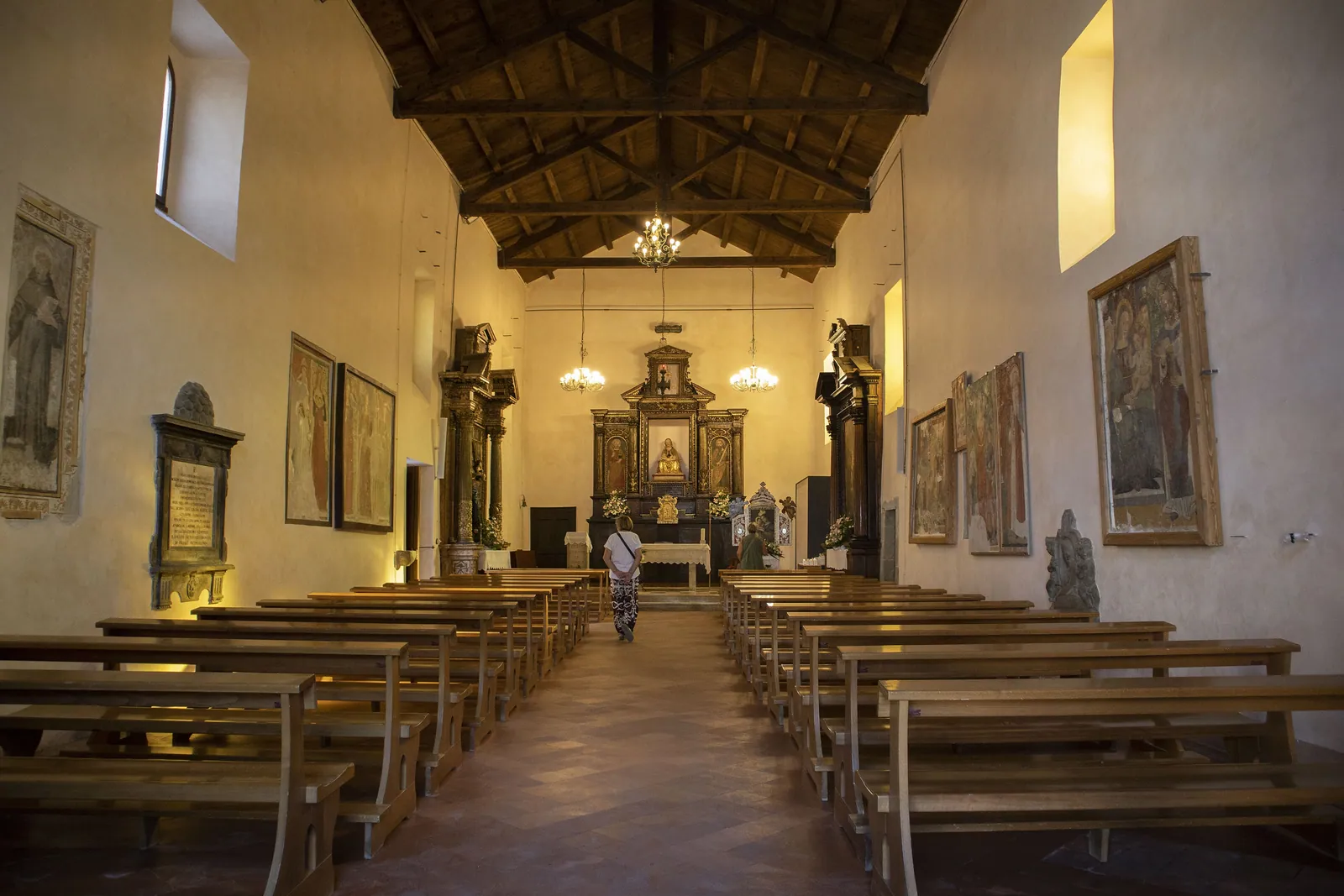
Church of Sant'Agata (Arquata del Tronto)
- Type
- Church
- Municipality
- SpelongaArquata del Tronto (AP)
Source: site database, © OpenStreetMap contributors (ODbL).
The Church of Sant'Agata (Chiesa di Sant'Agata) is the parish church of Spelonga, a hamlet of Arquata del Tronto, and it keeps the Turkish flag linked to the Battle of Lepanto of 1571. The church is dedicated to Saint Agatha, virgin and martyr, the patron saint of Spelonga, and it faces the village square. Unusable since the 2016 earthquake, it was restored with funds from the 8×1000 (the share of income tax that Italian taxpayers can assign to religious denominations). It reopened for worship in April 2025.
On the map
Points from the site database. Map © OpenStreetMap contributors · Protomaps.
History of the Church of Sant'Agata
The original building dates from the second half of the 15th century. Several alterations followed in the 16th and 17th centuries, as some inscriptions confirm. By 1576 the church was already a burial place for the people of Spelonga.
In 1933 the church of Santa Maria at Collepiccioni was demolished, and Sant'Agata took in many of its works of art.
After the earthquake, a project of consolidation and seismic upgrading covered the whole building, with specific work on the facade and the bell tower, the most damaged parts. Several interior features and frescoes were also recovered.
What to see in the Church of Sant'Agata
The interior is a long hall with exposed roof trusses. The best-known object is a battle flag bearing a Muslim emblem, seized from a Turkish ship in 1571 by men from Spelonga. People from Spelonga took part in that battle, serving aboard the papal galleys. The trophy is kept in a framed glass case.
The carved wooden high altar dates from 1631 and comes from the demolished church at Collepiccioni. Also from Collepiccioni are frescoes of the Umbrian school from the late 15th century. A seated Madonna in polychrome terracotta by Sebastiano Aquilano, from the 16th century, has been restored.
How to visit the Church of Sant'Agata
The church is back in use as a place of worship. Since it is a parish church, it is best to ask the parish whether it is possible to go inside, especially outside the times of services.
Every three years, in August, Spelonga celebrates the Festa Bella to commemorate the part its people played in the Battle of Lepanto. The hull of a Turkish ship is rebuilt in the middle of the square, and a copy of the flag is raised to the top of the mainmast.
Where the Church of Sant'Agata is
The church stands in Spelonga, a hamlet of the municipality of Arquata del Tronto, in the province of Ascoli Piceno. It is on the square, inside the village.
To reach Spelonga, leave the Salaria road at Trisungo and climb along the SP20. The road passes the hamlet of Faete and runs through a chestnut wood.
Around the Church of Sant'Agata
The center of Spelonga has many houses built in the 15th and 16th centuries. Many keep their stone walls, outside stairways and small loggias. Above the doors, the lintels carry inscriptions and bas-reliefs, often showing an angel in flight. The village stands on the height facing the Arquata Fortress, the fortress of Arquata del Tronto, and looks out over the main town.
In the same municipality is the Church of Santi Pietro e Paolo (Arquata del Tronto). Other places of worship in the area are on the page about the churches of the Sibillini Mountains.
Frequently asked questions
Is the Church of Sant'Agata in Spelonga open after the earthquake?
What is the Turkish flag of Sant'Agata?
How often is the Festa Bella of Spelonga held?
How do you get to Spelonga?
Nearby
What to see nearby
- 1.3 km
- 1.4 km
- 1.6 km
Where to stay
- Centro Polivalente Agorà, Arquata del TrontoSelf-catering accommodation2.2 km
- 2.2 km
- 2.2 km
Where to eat
- Bar Alimentari Marella, Arquata del TrontoBar and caféunder 100 m
- under 100 m
- Panzanella, Arquata del TrontoClimbing1.1 km
Straight-line distances.