


Arquata Fortress in Arquata del Tronto
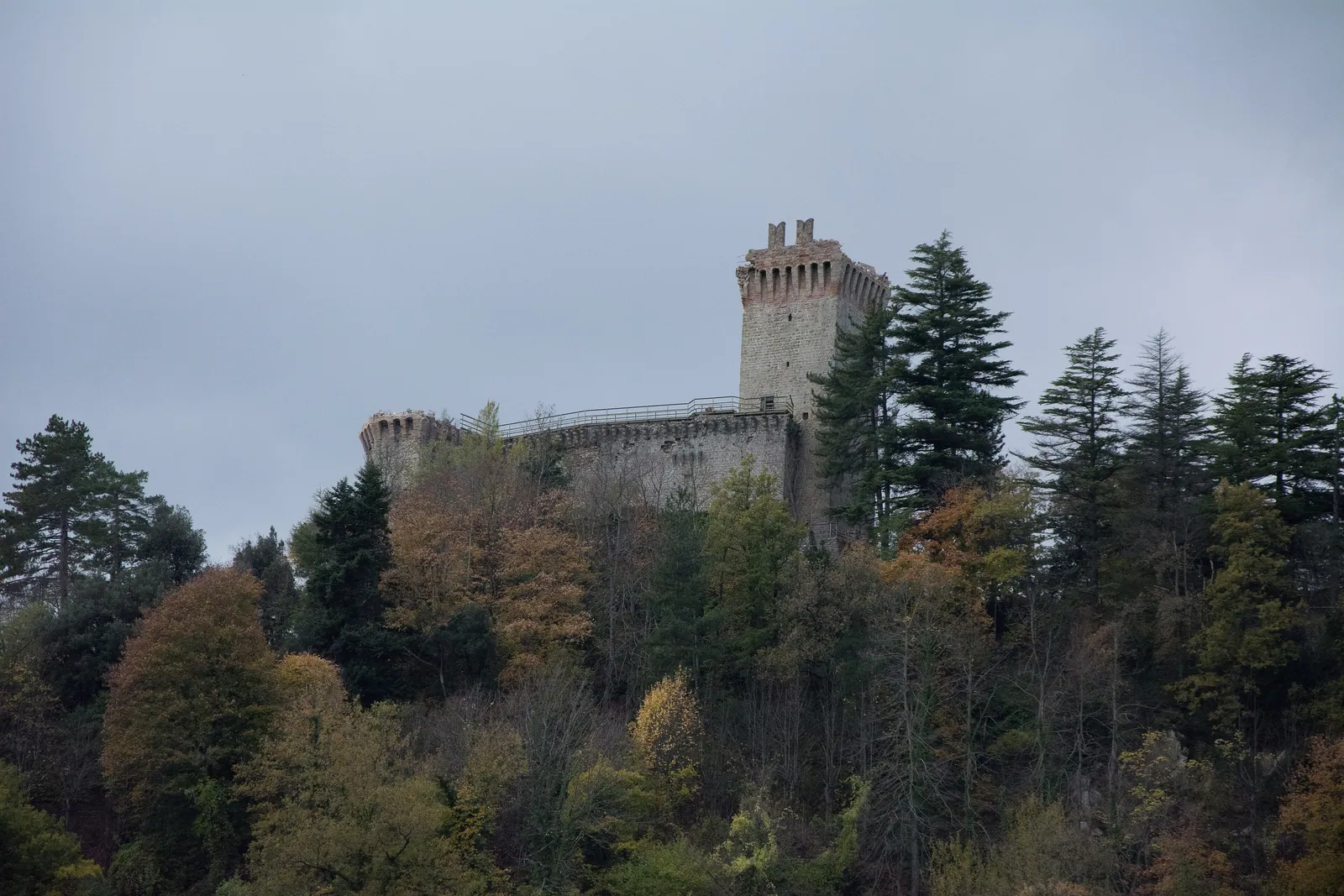
Arquata Fortress in Arquata del Tronto
- Type
- Castle or fortress
- Municipality
- Arquata del Tronto (AP)
Source: site database.
The Arquata Fortress (Rocca di Arquata) is a medieval fortress standing on the cliff north of the center of Arquata del Tronto, in the province of Ascoli Piceno. It cannot be visited today. The complex was damaged by the earthquakes of 2016-2017 and a final design for its restoration has been approved. Anyone planning a visit to Arquata can therefore see it only from a distance, as a dominant presence over the town and the valley.
It was built as a stronghold to control the territory, with defensive and tactical functions. It stands between the Tronto river and the Camartina stream, south of Monte Vettore, in an area close to the border between the Marche, Umbria, Lazio and Abruzzo. From above it watches over the Strada Consolare Salaria, the Via Salaria consular road. It has been listed as a National Monument since 1902 and is also known as the Castle of Queen Giovanna (Castello della Regina Giovanna).
On the map
Points from the site database. Map © OpenStreetMap contributors · Protomaps.
History of the Arquata Fortress
The first fortifications on the hill date from the 11th-12th century. In the 12th century Abbot Berardo III of Farfa bought the county and the Arquata Fortress, and Emperor Henry V confirmed the abbey's ownership. During the 13th century the town walls and the stronghold were built to defend the upper Tronto valley.
Arquata has always been a border land and for centuries was contested between Ascoli Piceno and Norcia. Norcia, which had been in confederation with Arquata since 1251, ceded it to Ascoli on August 7, 1255. In 1389 the podestà of Ascoli, Sinibaldo Cancellieri da Pistoia, had the structure reinforced. In the 15th century Norcia paid Lombard master builders for work on the fortress.
The fortress later underwent further damage and restoration. In 1564 it was restored with the authorization of the town of Norcia. An earthquake in 1703 damaged the structures. It remained state property until January 16, 1890, when it was handed over to the town of Arquata because of its poor condition. At the end of the 19th century, works rebuilt the tallest tower, the hexagonal tower and the curtain wall connecting them. In the 20th century, work by Giuseppe Sacconi added the square room at the top of the keep.
A legend surrounds the fortress. According to popular tradition, Queen Giovanna d'Angiò (Joan of Anjou) lived there between 1420 and 1435 and had the young shepherds she invited to her room, and then found unwelcome, hanged from the towers. It is not clear which queen named Giovanna this refers to.
What to see at the Arquata Fortress
The complex is built of blocks of local sandstone. The layout includes a circuit of walls, the square keep, a lookout tower and the remains of a third, circular tower, with a large inner courtyard. Of the circular tower, on the southwest side, the foundation walls remain.
The first element built on the hill was the hexagonal tower, about 12 meters high, at the southeast corner. Along the top of the towers runs a projecting band of brick and travertine, finished with swallowtail battlements. A multipurpose hall has been created within the walls.
How to visit the Arquata Fortress
The fortress is currently not open to the public. After the earthquake damage, the complex needs consolidation work. In October 2025 the Conference of Services on the restoration concluded with a positive outcome. In July 2026 the final design was given the go-ahead, with total funding of 5.4 million euros.
The project includes seismic upgrading and conservative restoration. It also covers the removal of architectural barriers and the recovery of the access paths and the surrounding landscape. The mayor has stated that the reconstruction will keep the medieval layout so that the fortress can be visited again. Before planning a visit, check with the town about the state of the works and access restrictions.
Where the Arquata Fortress is located
The Arquata Fortress is in Arquata del Tronto, in the area north of the town center, above the town and the Via Salaria. From here the view sweeps over the upper Tronto valley, the river that separates the Sibillini from the Monti della Laga.
Around the Arquata Fortress
The fortress was part of a wider defensive system, with lookout towers spread along the roads leading to it. The best known was the Torre civica of Arquata, the closest to the direct defense of the fortress, which collapsed in the earthquake of October 30, 2016.
Other towers stood at Borgo, Camartina, Faete, Pescara del Tronto, Piedilama, Pretare, Spelonga and Trisungo. At Trisungo there was a customs tower watching over the Salaria. At the site of Santa Gemma, above Pretare, are the ruins of a tower with a customs post, still active in September 1809. Other fortifications in the area are gathered on the page castles and fortresses of the Sibillini.
Frequently asked questions
Can you go inside the Arquata Fortress today?
Why is the Arquata Fortress called the Castle of Queen Giovanna?
When was the Arquata Fortress built?
What did the Arquata Fortress control?
Nearby
What to see nearby
- 100 m
- Ruins of the House of Count Gallo (Arquata del Tronto)Ruins or archaeological site200 m
- 200 m
Where to stay
- Centro Polivalente Agorà, Arquata del TrontoSelf-catering accommodation300 m
- 600 m
- 1.6 km
Where to eat
- Bar Ciccio, Arquata del TrontoBar and café200 m
- Star Tours Incoming, Arquata del TrontoBike rental200 m
- Terre In Seme, Arquata del TrontoDelicatessen200 m
Straight-line distances.