


Sanctuary of Macereto (Visso)
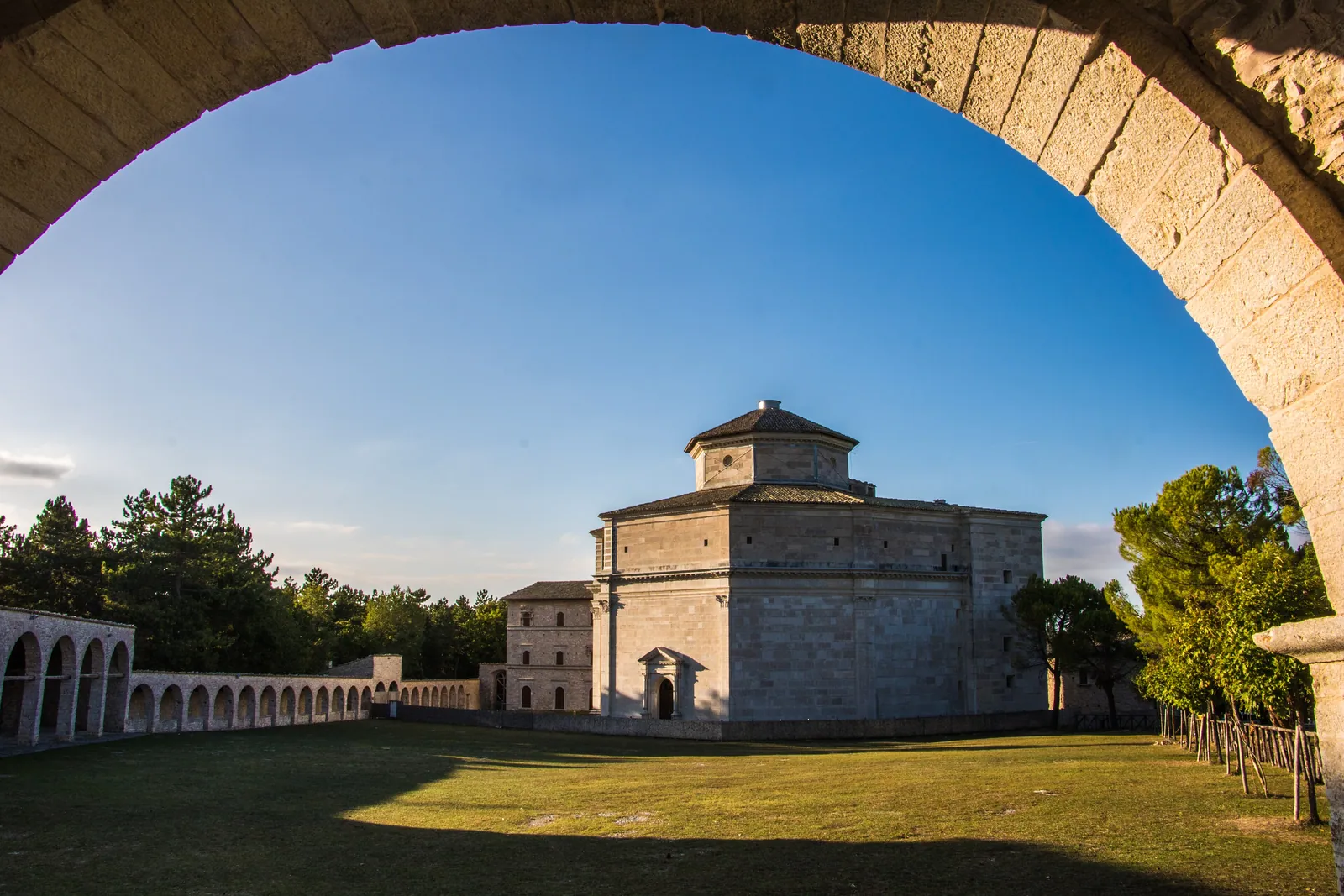
Sanctuary of Macereto (Visso)
- Type
- Sanctuary or hermitage
- Municipality
- Visso (MC)
Source: site database, © OpenStreetMap contributors (ODbL).
The Sanctuary of Macereto (Santuario di Macereto) in Visso (province of Macerata) is a Renaissance religious complex standing at about 1,000 m above sea level on the plateau of the same name, on the western side of the Sibillini Mountains. It has been a national monument since 1902 and is considered one of the finest expressions of 16th-century Renaissance architecture in the Marche region. It is surrounded by a planted pine wood and meadows.
After the 2016 earthquake, access to the interior of the church has been restricted: it is best to check before visiting.
On the map
Points from the site database. Map © OpenStreetMap contributors · Protomaps.
The history of the Sanctuary of Macereto
Tradition dates the origin of the site to August 12, 1359. That day a caravan was carrying a wooden statue of the Madonna and Child from Ancona to the Kingdom of Naples. The mules stopped on the plateau, knelt down and refused to go any further. The local people who rushed to the scene saw it as a divine sign and wanted the statue to stay there. Pilgrimages grew, and a small church dedicated to the Madonna was built, similar in form to the Porziuncola in Assisi. The ancient pilgrim route from the Kingdom of Naples to Loreto crossed the plateau.
In the second half of the 15th century the original statue was replaced by another one, now kept in the Museo civico diocesano in Visso. It is attributed to the Master of the Madonna di Macereto, more recently identified as Lucantonio di Giovanni Barberetti da Camerino.
In 1527 the Università (community) of Visso decided to build a new sanctuary around the original shrine. Work began in 1529 to a design by Giovan Battista da Lugano, who adapted a 1505 drawing attributed to Bramante. After Giovan Battista da Lugano died in 1539, work resumed in 1553 under the direction of Filippo Salvi da Bissone and was completed in 1556. The roof and bell tower date from 1564, while the three portals bear the dates 1563 and 1565.
The sanctuary is part of a larger complex that also includes the Casa dei Pellegrini (pilgrims' house), the Casa del Corpo di Guardia (guardhouse) and the Palazzo delle Guaite.
What to see at the Sanctuary of Macereto
The church has an octagonal plan, with three entrances decorated in the 1560s by sculptors who remain anonymous. Each of the four flat sides of the interior opens into an apse.
At the center stands a small temple built between 1580 and 1590 on the model of the Santa Casa of Loreto. The story of the Macereto miracle is carved on it in Latin, and it holds the old 14th-century shrine.
The presbytery has frescoes and stuccoes made between 1580 and 1582 by Simone De Magistris, commissioned by the Community of Visso. They were restored between 1990 and 1991. The upper part shows Stories from the Life of the Virgin. Below, three large frescoes illustrate the life of Jesus: the Nativity on the left, the Adoration of the Magi on the right and, as the altarpiece, the Deposition. The latter recalls the altarpiece painted by Barocci in 1569 for Perugia Cathedral.
If the interior is not accessible, there is still the exterior of the complex to see, along with the pine wood and the surrounding meadows.
How to visit the Sanctuary of Macereto
For a long time the park and the pine wood have been open all year round. The interior, on the other hand, could be visited only on certain occasions, mainly in summer and on feast days. Before setting out, check access conditions and opening times, as they may have changed.
If you prefer to walk, you can start from Visso on trail E7 of the Sibillini National Park. The route, of hiking difficulty (E), is just under 8 km one way, with an elevation gain of about 500 m. It alternates wooded stretches and viewpoints and follows the old pilgrim path to Loreto (cammino lauretano).
Where the Sanctuary of Macereto is located
The sanctuary is on the Macereto plateau, in the locality of Cupi, in the municipality of Visso. It is in an isolated area, reached by a few kilometers of mountain roads. There are hairpin bends, but the stretch is not considered difficult. Keep your speed down: the road is narrow and wildlife may be encountered.
From the A14 highway, take the Civitanova Marche exit and follow the former SS 77 toward Foligno. At Polverina turn off for Fiastra, then follow the signs for Visso and Cupi. From the Civitanova tollbooth the drive takes about an hour. From Camerino, head toward Muccia and Pievebovigliana. At Fiordimonte turn left for the sanctuary. From the Valnerina, once in Visso, take the road toward Macerata and, before the Le Fornaci tunnel, turn right. At the Fornaci pass turn right again for Macereto.
Around the Sanctuary of Macereto
For those arriving from Civitanova, Lago di Fiastra is a natural stop along the way. At Trebbio di Fiastra stand the remains of a castle of the Counts of Fiastra.
The plateau offers a good view of the Monte Bove Nord massif. For other places of worship in the area, see the page on the sanctuaries and hermitages of the Sibillini.
Frequently asked questions
Can you go inside the Sanctuary of Macereto?
Can you walk to the Sanctuary of Macereto from Visso?
How long does it take to drive to the Sanctuary of Macereto?
Why was the Sanctuary of Macereto built in that spot?
Nearby
What to see nearby
- 2.4 km
- 3.0 km
- 3.6 km
Where to stay
- Rifugio San Benedetto, UssitaBivouac or unstaffed hut2.1 km
- Rifugio escursionistico di Cupi, VissoMountain hut2.4 km
- 3.7 km
Where to eat
- Azienda Agricola Coppacchioli Tattini, VissoWine shop and winery2.3 km
- 3.0 km
- Ristorante Crystal, UssitaRestaurant3.8 km
Straight-line distances.