


San Ginesio: what to see and do
At a glance
- Municipality
- San Ginesio
- Province
- Macerata
- Region
- Le Marche
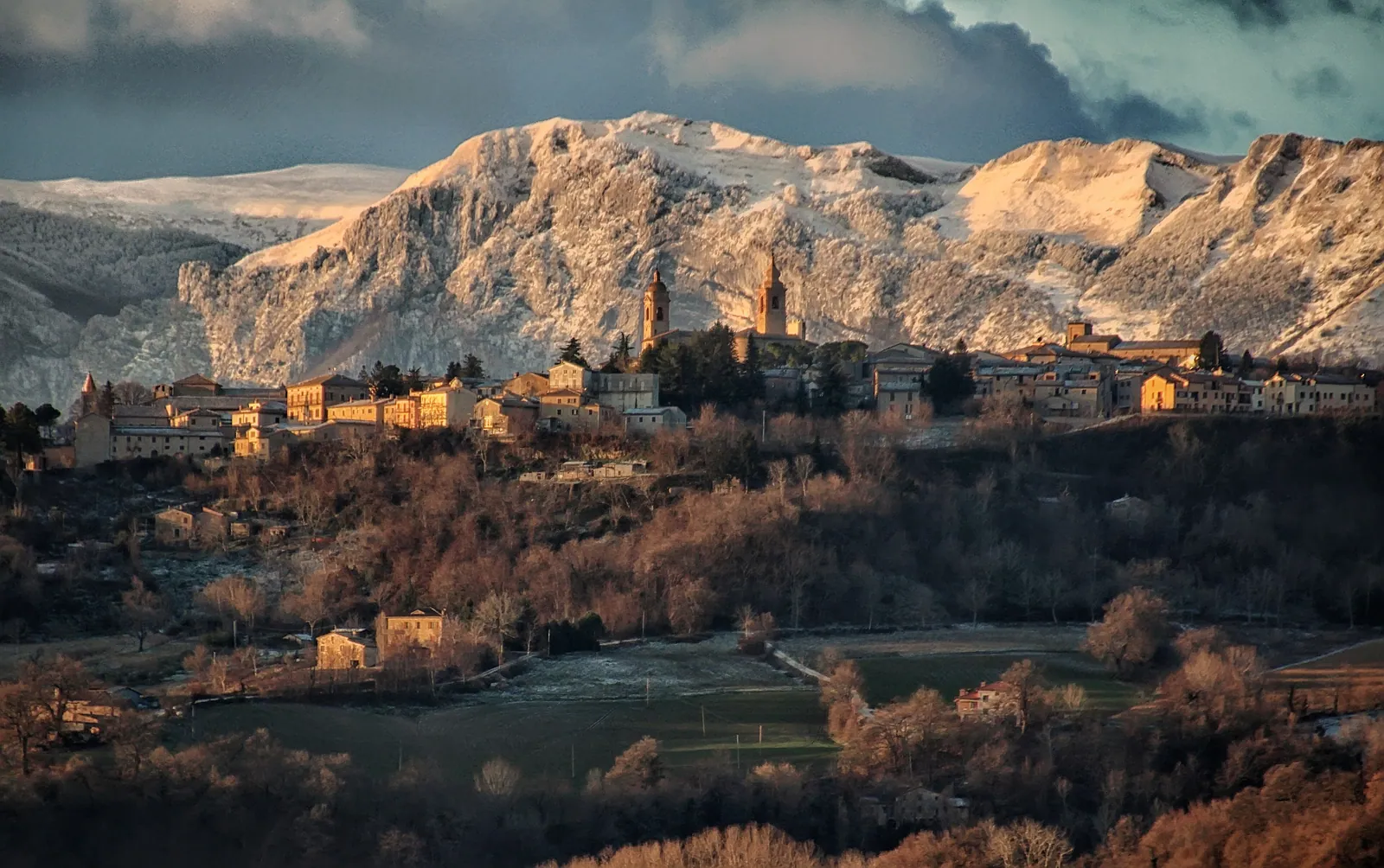
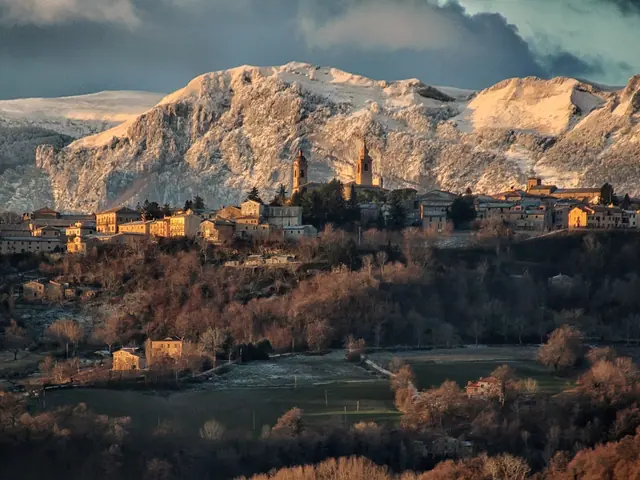
San Ginesio is a medieval village in the province of Macerata, in the Marche region, inside the Sibillini National Park (Monti Sibillini), at about 690 meters above sea level. It is called "the balcony of the Sibillini" because the whole range can be seen from its hill, from Monte Vettore to Pizzo Tre Vescovi. The view reaches as far as Monte San Vicino, the Conero, the Adriatic Sea and the Gran Sasso. The historic center has a cross-shaped plan and is enclosed by 14th-century walls. Along the walls you can still make out the sentry walk, the arrow slits and the towers. San Ginesio belongs to the Borghi più belli d'Italia (Most Beautiful Villages in Italy) and holds the Orange Flag of the Touring Club Italiano.
The name first appears in 995 as "castrum Sancti Genesij". The patron saint is San Ginesio (St. Genesius), the Roman mime martyred under Diocletian in 303 who became the protector of theater people. This link lives on in the Ginesio Fest, the contemporary theater festival held at the end of August. The village is also called "the town of 100 churches", but it bears the scars of the 2016-2017 earthquake, which caused very serious damage. Some of the main monuments, starting with the Collegiata, are still closed or under restoration.
On the map
Points from the site database. Map © OpenStreetMap contributors · Protomaps.
What to see in San Ginesio
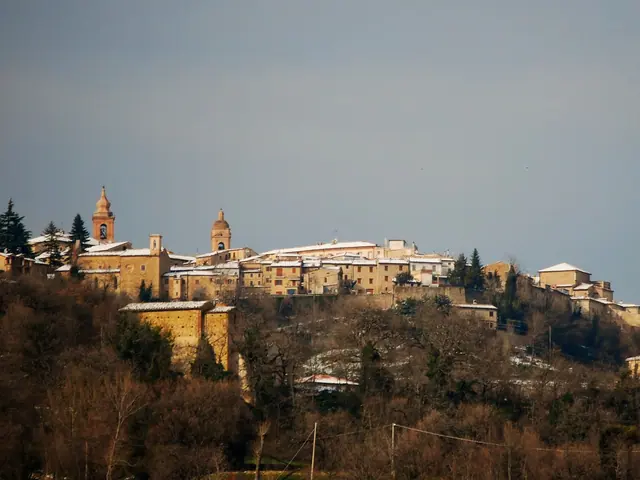
The main things to see in San Ginesio are the medieval walls, Porta Picena, the Ospedale dei Pellegrini and Piazza Alberico Gentili with the Collegiata, now closed for restoration. A visit usually starts from Porta Picena, on the east side of the village, where a large square allows parking. Before entering you come to the Parco della Rimembranza, a shady green area dedicated to the fallen of the two world wars.
Porta Picena dates from the 14th century and is one of the four surviving gates of the original eight. The walls of San Ginesio were begun in 1308 and completed about 150 years later. Towers and bastions punctuate their course.
Just past the gate, on the right, is the Ospedale dei Pellegrini, also called the Ospedale di San Paolo. It is a Romanesque building from 1295, with a portico of stone arches and a 15th-century loggia. It was not a hospital in the modern sense: it offered rest to pilgrims heading to Rome or Loreto. Climbing toward the center you pass the church of Sant'Agostino, rebuilt in 1756 and now used as an auditorium. The cloister of the former convent houses high schools and, at the end of August, some Ginesio Fest events.
Piazza Alberico Gentili is the village's main square. Facing it are the Teatro Giacomo Leopardi, a historic theater inaugurated on August 18, 1877 and unusable since the 2016-2017 earthquake, the Torre Civica (civic tower), joined to the church, and the Collegiata di Santa Maria Assunta, also called the Collegiata della Santissima Annunziata. Built in 1090, the Collegiata combines Romanesque and Gothic elements. It is considered the only example in the Marche of a church in the florid Gothic style. Inside it holds:
- the relics of San Ginesio;
- the crypt with a fresco cycle by Lorenzo Salimbeni from 1406;
- the Oratorio di San Biagio;
- the Cappella del Perdono, decorated by Adolfo De Carolis.
The Collegiata of San Ginesio has been closed since the 2016 earthquake. Restoration with seismic strengthening is under way, funded with more than €7 million. In summer 2026 it opened only for special visits, with small groups guided across the scaffolding of the building site.
The Museo e pinacoteca Scipione Gentili (museum and art gallery) has also been unusable since the earthquake. It is housed in the former church of San Sebastiano, near the apse of the Collegiata. The collection includes paintings from the 15th to the 18th century, among them a Pietà by Simone De Magistris from 1584 and panels by Stefano Folchetti and Vincenzo Pagani. There are also Picene finds, Roman inscriptions and objects from the tomb of a Celtic prince found in San Ginesio. After the earthquake, some of the works were displayed in the Auditorium Sant'Agostino. Work on the historic building is planned.
For the view over the Sibillini, the best spot is the Colle Ascarano park, where the view opens from the Gran Sasso to the Conero. From the village you can also see the nearby towns, such as Ripe San Ginesio, Gualdo, Sant'Angelo in Pontano and Penna San Giovanni. Ripe San Ginesio is a small hill village with narrow spiraling streets and stairways: it is easy to reach as an extra visit.
In August the Palio brings the four districts to life with costume parades and the Giostra dell'anello (ring joust). The program also includes a reenactment of the battle of the Fornarina, fought on November 30, 1377 in the long rivalry with Fermo. At the end of August comes the Ginesio Fest, with shows, national premieres and workshops: the 2026 edition ran from August 25 to 30. The full list of monuments is on the page things to do in San Ginesio. Other towns in the area are gathered on the page about the villages of the Sibillini Mountains.
Nature and trails near San Ginesio
Near San Ginesio the easiest and most popular hike is the Sentiero Natura di San Ginesio (San Ginesio Nature Trail), which the Sibillini National Park calls "Il faggio signore dei boschi" (The beech, lord of the woods). The municipality is very varied: it runs from lowland to mountain and reaches a maximum of 1,294 meters. The Fiastra river rises here, while the Fiastrone flows near the hamlets of Morico, Morichelli and Pian di Pieca.
The Nature Trail starts from the hamlet of San Liberato, near the sanctuary of the same name. It is a loop of about 2 km, of tourist difficulty (T), taking an hour or an hour and a half depending on pace. It is walked clockwise. After a short paved stretch, a dirt track climbs to a grassy plateau, full of flowers in spring, with benches and tables at the edge of the beech wood. The route is well marked and suitable for families. In the San Liberato area the woods are mostly beech and oak. The loop can be done in winter too, with clothing and footwear suited to the season.
The convent of San Liberato was founded in 1274 by the lords of Brunforte, at the foot of Monteragnolo. During World War II, Father Sigismondo Damiani was killed there. Recently the hermitage was being renovated in many parts, but it was accessible. It is a stage of the Cammino Francescano della Marca. The Anello di San Liberato also starts here, an easy half-day mountain bike route, currently affected by ongoing works. Before setting out, check the condition of the route and the weather.
Where to stay in San Ginesio
The municipality of San Ginesio has several places to stay, also useful as a base for exploring the Macerata side of the Sibillini. For the weeks of August, with the Palio and the Ginesio Fest, it is best to plan ahead. The full list of accommodation is on the page where to stay in San Ginesio.
Where to eat in San Ginesio
At the table, San Ginesio's signature dish is Polentone. It is usually accompanied by a glass of San Ginesio DOC, the local red wine. The municipality has various restaurants and eateries. The list is on the page San Ginesio restaurants.
Local products of San Ginesio
The local products of San Ginesio are Polentone, San Ginesio DOC wine and ciauscolo, a soft spreadable salami. Polentone is made with cornmeal from a local variety of corn. It is served with meat sauce or "in bianco" (without tomato), with sausage, pork ribs and mushrooms, and with pecorino.
San Ginesio DOC is a red wine, still or sparkling, made from Vernaccia Nera, a native grape of the middle and upper Macerata hills. Ciauscolo rounds out the flavors of the area. Shops and producers are gathered on the page San Ginesio local products and shops.
Weather in San Ginesio and how to get there
San Ginesio has pleasant, breezy summers and fairly harsh, snowy winters. Spring and fall are mild and rainy. The average temperature is about 5-6 °C in January and about 23-24 °C in July. The municipality has a weather station at Pian di Pieca, at 468 meters above sea level. Between 1979 and 2021 the local average temperature rose by about 2 °C. The village can be visited all year round. For the Park's trails the best season runs from spring to fall.
San Ginesio is about 60 km from Ancona and 25 km from Macerata. By car, coming from the north or south, leave the A14 highway at the Civitanova Marche exit. Then take the SS77 to the Macerata Ovest-Sforzacosta exit and continue on road 78, the Via Picena, to Passo San Ginesio, from where you climb up to the village. Parking is easy in the square in front of Porta Picena. By public transportation, the nearest train station is Tolentino. From there a bus goes to San Ginesio, stopping at Porta Picena.
In this section
4 results
 Things to do in San Ginesio8 places
 Where to Stay in San Ginesio19 places to stay
 San Ginesio Restaurants9 places
 San Ginesio Local Products and Shops8 places
No results with these filters.