


Things to Do in Smerillo
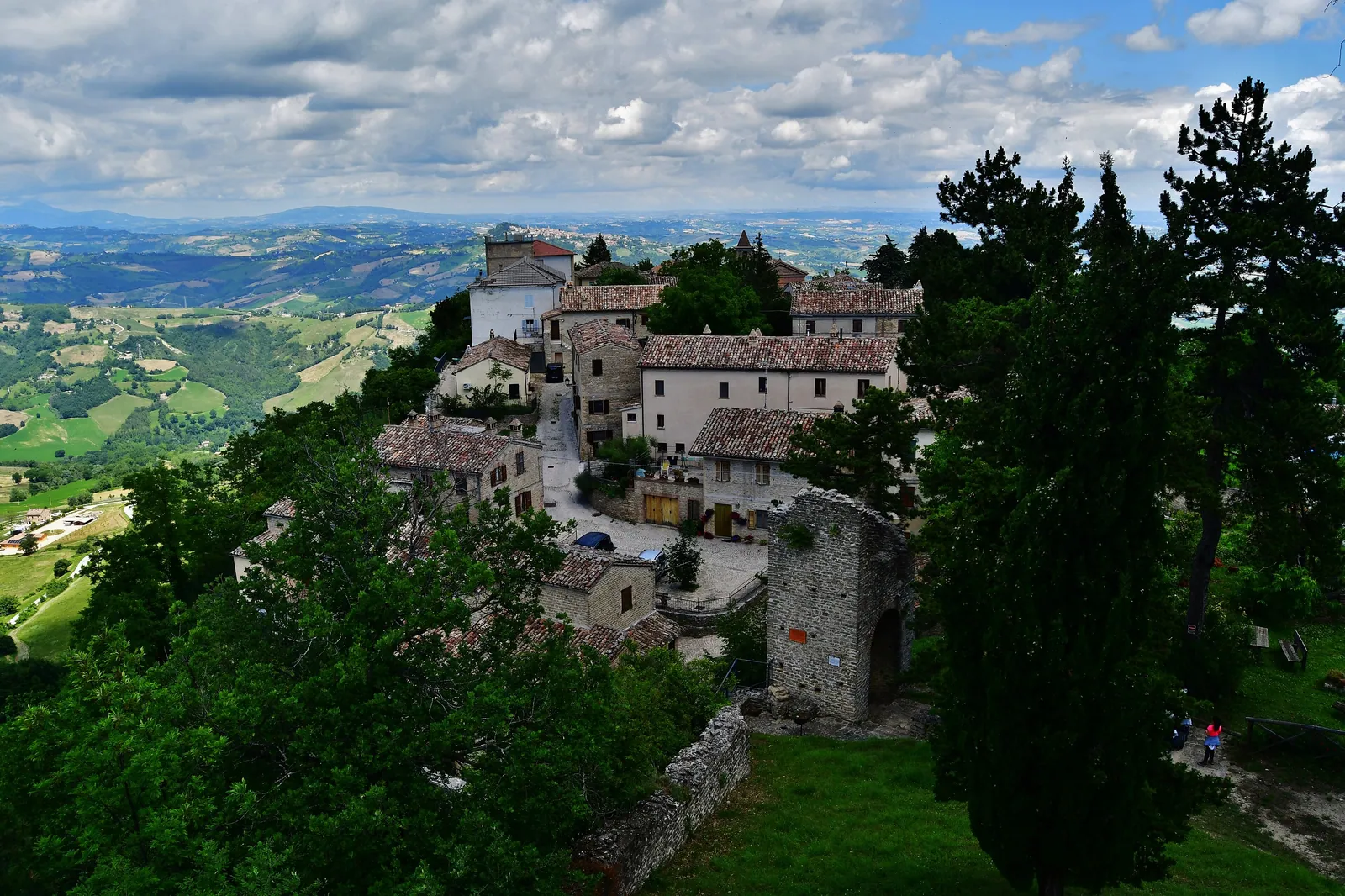
Things to do in Smerillo start with the village itself: a hill town in the province of Fermo, at 806 m above sea level. Its stone houses line the edge of a rocky ridge that drops sharply above the valley of the Tenna River. The sights include the remains of the Castrum Smerilli with the Porta Nord gate, two churches, the Fessa (a cleft in the rock with fossils) and three small museums. The panorama is an attraction in its own right.
From here the view stretches from the Gran Sasso to the Conero, from the Sibillini to the Adriatic Sea. The name comes from the merlin (falco smeriglio), a small falcon that also appears on the town's coat of arms. The village is also known as the Tetto delle Marche ("Roof of the Marche") and the Cittadella della poesia ("Citadel of Poetry"). In the Middle Ages it was a castle as important as Fermo.
The places
5 results
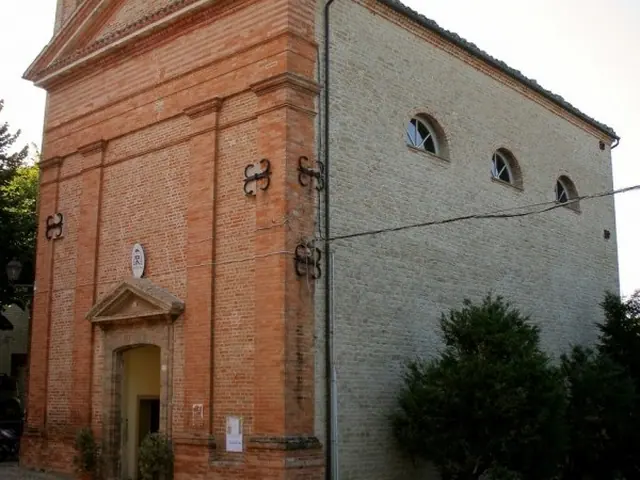 Church of Santi Pietro e Paolo (Smerillo)Church · Smerillo
- Museum or art galleryThe Museo dei Fossili and the Pinacoteca (Smerillo)Museum or art gallery · Smerillo
- Castle or fortressPorta Nord in SmerilloCastle or fortress · Smerillo
- Castle or fortressMedieval Fortress in SmerilloCastle or fortress · Smerillo
- Castle or fortressWatchtowerCastle or fortress · Smerillo
No results with these filters.
On the map
Points from the site database. Map © OpenStreetMap contributors · Protomaps.
Things to Do in Smerillo: The Map
The town is visited on two levels. The Castrum Smerilli stood on the highest part of the hill; a few stretches of wall and a restored keep (cassero) remain. The village proper lies right next to it, lower down. Arriving on the provincial road that climbs from Montefalcone, the walls come into view even before the first houses.
At the entrance to the town, in a small square, stands the parish church of Santi Pietro e Paolo. The museums are all housed in a single building. The Fessa is outside the town: a short detour, marked by a wooden sign, leads to the cleft in the mountain.
The municipality also includes several hamlets. Durano is the closest to the town and the access point to the Fosso delle Anguille, a stream where small pools and little waterfalls form natural scenery. To the south lies Ceresola, gathered around the church of San Nicola, dating from 1627.
Things to Do in Smerillo: The Sights Not to Miss
Rocca Medievale and walls. Only remains survive of the castle walls and the medieval fortress that made up the Castrum Smerilli. According to one historical reconstruction, the fortress began as a watchtower built by the monks of Farfa. The Medieval Fortress in Smerillo offers a wide view over the Fermo hills. The fortress tower has been rebuilt as a metal structure: the original is gone, and inside there is a drinking-water tank. The metal has a copper-like color to recall that of the old fortress.
Porta Nord. The Porta Nord (North Gate) is very well preserved and restored, and it is a viewpoint over the panorama. The history of the gate is on the page about the Porta Nord of Smerillo. Lower down, along the street, there is a watchtower: through its large arch a few minutes' walk leads from the castle down to the village. More details are on the page about the Smerillo watchtower.
Chiesa dei Santi Pietro e Paolo. The church has reopened after the restoration, repair and structural consolidation work that followed the 2016 earthquake. The work covered the apse, sacristy, bell tower, roof and facade. Inside, the light colors, the unexpected spaciousness and the pleasant natural amplification of voices and choirs stand out. Local guides point out a wooden crucifix there, an object of popular devotion. Details are on the page about the Church of Santi Pietro e Paolo in Smerillo.
Chiesa di Santa Caterina. A Romanesque church known for its plain simplicity. Inside there are frescoes.
La Fessa. A cleft so narrow that only one person at a time can pass through, it shows layers of sandstone and sandy conglomerates. The fossils found in Smerillo are remains of shells and crustaceans: they prove that those rocks formed under the sea.
Museums. The Museo dei Fossili e dei Minerali (fossil and mineral museum) has two sections and four rooms. One room is devoted to minerals and rocks, the others to local fossils from the lower Pliocene and to fossils from other parts of Italy. The Pinacoteca d'Arte Contemporanea holds works donated by contemporary artists. The Museo Pinacoteca dell'Arte dei Bambini, a children's art museum, is dedicated to the theme "The Child and Peace" and has run educational activities since 1999.
Surroundings. In the hamlet of Val di Tenna there is a water mill from the 1700s on the Tenna River. The Bosco di Smerillo, an environmental education center, was established in 1987 by the Ministry of the Environment.
Things to Do in Smerillo: Tips for Your Visit
Smerillo can be visited in any month of the year; summer is a good time for the light that shows the village at its best. Before setting out, it is worth checking the opening times of the museums and churches.
The center is small, so it is easily explored on foot. The walls, the keep and the Porta Nord are at the top. The village and the square of the parish church are lower down. The Fessa requires a detour from the town. Smerillo is in the province of Fermo. For a longer stay, see the page on where to stay in Smerillo.