


Smerillo: what to see and what to do
At a glance
- Municipality
- Smerillo
- Province
- Fermo
- Region
- Le Marche
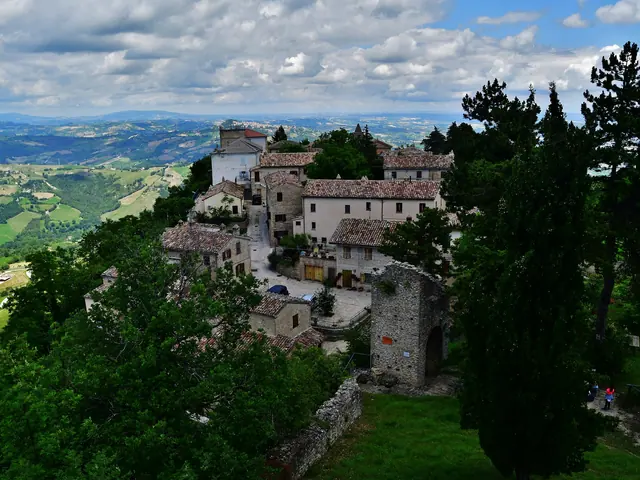
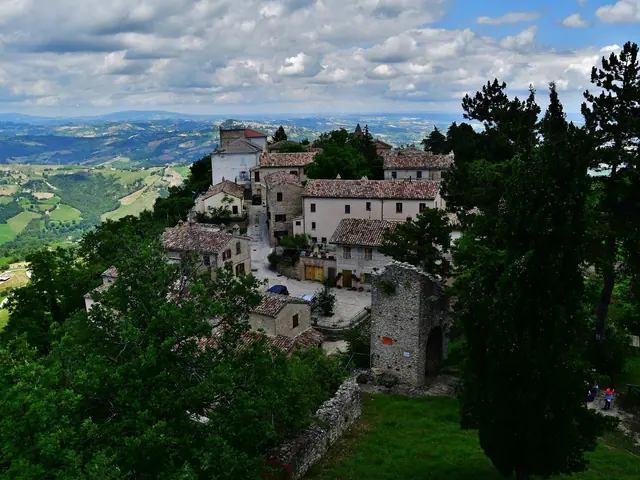
Smerillo is a small village in the province of Fermo, in Le Marche. It stands on a rocky spur at about 806 meters above sea level, halfway between the Sibillini Mountains and the Adriatic Sea. The village stretches along a ridge that drops sheer to the valley of the Tenna river. From this position the views take in the Gran Sasso to the south, the Sibillini to the west, Monte Conero to the north and the sea to the east: this is why Smerillo is called the “roof of the Marche”. Along the line of the Sibillini, the Vettore, the Sibilla, the Priora and Castel Manardo can be made out, and further away Monte Catria.
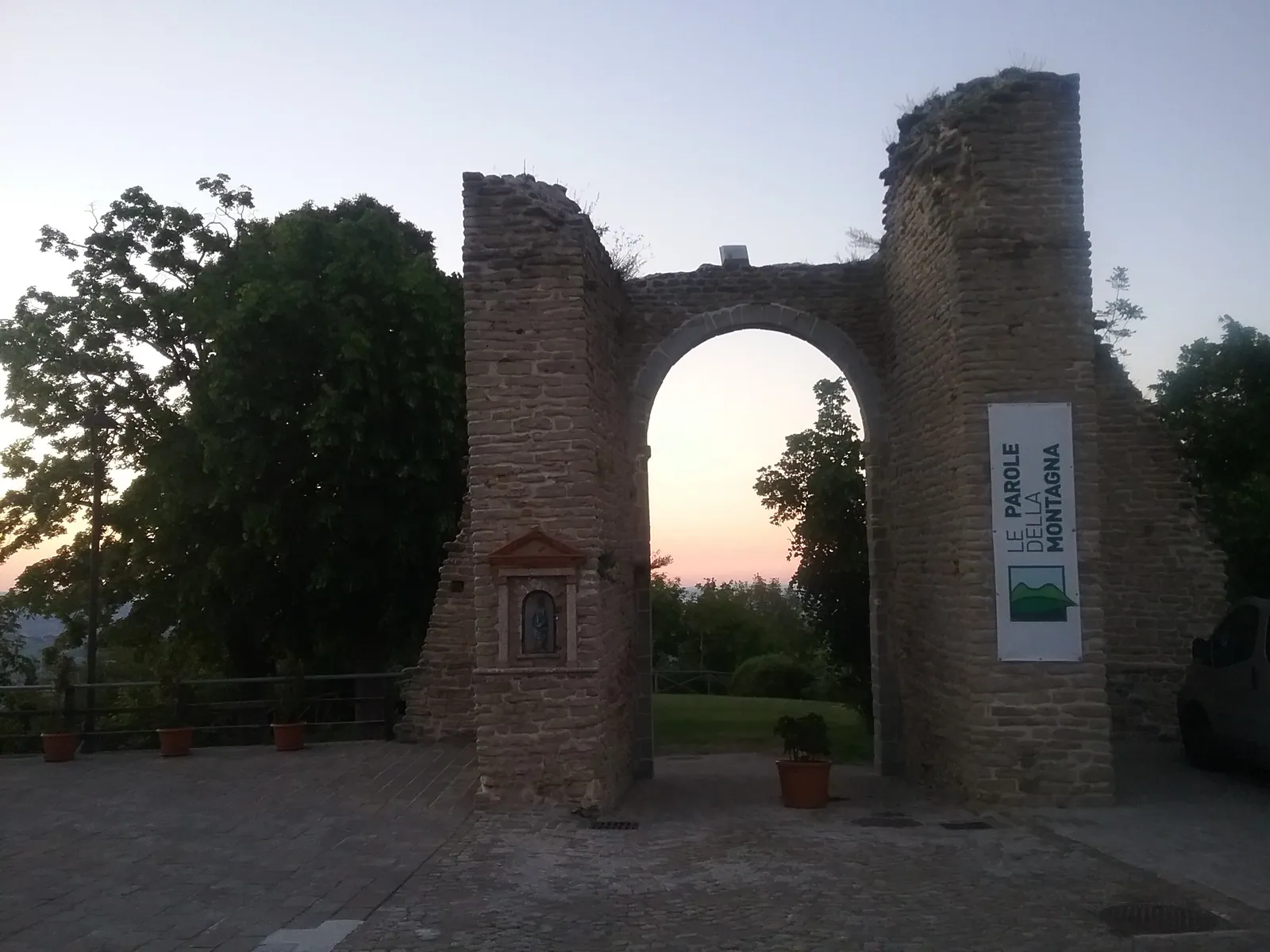
In the Middle Ages Smerillo was a castle considered equal in standing to Fermo. From that period remain the ruins of the walls, the Porta Nord (north gate) and the cassero (keep). The name is traced back to the smeriglio, the merlin with which the feudal lord hunted, or to a family of local lords called “De Smerillo”. Today the village has just over 300 inhabitants. It is also known as the “Cittadella della Poesia” (Citadel of Poetry) because poets often come here, and in summer it hosts the festival Le Parole della Montagna. Around the village lies a wood crossed by trails, home to the Fessa: a narrow cleft in the sandstone full of fossils from when the sea covered this area.
On the map
Points from the site database. Map © OpenStreetMap contributors · Protomaps.
What to see in Smerillo
In Smerillo, visitors can see the remains of the medieval castle, the small museum complex and the Fessa, reached on foot from the center.
Arriving by car on the provincial road that climbs from Montefalcone Appennino, the remains of the Castrum Smerilli come into view even before the houses. This was the medieval fortification that occupied the highest part of the hill. The area reserved for the lords was enclosed on three sides by walls with towers. The fourth side had no defenses, because it faced the cliff. Today a few stretches of wall and the restored keep remain. The fortress tower has been rebuilt and, after work in 2012, became the drinking water tank. From the top the view sweeps over the hills of the Fermo area. The village spreads out lower down and ends at the Porta Nord, the old entrance to the village, next to a garden viewpoint.
Smerillo was one of the municipalities in the province of Fermo hardest hit by the 2016 earthquake. In June 2025 all the village's places of worship were still closed as unsafe. The parish church of Santi Pietro e Paolo, on the square of the same name, reopened at the end of August 2026. The work repaired the damage and strengthened the apse, the sacristy, the bell tower, the roof and the façade. The church is medieval in origin. A plaque records that in 1474 Giovanni Falcuzio paid for the construction of the bell tower. Inside is a wooden crucifix.
The Romanesque Chiesa di Santa Caterina was built as a thanksgiving after the population survived a severe plague epidemic, and it keeps some frescoes. It is best to check its status before going. Outside the center, in the hamlet of San Martino al Faggio, is the Chiesa di San Vincenzo Ferreri. In the hamlet of Val di Tenna, on the river, there is an 18th-century water mill.
The Museo dei Fossili e dei Minerali (fossil and mineral museum), also called the Museo delle Scienze Naturali, is housed in the former elementary school. It displays local fossils from the Lower Pliocene and a teaching collection of Italian fossils, from the Paleozoic to the Cenozoic. The tour starts with a trilobite, one of the oldest animals in Italy. Among the minerals are a rough diamond, a large amethyst quartz geode from Brazil and a big block of sulfur from the Perticara quarries. The museum also has a laboratory for cleaning and cataloguing fossils, with a microscope for observing microfossils and botanical specimens.
On the upper floor of the same building is the Museo d'Arte Contemporanea, with works mainly by artists from the Marche. The Museo Pinacoteca dell'Arte dei Bambini was founded in 1999 from an idea by Luciano Galassi: it gathers the “small voices” of children and invites reflection on the theme of peace. Museum opening times change during the year and should be checked before visiting. More details are on the page things to do in Smerillo.
Nature and trails near Smerillo
The best-known trail in Smerillo is the Fessa trail. It is a short, easy loop that starts from the village viewpoint and can be walked in every season. It takes about 40-45 minutes on foot, with an elevation change of around 70 meters. Past the Porta Nord, the trail zigzags down the paved hairpins of the old medieval road. In about ten minutes it reaches the entrance to the Fessa.
The Fessa is a cleft in the sandstone about 30 meters long and just as high, and about 50 centimeters wide: only one person can pass at a time. Pliocene fossils can be seen in the walls, including the oyster Ostrea edulis, because the cliff was once the Adriatic coastline. After the cleft the trail enters the woods and climbs back up the opposite side, closing the loop. The wood is dense and the sun does not dry the ground, so some stretches can be slippery. Shoes with good soles are needed.
The Bosco di Smerillo lies on the north side of Monte Falcone, between 780 and 870 meters above sea level. The village shares it with Montefalcone Appennino. It has been a protected floristic area since the Seventies. Despite the modest altitude, mountain species such as beech and chestnut grow here, and in all more than 550 plant species have been counted. Signs of yew, porcupine, beech marten and fox can be found in the wood, and several species of birds of prey can be seen. The trail network measures about 10 kilometers. Since 1993 the wood has hosted orienteering, with a national race and a permanent regional school.
The “Bosco di Smerillo” Environmental Education Center was founded in 1987 on the initiative of the Ministry of the Environment. It organizes guided visits on flora, fauna and fossils, as well as orienteering activities. The center also manages Lago di San Ruffino. Many wild boar and roe deer live near the lake, and on the water there are great egrets and gray herons, little egrets, moorhens, grebes and several species of ducks.
For a longer walk there is an easy route linking Smerillo to the Rocca di Montefalcone. It passes the Fessa, the nature trail and the wooded ridge: it is 7.2 km long and takes about 2 hours and 40 minutes. A woodland variant from Montefalcone Appennino to Smerillo is 4.7 km long, takes about 2 hours and is of medium difficulty. It is not suitable for strollers.
To the south start the Sentiero della Fonte, which follows the old route between the village and the valley, and the Sentiero delle Fontanelle, which reaches the Grande Faggio (great beech). At San Martino al Faggio the trail enters a rare “depressed” beech wood, at an unusually low altitude, between the Rebuscano stream and some sulfur water springs.
Where to stay in Smerillo
In Smerillo, accommodation is in the village or in the farming districts of the municipality, where there are also agriturismi (farm stays). The list of places to stay is on the page where to stay in Smerillo. For travelers with a camper, there is an RV parking area in the municipality. It can also be reached on foot from the center, along the Via della Fonte. Smerillo pairs well with a visit to Amandola and Montefalcone Appennino, with which it shares Monte Falcone and the wood.
Where to eat in Smerillo
Smerillo's food is the cooking of the Fermo hinterland. Traditional dishes include vincisgrassi (a baked lasagna of the Marche), beans with pork rind and calcioni, ravioli either savory with cheese or sweet with a chestnut filling. The village often holds dinners based on wild herbs, and its events include Le erbe del gusto. In the fall, during the Castagnata, food stands in the square serve traditional dishes and chestnut desserts. Restaurants and trattorias are listed on the page Smerillo restaurants.
Local products of Smerillo
The most typical products of Smerillo are chestnuts and the mela rosa dei Monti Sibillini, the Sibillini pink apple. The mela rosa is an old variety, small and slightly flattened, with pink shading on the deep green of the unripe fruit. Smerillo is reviving it together with the neighboring municipalities of Monte San Martino, Amandola and Montedinove.
Chestnut trees have always grown in the woods around the village. The chestnut is celebrated at the Castagnata in the square, usually held on the third Sunday of October. It was one of the first festivals of its kind in Le Marche, and the 42nd edition took place in 2024. It is organized by the local association Il Castagno, with the municipality and the Pro Loco. The stalls offer roasted chestnuts, tarts and cakes with chestnut cream and jam, calcioni, and other local products such as pink apples, corn and walnuts.
In the countryside of Smerillo, an organic farm grows old local varieties of corn for cobs and polenta, Senatore Cappelli durum wheat and emmer (farro dicocco).
Weather in Smerillo and how to get there
Smerillo can be visited in every season. The Fessa trail can be walked all year. The festival Le Parole della Montagna is usually held in July, while the Castagnata takes place in the fall. The village is at 806 meters above sea level and the ground in the woods stays damp, so it is worth checking the weather forecast before a hike.
Smerillo is reached by car on the provincial road that climbs from Montefalcone Appennino. As the crow flies, the village is about 35 km west of Fermo, about 35 km northwest of Ascoli Piceno and about 80 km south of Ancona. Amandola is about 8 km away. Cars are usually left along the road at the entrance to the village, near the castle remains. On Castagnata days, shuttles have been run between the historic center and the access areas of the village. By public transport there is no direct connection from Rome: buses go as far as Amandola. The page villages of the Sibillini Mountains helps plan the other stops of the trip.
In this section
3 results
 Things to Do in Smerillo5 places
- Where to Stay in Smerillo3 places to stay
 Smerillo Restaurants3 places
No results with these filters.