


Camping Tent: How to Choose and Where to Pitch It
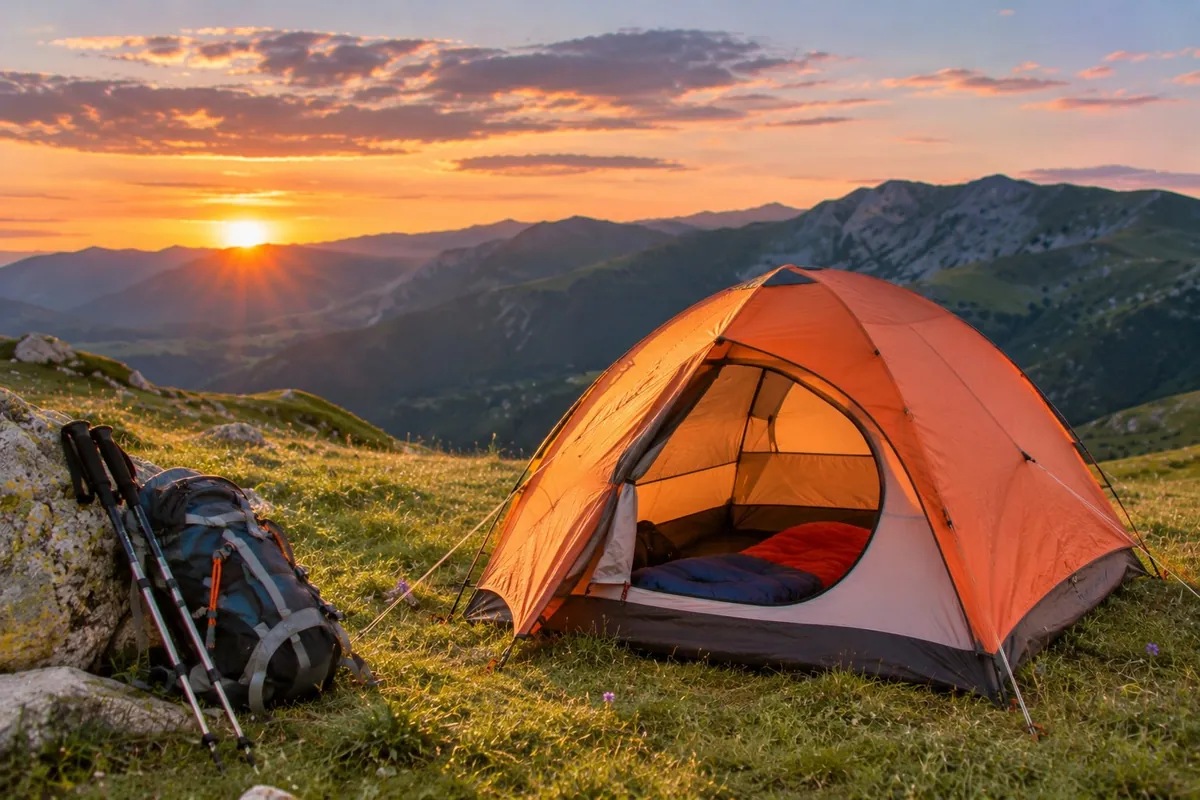
A camping tent is chosen starting from three questions: how many people will sleep in it, how it will be carried and in which season it will be used. Those traveling by car and staying at a campground can go for space and comfort; those carrying it in a backpack or on a bike must look first of all at weight and bulk.
In the Sibillini Mountains there is a fourth question, which comes before the others: where it is allowed to pitch it. In the National Park, camping is not allowed outside equipped areas, and bivouacking is permitted only in some zones. Anyone buying a tent with the idea of pitching it freely at altitude needs to know this.
Camping tent: how to choose
The shape. Tents differ mainly in their structure.
- Dome. It is supported by crossed poles and is the most common model among tents for one to three or four people. It is light, compact and quick to pitch, and the shape stands up well to wind and rain.
- Tunnel. It has parallel poles. In one- or two-person versions it is compact and light, and popular with hikers and mountaineers; family versions offer good living space even during the day, with several rooms.
- Cabin. It has at least two rooms and a living area tall enough to stand up in. It suits families and long stays, but it is large, heavy and demanding to pitch: it can only be carried by car.
- Ridge tent. The classic tent with two sloping sides, easy to pitch but very exposed to wind, and little used today.
There are also pop-up tents and tents with inflatable beams instead of poles, which are practical for beginners.
The number of places. One place corresponds to about 60 cm of width in the sleeping area, and a two-person tent leaves no room for luggage. The advice is to choose a tent with one place more than the number of occupants, for example a three-person tent for two people. Look at the internal dimensions, not the external ones. Anyone taller than 1.80 meters should check the length.
Transport. For those walking or cycling, weight and bulk are decisive: small, light, compact tents are needed. For those traveling by car they matter little, and a roomier, taller model can be chosen. Interior height improves comfort but increases weight and bulk: it is important for a family that lives in the tent during the day too, marginal for those who only use it to sleep.
The season. For summer in a Mediterranean climate a light fly is enough. For the mountains, for northern Europe and for use from fall to spring, a thicker fabric is needed. Winter tents, called four-season tents, have denser fabrics and reinforced poles to bear the weight of snow and strong wind; for winter camping, a good-quality double-wall tent is almost a must.
Camping tent: what to consider
Single or double wall. A single-wall tent is lighter for the same number of places and practical for bivouacs, but often has no mosquito net. A double-wall tent is heavier and bulkier, but insulates better from heat and cold, lets air circulate and creates a covered space in front of the entrance (vestibule) for shoes or a stove.
Waterproofing. It is measured as a hydrostatic head (water column), expressed in millimeters: it indicates the water pressure the fabric can withstand before letting water through. As a guideline, the outer fly needs at least 2,000-2,500 mm and the floor, which is in contact with the ground, at least 4,000 mm. The values are shown on the label or in the technical specifications. The number alone does not tell the whole story, because it does not take wind into account.
Seams and zippers. These are the points where water gets in. Check that the seams are taped: taping reduces leaks.
Fabrics. The outer fly is usually polyester, which is strong, light, waterproof and inexpensive. The inner tent is nylon or polycotton, a blend of polyester and cotton that is cooler and more breathable but slower to dry after a storm.
Floor. The bottom of the tent, called the bathtub floor, is often polyethylene. Underneath it is worth laying a footprint of the same size as the tent: if it sticks out, it channels water under the floor.
Poles and stakes. Telescopic fiberglass poles are practical to carry and pitch and work for small tents. Aluminum poles last longer and resist breaking better. Stakes can be steel, strong but heavy, or aluminum, lighter and more expensive. It is good to have a few spares.
Ventilation. Besides the entrance, windows or openings are needed to let air circulate, ideally all with mosquito netting. The double wall also helps manage the condensation that forms inside.
Safety. The fabrics should be flame-retardant: among the certifications to look for is CPAI-84.
Camping tent: practical tips
Check the park rules first. In the Sibillini National Park, in the Sibillini Mountains, camping is not allowed outside specially equipped areas. Bivouacking, that is, roving camping with stops of no more than forty-eight hours in the same place, is permitted only in some areas, shown on a map published by the Park, and requires the landowner's consent. It is in any case forbidden in zone A (strict nature reserve), in the valley of Lago di Pilato and on the Piani di Castelluccio (the Castelluccio plains), where camper parking is also regulated. Some municipalities have their own rules: in Fiastra and Bolognola the ban applies across the whole municipal territory, with few exceptions, and in Ussita bivouacking is allowed in only two areas. Open fires are not lit anywhere in the Park. The rules can change: they should be checked on the Park's website and with the municipality before setting out. Those looking for a pitch will find the facilities on the page about campgrounds in the Monti Sibillini.
Choose the tent for the most frequent use. For summer camping at an equipped campground, a dome or tunnel tent, an outer fly of 2,000-2,500 mm and one extra place for luggage are enough. For carrying it in a backpack, weight is what matters most.
Learn to pitch it. The instructions should be read carefully, and if needed a video can help. A badly pitched tent tears in the wind, lets the rain in and often no longer fits back in its bag.
Avoid full sun in summer. The temperature inside a tent in the sun can rise a lot: when possible, a shaded pitch is better.
Always dry it before packing it away. After each use the tent should be cleaned of dirt and debris. It is washed outdoors with soap and water, never in the washing machine, because heat and spinning damage seams and plastic parts, and it is stored only when completely dry. If it had to be packed wet, it should be washed again at home and left to dry.
Complete the night gear. Inside the tent you need a sleeping pad and a bag suited to the season: the guide to the sleeping bag for hiking explains how to read the temperatures on the label. To carry everything there is the guide to the hiking backpack.