


Sleeping Bag for Hiking: How to Choose
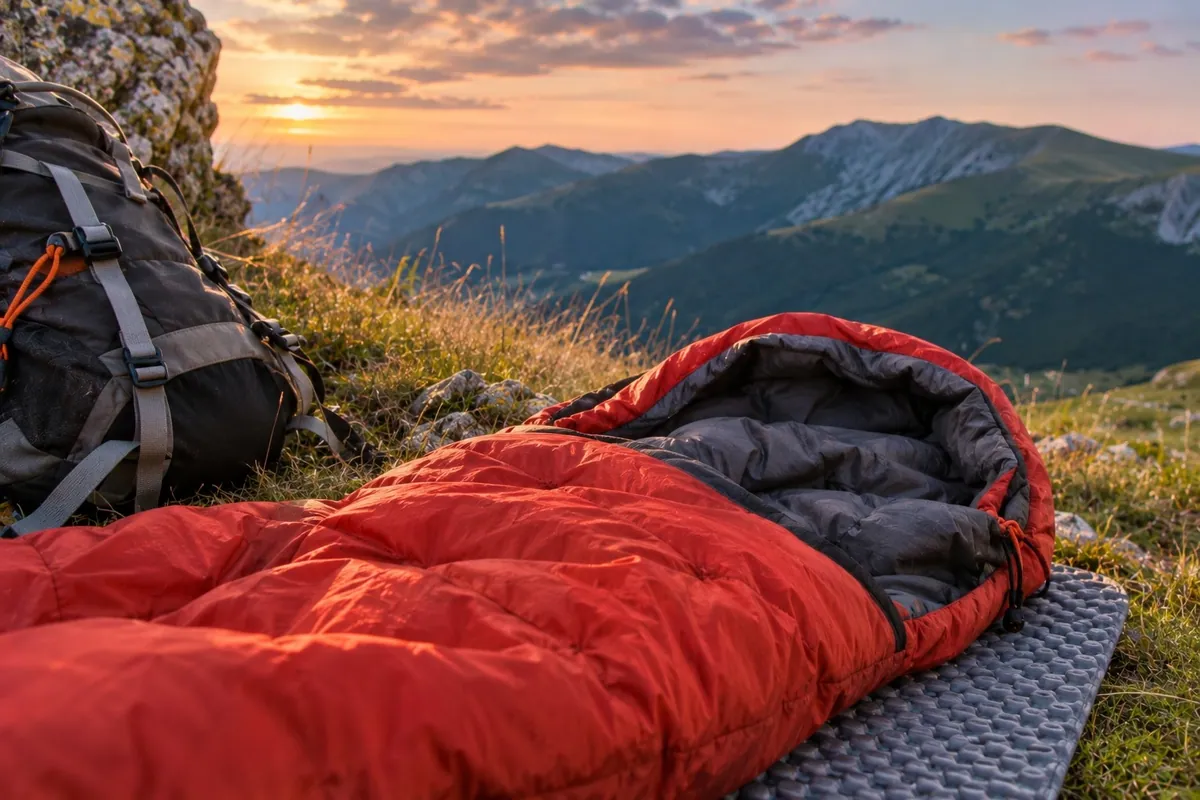
A sleeping bag for hiking is chosen by reading three things on the label: the comfort temperature, the type of fill and the shape. The temperature tells you down to what point you will sleep well; the fill, down or synthetic, determines weight, bulk and behavior in damp conditions; the shape, mummy or rectangular, sets how much heat is retained and how much room there is to move.
One mistake to avoid is choosing by the lowest temperature printed on the bag. That number, the extreme temperature, does not indicate a night's sleep but a survival threshold.
Sleeping bag for hiking: how to choose
Read the temperatures the right way. The values shown on sleeping bags follow a common standard, ISO 23537, which replaced the earlier European standard EN 13537. Measurements are made in a laboratory, with a thermal mannequin fitted with sensors, and do not account for each person's sensitivity to cold. Bags that carry the old code are still on sale and remain reliable. The values are as follows.
- Comfort temperature. The temperature at which a standard woman sleeps comfortably in a relaxed position. It is the reference for people who feel the cold.
- Limit temperature. The temperature at which a standard man, curled up, sleeps without waking from the cold. It can be used as a reference by people who usually sleep warm.
- Extreme temperature. The threshold within which the bag protects against hypothermia for about six hours. It should never be used for choosing: it only serves to compare bags with each other.
Some labels also show a maximum temperature, above which you start to sweat. It matters little, because in warm weather the zipper can always be opened.
Decide for which season. A summer bag is light, thin and breathable, often rectangular; for family summer camping a comfort rating around 10-15 °C is enough. Between the two extremes is the three-season bag. A winter bag is designed for harsh temperatures, often below freezing: it has a thick fill and a mummy shape.
Consider how it will be carried. If the bag travels in the trunk of the car, weight and bulk matter little. If it sits in a backpack for hours, they become decisive. As an order of magnitude, a summer bag weighs less than one kilo; a three-season bag between one and two kilos, with down models able to stay under one kilo; a winter bag from about 1.7 to 3 kilos.
Sleeping bag for hiking: what to consider
Down. It offers the best balance of warmth, weight, compressibility and durability: at the same temperature rating a down bag is lighter and takes up less space. It has two drawbacks. It costs more, and it suffers in damp conditions: wet down loses its insulating power. Some models use down with a water-repellent treatment, which reduces the problem.
Down quality is measured in cuin (cubic inches): the higher the value, the more air the down traps and the better it insulates. Around 600 is a normal value, between 650 and 750 very good, from 800 up excellent. The ratio between down clusters and feathers also matters: the down insulates, the feathers give structure, and the ratio considered ideal is 90 to 10. The weight of the fill gives an idea of the season: from 200 to 400 grams for summer, from 400 to 800 for three seasons, over 800 for winter.
Synthetic. It costs less, needs less care and handles moisture better: it keeps insulating even when wet. In exchange it is heavier and bulkier, and with use it tends to flatten and trap less air. Hollow fiber is the cheapest option, suited to occasional camping and nights in mountain huts; microfibers are lighter and less bulky, but more expensive.
Shape. The mummy bag is narrow at the feet and wider at the shoulders, almost always with a hood. It leaves little room to move, but retains heat better and reduces weight and volume: it is the most common shape for hiking. The rectangular, or blanket, bag is roomier and can be opened out completely; it is, however, heavier, bulkier and less warm. It suits mild climates.
Length. The bag must be longer than the person: the most common advice is a total length about 30 cm greater than your height. Adult models usually measure between 210 and 230 cm; women's models are shorter and have more fill at the feet and hips. Read the specifications carefully: some manufacturers give the length of the bag, others the maximum height of the user.
Zipper. A poor-quality zipper can break: it is a detail worth checking.
Sleeping bag for hiking: practical tips
Choose by the comfort temperature, with a margin. Sensitivity to cold varies from person to person, and in general women need a few degrees more. Each person may therefore need a warmer or cooler bag than someone else in the same conditions.
Prefer synthetic if damp weather is expected. In rain or high humidity, a synthetic bag is the more reliable choice. Down performs better when the warmth-to-weight ratio is what counts.
Do not sleep in too many clothes. Once lying down, warmth builds up: with too many layers on you wake up sweaty.
Use a sleeping bag liner. It is a sewn sheet, in cotton or silk, with no fill. On its own it is enough in warm climates and when it is warmer than expected.
Pair it with a sleeping pad. The sleeping bag should be paired with a sleeping pad, which cushions the unevenness of the ground.
Store it uncompressed. The bag should not be left compressed longer than necessary. At home it is stored laid flat, hung up or loosely rolled, for example in a closet. If it got wet, it should be aired for a few days: residual moisture reduces insulation and encourages mold.
Wash it as little as possible. Washing damages both synthetic fibers and down, which loses loft. When necessary, follow the instructions on the label; for down, professional cleaning is often preferable. With good care a sleeping bag can last as long as ten years.
Those sleeping outdoors will find the rest in the guide to the camping tent, those who prefer a bed at altitude can look at the mountain huts in the Sibillini Mountains; to carry everything on your back there is the guide to the hiking backpack.