


Il Laghetto: how to get there and trails
At a glance
- Type
- Lake
- Municipality
- Montemonaco (AP)
Source: site database, © OpenStreetMap contributors (ODbL).
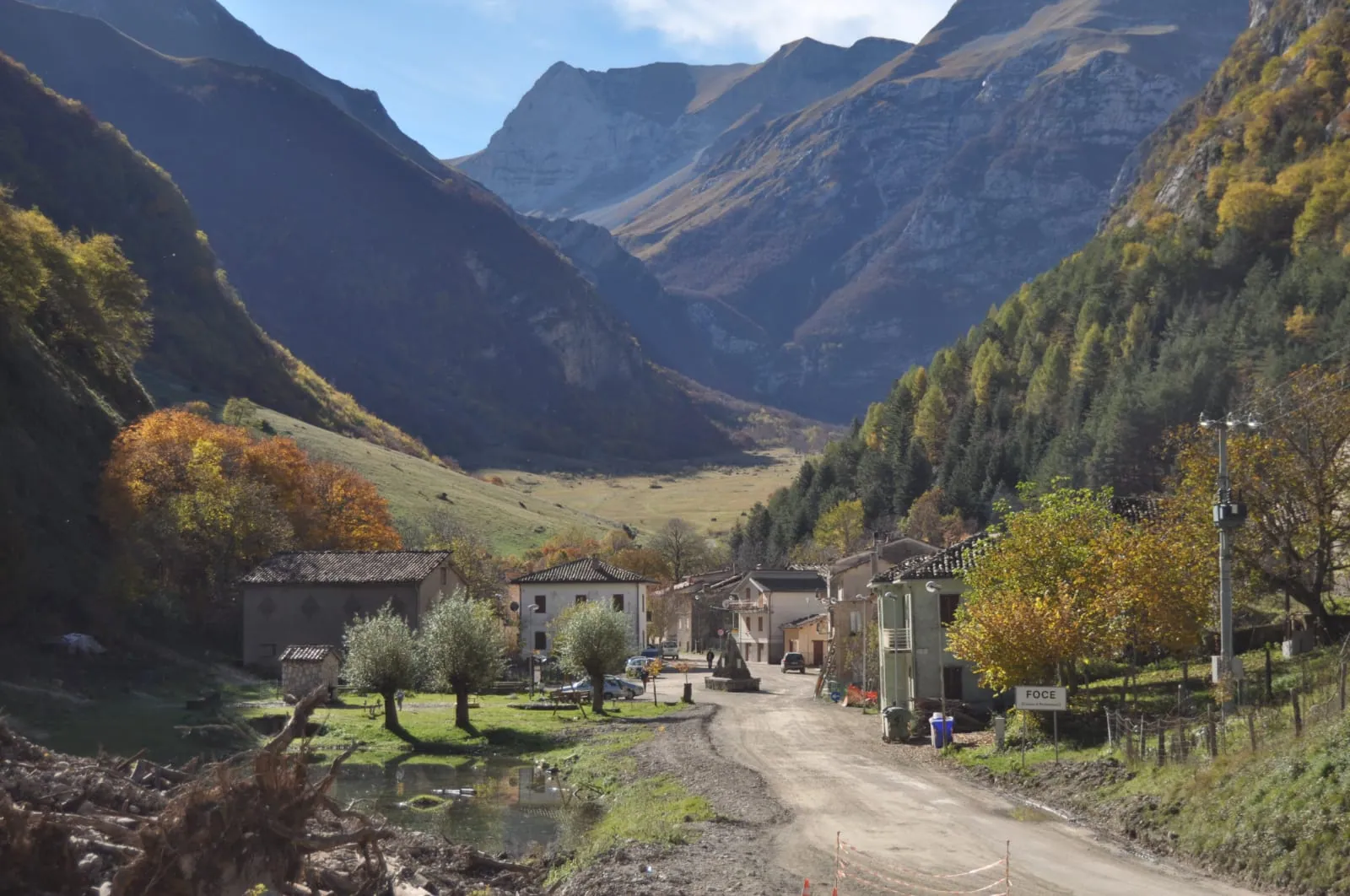
Il Laghetto, the small lake of Foce, a hamlet of Montemonaco (province of Ascoli Piceno), is a small natural lake in the National Park of the Sibillini Mountains. Until the last decade of the 20th century it was fed by resurgent water from Lago di Pilato and was home to trout and freshwater shrimp. Today it is dry for almost the whole year. A visit therefore makes sense mainly as a stop in Foce, where the trails to Lago di Pilato and the nearby peaks start.
Before you go
Forecast
- Today16° / 11°0.0 mmCloudy
- Tomorrow17° / 11°5.2 mmPartly cloudy
- Friday13° / 9°23.3 mmHeavy rain
Forecast by MET Norway, updated automatically · license CC BY 4.0
Rules and orders: Park website. Snow and avalanches: Meteomont bulletin.
On the map
Points from the site database. Map © OpenStreetMap contributors · Protomaps.
Where Il Laghetto is
The small lake is in Foce, in the municipality of Montemonaco, on the border between the Marche and Umbria. The few houses of the village stretch along a valley carved by glaciers in remote times, which joins the Valle del Lago di Pilato to the south.
Water has a special story here. The Aso river appears on the surface at Lago di Pilato, then follows an underground karst course of about six kilometers and resurfaces just before Foce. Until the first half of the 20th century it ran between the houses in small channels and flowed into the lake. Drawing water from the aquifer for the water needs of the Marche moved the source of the Aso about two kilometers farther downstream, and the lake dried up.
How to get to Il Laghetto
Foce is reached on provincial road 86, toward Montemonaco. At the locality of Pignotti, turn at the junction for Foce and continue for about 5 km.
It is advisable to leave the car at the edge of the village. Private vehicle traffic on the cart track of the Piano della Gardosa may be restricted, especially in summer: before driving up, ask at the Casa del Parco, the park visitor center at the edge of the village.
Trails and hikes from Il Laghetto
The classic hike from Foce leads to Lago di Pilato (1,941 m), along trail no. 151. It starts at the village footbridge and follows the cart track to the end of the Piano della Gardosa. It then climbs through the beech wood to the Svolte, a steep rock step that is the hardest section. After the Svolte the valley opens up and leads to the lake with a gentler climb.
The out-and-back route on the same path is about 12 km long, with an elevation gain of about 1,000 m and a total time of between 5 and 6 hours. The difficulty is moderate (E).
From Foce it is also possible to reach Monte Argentella, Palazzo Borghese, Monte Sibilla, Monte Porche and the Grotta delle fate. There are also easier walks in the woods.
After the earthquake of August 24, 2016, the trail to Lago di Pilato was closed. It was partly reopened in 2017, and the Svolte section reopened in May 2018. Before setting out, it is wise to check the ordinances of the Comune di Montemonaco.
When to visit Il Laghetto
Summer is the most suitable season for hikes from Foce. The recommended period for Lago di Pilato runs from late spring to fall. The climate is continental, with cool summers and very harsh winters, and on the highest peaks temperatures can drop to -25 °C. Since the small lake is almost always dry, there is no season when it can be counted on to be full.
What to see near Il Laghetto
In the small square of Foce stands a pyramid-shaped concrete monument, about five and a half meters high, dedicated to don Basilio Brunori, the village priest who died in the war in 1917. The church of San Bartolomeo apostolo, patron saint of Foce, is mentioned in documents as early as April 1178.
From the village the walk can continue toward Lago di Pilato. Nearby destinations also include the Laghetto di Palazzo Borghese. For a broader overview, see the page on the lakes of the Sibillini Mountains in the Marche.
Frequently asked questions
Does the small lake of Foce have water?
Where does the water of the small lake of Foce come from?
How long is the hike from Foce to Lago di Pilato?
Are there easy walks from Foce?
Nearby
What to see nearby
- 600 m
- 600 m
- 600 m
Where to stay
- Taverna della Montagna, MontemonacoMountain hut200 m
- Rifugio Altino, MontemonacoMountain hut3.0 km
- 3.1 km
Where to eat
- Battì, MontemonacoBar and café200 m
- 200 m
- Franca, MontemonacoClimbing2.1 km
Straight-line distances.