


Church of San Francesco (Visso)
Church of San Francesco (Visso)
- Type
- Church
- Municipality
- VissoVisso (MC)
Source: site database, © OpenStreetMap contributors (ODbL).
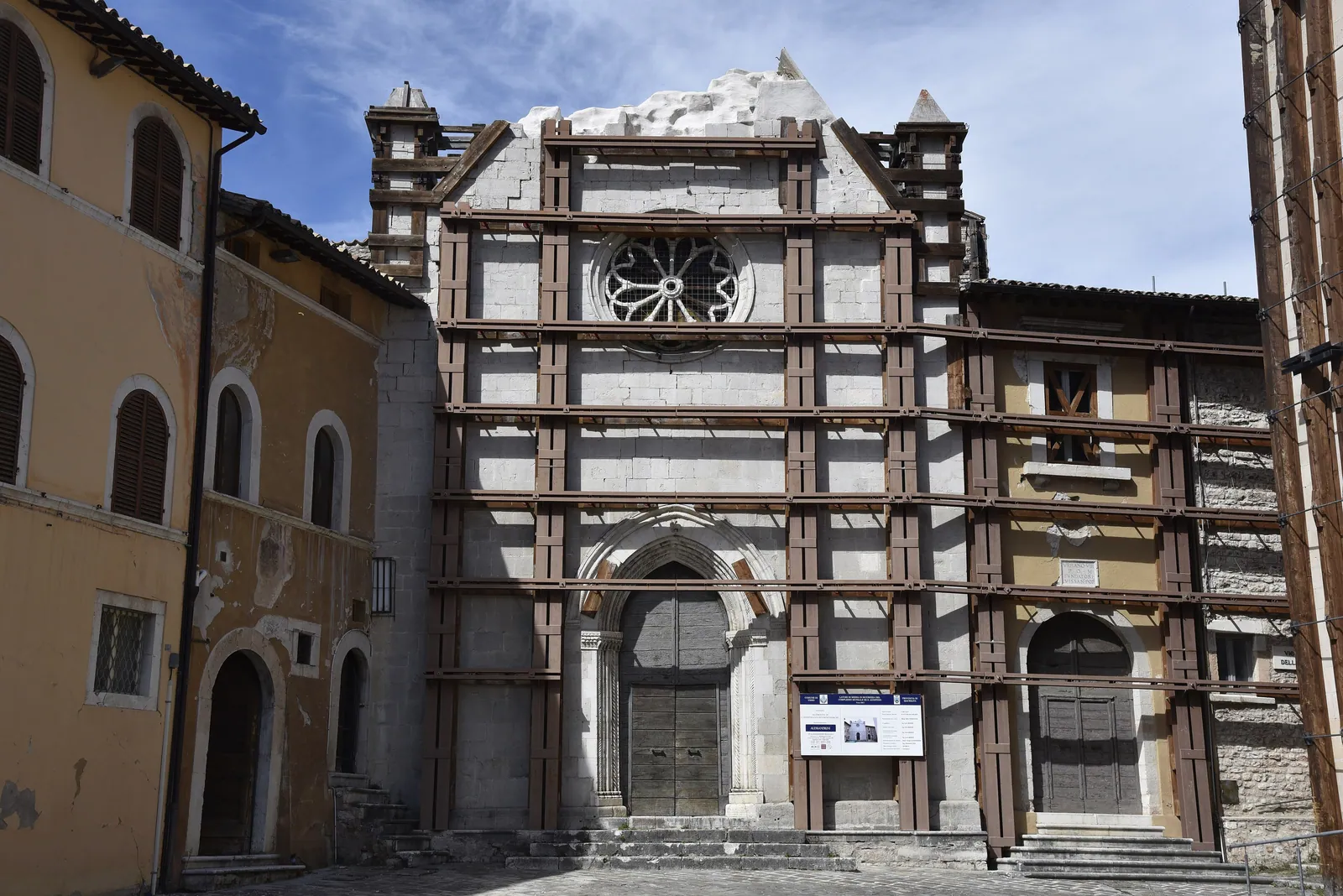
The Church of San Francesco (Chiesa di San Francesco) in Visso, in the province of Macerata, is a 14th-century Romanesque-Gothic building. Its square facade was moved back after the 1858 flood to make room for the embankment of the Ussita stream. The 2016 earthquake hit the church hard. The rose window and the upper part of the facade collapsed, and the building is part of the joint project for the San Francesco block, funded with 11.4 million euros.
On the map
Points from the site database. Map © OpenStreetMap contributors · Protomaps.
History of the Church of San Francesco
A building dedicated to San Biagio (St. Blaise) already stood on the site from 1216. It was probably demolished in 1291 to make way for the convent, built on land granted by the Comune to the Conventual Friars. The present church dates from the late 14th century, like the stone portal, and is mentioned in the Pelosius codex of 1393. The bell tower was converted from a defensive tower, probably from the 13th century.
In 1858 the flooding river poured mud and debris into the church and the nearby houses. To make room for the embankments, the church was shortened. The main facade and the side portal were dismantled and rebuilt at a higher level, about 1.50 meters, thanks to the support of Pope Pius IX.
In the 20th century the roof was rebuilt. After the earthquakes of September 26, 1997 a restoration project was approved. For years the church hosted the concert season of the Polyphonica Festival.
What to see in the Church of San Francesco
The exterior is recognizable by its square facade and the stone side portal with a pointed arch. Above the side portal, in a niche, is a 16th-century fresco of the Madonna and Child by an anonymous painter of the Umbrian school.
The interior has a single nave, with the presbytery framed by a large pointed arch. The furnishings included a walnut pulpit, a wooden choir with painted doors, an organ and a choir loft with a floral-patterned parapet. During restoration, a fresco of the Crucifixion was found on the west wall of the sacristy, along with one of the Madonna Enthroned with Child.
In March 2017, among the rubble left by the earthquake, the Caschi Blu della Cultura (the Italian "Blue Helmets for Culture" heritage task force) recovered a fresco probably by Paolo da Visso, a local 15th-century painter.
How to visit the Church of San Francesco
The church was severely damaged by the 2016 earthquake, and its recovery is tied to the reconstruction of the San Francesco block. Before traveling to Visso, it is advisable to find out whether the building and the surrounding area are actually accessible. The earthquake made 90% of the town's buildings unsafe.
Where the Church of San Francesco is located
The church is in the historic center of Visso, in Le Marche. The town lies in a basin where five valleys meet, at about 600 meters above sea level. The building belongs to the San Francesco block, which also includes the Church of Santissimo Crocifisso in Visso, the Ponte Lato gate and part of the old convent, the headquarters of the national park of the Sibillini Mountains.
Around the Church of San Francesco in Visso
The historic center of Visso is home to the Collegiata di Santa Maria, consecrated in 1256, and the Chiesa di Sant'Agostino, a 14th-century Gothic church that housed the Museo-Pinacoteca Diocesano (diocesan museum and art gallery). The medieval town walls open through four gates. A few kilometers from the town, on the Macereto plateau, stands the 16th-century Sanctuary of Macereto. For other places of worship in the area, see the page on the churches of the Sibillini Mountains. After the earthquake, whether each building is open needs to be checked.
Frequently asked questions
When was the Church of San Francesco in Visso built?
Why was the facade of the church moved back?
What did the Caschi Blu della Cultura find in the church?
Was the Church of San Francesco in Visso damaged by the earthquake?
Nearby
What to see nearby
- under 100 m
- 100 m
- Church and Convent of Sant'Agostino (Visso)Museum or art gallery200 m
Where to stay
- 300 m
- Area Camper VissoRV area300 m
- 400 m
Where to eat
- La Filanda, VissoRestaurantunder 100 m
- Calabro, VissoButcher and pork productsunder 100 m
- Bar Sibilla, VissoBar and café100 m
Straight-line distances.