


Church of San Sebastiano (Castelsantangelo sul Nera)
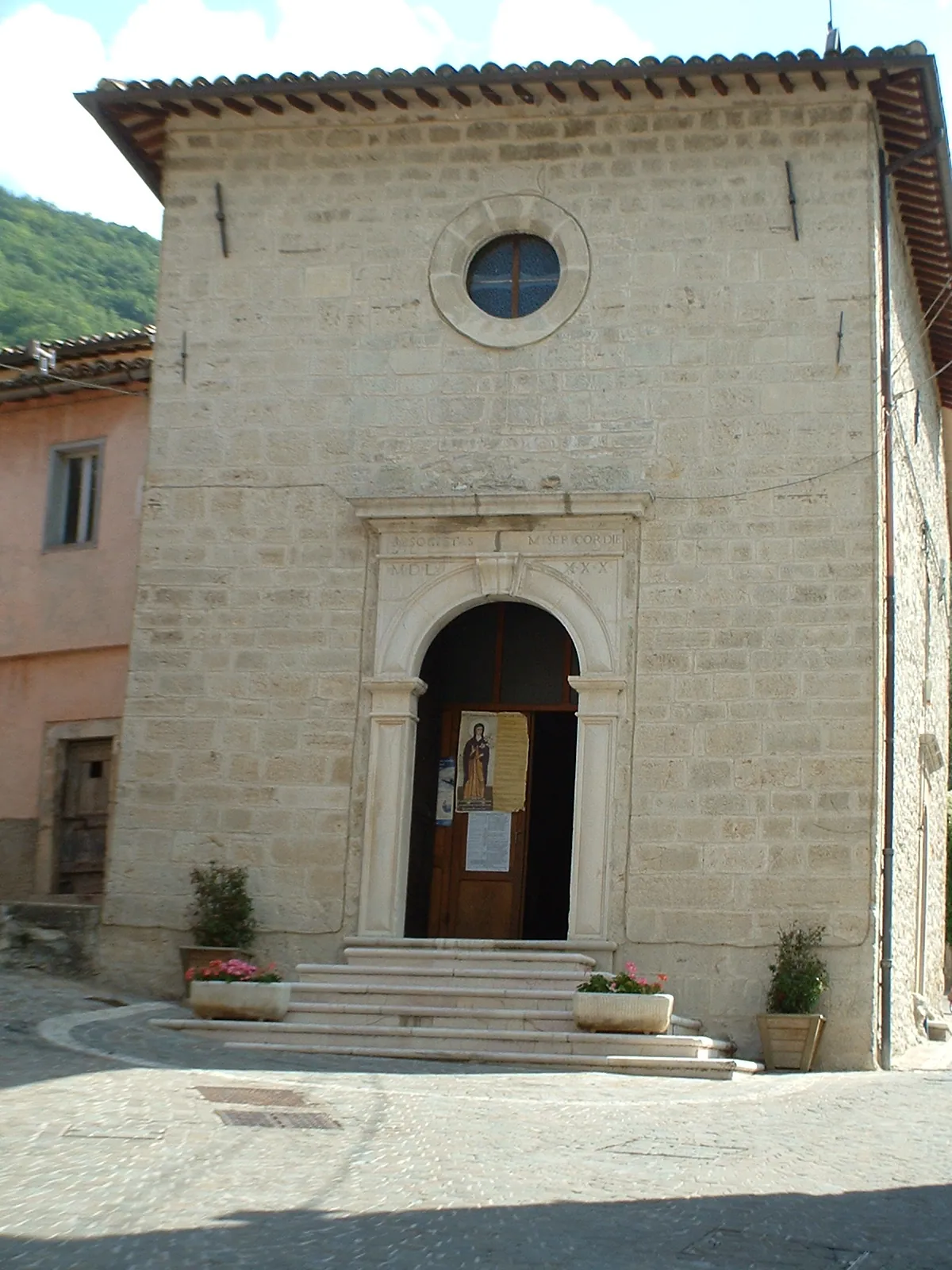
The Church of San Sebastiano (Chiesa di San Sebastiano) stands on the main square of Castelsantangelo sul Nera, in the province of Macerata. It is a building of Romanesque character, with a facade of squared stone blocks and a single-nave interior. It began as the oratory of the Confraternita della Misericordia (Confraternity of Mercy), designed by the architect Pietro da Tolentino, and was completed in 1528. The 2016 earthquake damaged it badly, so before a visit it is worth checking whether it is accessible.
Church of San Sebastiano (Castelsantangelo sul Nera)
- Type
- Church
- Municipality
- Castelsantangelo sul Nera (MC)
Source: site database, © OpenStreetMap contributors (ODbL).
On the map
Points from the site database. Map © OpenStreetMap contributors · Protomaps.
History of the Church of San Sebastiano in Castelsantangelo sul Nera
The church was built as an oratory for the Confraternita della Misericordia and completed in 1528, on an earlier structure. The lintel of the portal bears the inscription «Societas Misericordiae», recalling the confraternity's contribution to the works. On the facade, above the round window, the date 1576 is carved, linked to a probable enlargement.
Tradition links the building to the Battle of Pian Perduto of 1522, through which the people of Castelsantangelo freed themselves from the protectorate of Norcia. According to local lore, the banner captured on that occasion is hidden beneath the church floor.
The shock of October 26, 2016, with its epicenter in Castelsantangelo sul Nera, damaged the building. On February 9, 2017, 24 works of art were recovered and moved to the storage facility in San Severino Marche.
What to see in the Church of San Sebastiano
The exterior is plain: a squared-stone facade, a round window and a carved stone portal. The interior has a single nave ending in a semicircular apse. The gabled roof rests on two double-curved arches.
On the right wall, in a niche, is a Madonna enthroned with Child, with Saint Lawrence and Saint Anthony Abbot. The fresco is attributed to Ascanio Poggini, the last exponent of the Scuola di Mevale (school of Mevale). A frieze bears the date 1597 and records the patrons. Other fresco decorations, by local 18th-century artists, cover the dome and some niches.
Visiting the Church of San Sebastiano
Since the 2016 earthquake, access to the interior is not guaranteed. The building remained standing but was secured after the damage, and the artistic heritage of Castelsantangelo can only partly be visited today. Before planning a visit, it is advisable to ask for information at the Comune (town hall) or in the village.
Where the Church of San Sebastiano is located
The church is on the main square of Castelsantangelo sul Nera, called piazza del Ponte, in the Marche. The municipality lies within the Sibillini National Park, in the Sibillini Mountains, about 50 km southwest of Macerata. The springs of the Nera river rise within the municipality. The building depends on the Diocese of Camerino-San Severino Marche and is a subsidiary church of the parish of Santo Stefano.
Around the Church of San Sebastiano
The historic center preserves its medieval layout, with its ring of walls, five entrance gates and a square tower. A short distance from the square is the Church of Santo Stefano, Castelsantangelo sul Nera, from around 1300, with an imposing bell tower. Higher up, passing through porta Nocrina, the route climbs to the monastery of San Liberatore. A path along the walls also leads to the Centro visite del cervo (deer visitor center) and the Park's Centro faunistico (wildlife center), home to some reintroduced deer.
Other places of worship of the area are described on the page about churches in the Sibillini Mountains. Ussita also has a church linked to the saint: the Church of Santi Rocco e Sebastiano in Ussita.
Frequently asked questions
When was the Church of San Sebastiano in Castelsantangelo sul Nera built?
Was the church damaged by the 2016 earthquake?
What does tradition say about the banner of Pian Perduto?
Which fresco in the church is attributed to Ascanio Poggini?
Nearby
What to see nearby
- under 100 m
- 100 m
- 200 m
Where to stay
- 500 m
- 900 m
- 1.3 km
Where to eat
- under 100 m
- Norcineria Alto Nera, Castelsantangelo sul NeraButcher and pork products100 m
- Bar Rita, Castelsantangelo sul NeraPub and brewery100 m
Straight-line distances.