


Church of San Silvestro (Cascia)
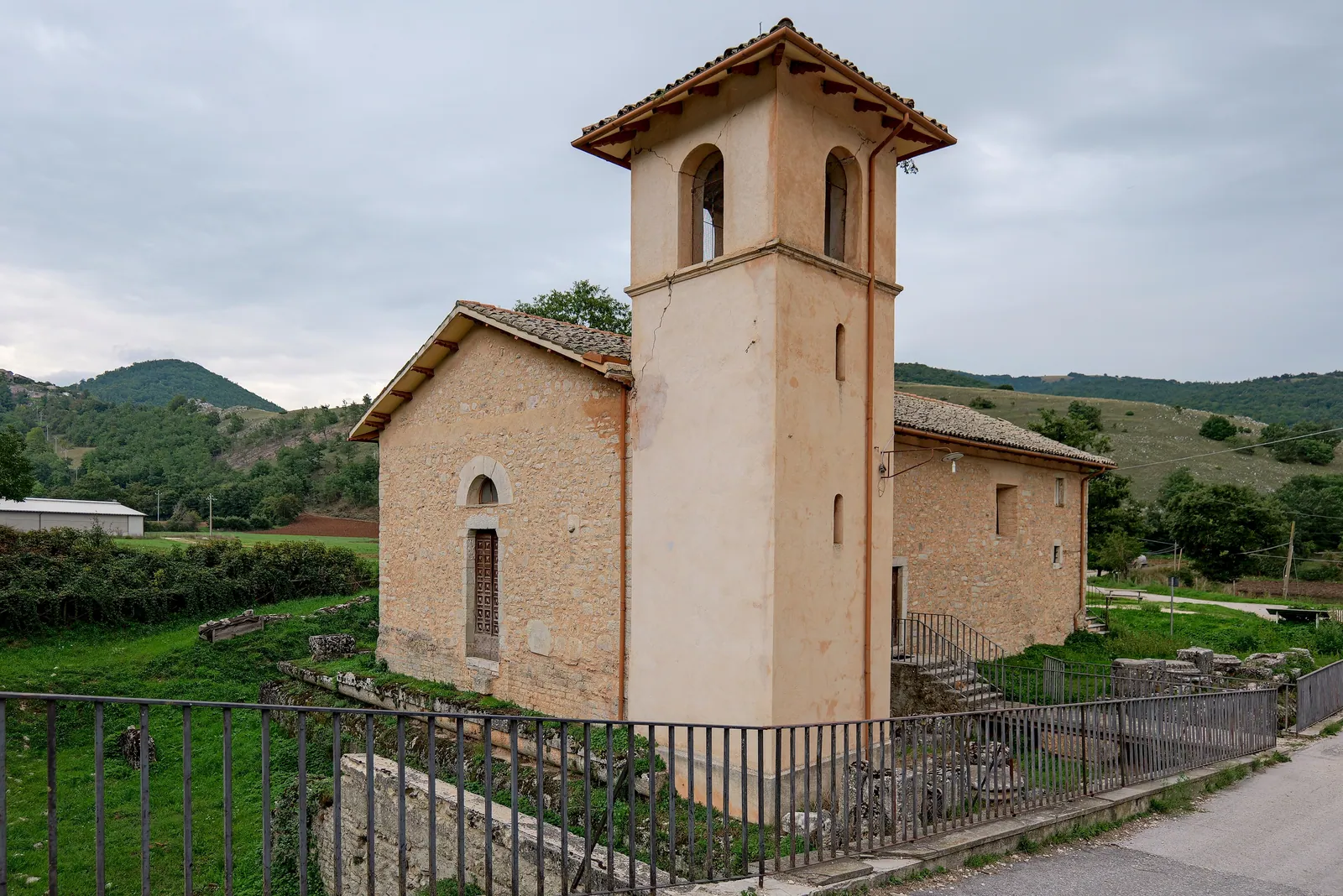
Church of San Silvestro (Cascia)
- Type
- Church
- Municipality
- Cascia (PG)
Source: site database, © OpenStreetMap contributors (ODbL).
The Church of San Silvestro (Chiesa di San Silvestro) in Cascia stands at Villa San Silvestro, a hamlet of the municipality of Cascia, at 991 m above sea level, on the Chiavano plateau. The building rests on the remains of a Roman temple: it occupies the entire space of the central cella. On the north side, toward the mountain, the temple podium came to light in the 1920s; it is 29.25 m long, 20.80 m wide and 3.26 m high.
On the map
Points from the site database. Map © OpenStreetMap contributors · Protomaps.
History of the Church of San Silvestro in Cascia
The temple was probably first built shortly after the Roman conquest of the Sabina, in 290 BC. The architectural terracottas found during excavations have made it possible to date the surviving structures to the beginning of the imperial age, perhaps following a rebuilding after the earthquake of 99 BC. The site was then gradually abandoned during the 1st century AD.
The church is documented later. Under the name San Sylvestri de Ocrile it was already known in 1253. In the 14th century it was a pieve, with a baptismal font and canons. It was rebuilt by the Silvestrine monks in the 16th century and damaged by the earthquake of 1703. A restoration was carried out in the 1980s.
What to see in the Church of San Silvestro
The architecture of the church is very simple. Inside are frescoes from the 16th to the 18th century, a holy water font from 1577 and a late 16th-century wooden ciborium in the shape of a small Bramante-style temple.
Outside, the main interest is the temple podium. On some parts of the cornice the lime plaster applied to imitate the look of marble still survives. Three travertine column bases, 1.30 m in diameter, are preserved out of their original position.
Visiting the Church of San Silvestro
Visits to the temple site are by request. Contact details for arranging one are in the information box on this page. It is worth checking access conditions for the church and the archaeological area in advance, including the weather, since the site is in the open air.
Where the Church of San Silvestro is located
The church is at Villa San Silvestro, in the municipality of Cascia (Perugia). It stands just before the village. The temple remains are next to the village, where the Chiavano plain begins to open out.
Around the Church of San Silvestro
The excavation finds are in the Museo civico di Cascia, at Palazzo Santi in Cascia, on the stairway leading to the Sanctuary of Santa Rita in Cascia. Among them is the arm of the cult statue. The exhibition on the temples and forum of Villa San Silvestro, set up in 2009, later became permanent. Cascia also includes the hamlet of Roccaporena, birthplace of Saint Rita. Other places of worship in the area are on the page churches in the Sibillini Mountains.
Frequently asked questions
What lies beneath the Church of San Silvestro in Cascia?
How old is the Roman temple at Villa San Silvestro?
Where can the finds from Villa San Silvestro be seen?
When was the Church of San Silvestro built?
Nearby
What to see nearby
- Monte PizzoPeak3.3 km
- 8.1 km
- 8.1 km
Where to stay
- 3.7 km
- 6.8 km
- Agriturismo La Commenda in CasciaFarm stay7.0 km
Where to eat
- Fattoria di Opagna, CasciaFarm shop3.7 km
- Ristorante Pizzeria La Lanterna, CasciaRestaurant6.5 km
- Osteria Al Casale, CasciaRestaurant6.9 km
Straight-line distances.