


Sellano: what to see and what to do
At a glance
- Municipality
- Sellano
- Province
- Perugia
- Region
- Umbria
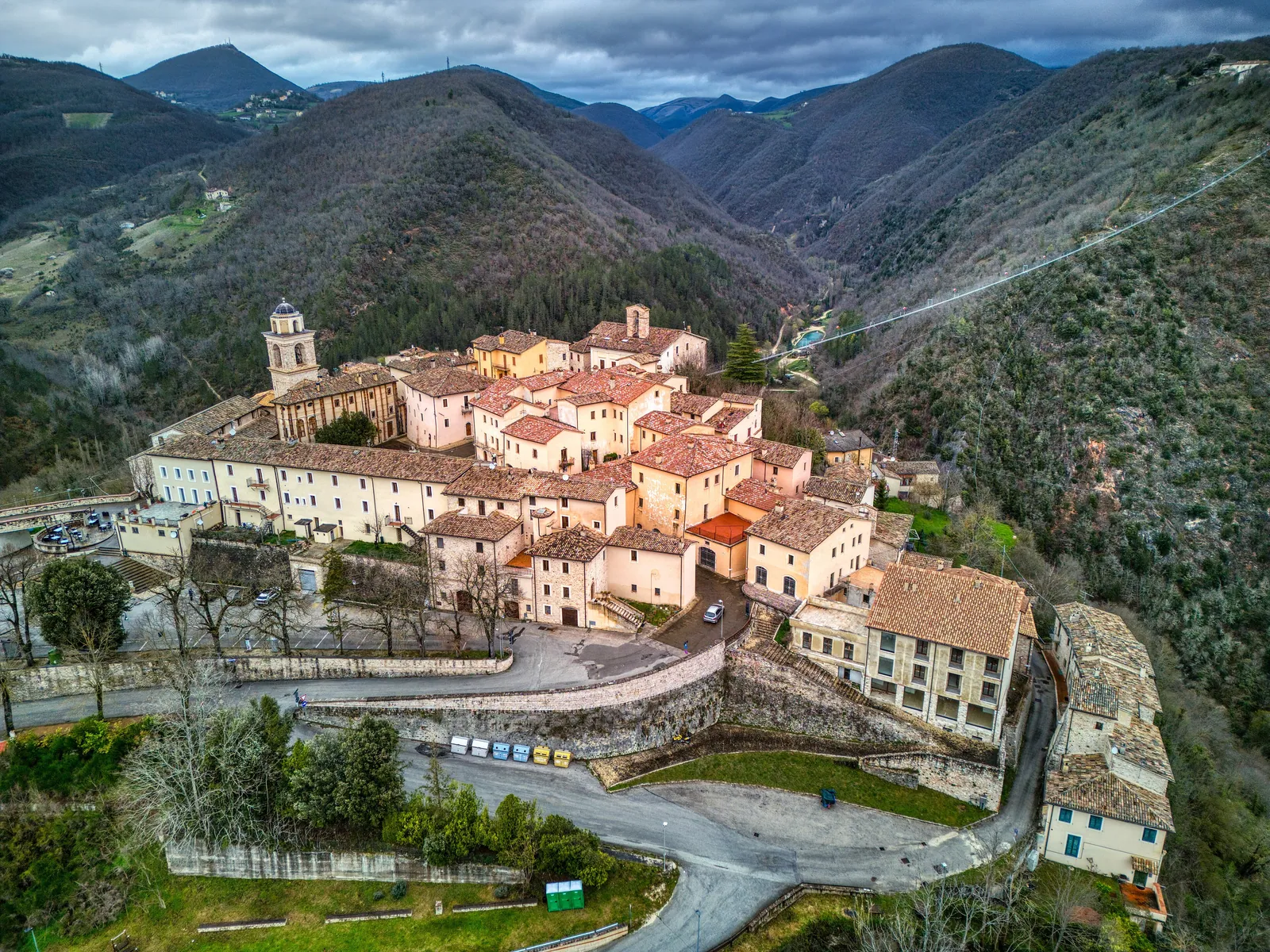
Sellano is a village in the province of Perugia, in Umbria. It stands at 640 m above sea level on a mostly clay hill in the valley of the Vigi, a stream that flows into the Nera river from the right. One theory on the origin of the name links it to the Latin “sella”, meaning a pass or saddle. The town coat of arms echoes it: it shows Saint Michael the Archangel standing on a saddle, because the village is built right on the saddle of a hill. The historic center, gathered inside a circuit of walls with bastions and gates, has a late medieval look. It grew up along the routes that linked the Valnerina with Foligno and the Camerino area through the Vigi valley and reached Spoleto along the Via della Spina. The earthquakes of September 1997 and 2016 struck Sellano, which has now returned to normal life after a restoration that respected both the historic quality of the buildings and earthquake-resistant standards. The village is one of the Borghi più belli d'Italia (Most Beautiful Villages in Italy).
Since the Tibetan bridge to the hamlet of Montesanto opened, hanging 175 m above the Vigi valley, Sellano has drawn many more visitors. The municipal territory covers 85.85 km² and includes numerous hamlets with frescoed churches. There are also many springs: the Menotre river rises here, along with the Fonte Tullia mineral water and the water that supplies Spoleto. Trails lead down toward Lago del Vigi and the Cascate delle Rote waterfalls.
On the map
Points from the site database. Map © OpenStreetMap contributors · Protomaps.
What to see in Sellano
A visit to Sellano revolves around three stops: the Tibetan bridge, the historic center with its churches, and the village of Montesanto. With more time, the hamlets are worth exploring for their small frescoed churches.
The Sellano Tibetan bridge opened in spring 2024 and links the historic center with the village of Montesanto, crossing the valley of the Vigi river. It is 517 m long and 175 m high, and it is considered the highest Tibetan bridge in Europe together with the one in Arouca, Portugal. The walkway climbs 68 m and has an open-step structure: there is empty space between one step and the next, for a total of 1,023 steps. The crossing takes 30 to 40 minutes and is made safely with a harness. Riders must be at least 120 cm tall. The departure station is in the center of the village, next to the old town hall. The facility can be reached only on foot: cars are left in the parking areas outside the village. Tickets are bought online by choosing a date and time slot. There is also an option with a shuttle back from Montesanto to Sellano. In October 2026 the bridge was listed as not operating, so it is best to check whether it has reopened before going.
In the main village, the Chiesa di Santa Maria was built in the 13th century and rebuilt in the 16th century. It holds 16th- and 17th-century canvases, a carved walnut pulpit and the remains of Blessed Giolo, a hermit who lived between 1250 and 1315 and co-patron of Sellano. The Chiesa di San Francesco, known as “Madonna della Croce”, was completed in 1538. It has an octagonal plan, a portico topped by a pediment and a three-aisled interior; above the main altar is a 16th-century fresco of the Madonna and Child. It stands at the edge of the village and is reached along a long avenue. The town hall has 16th-century forms and keeps traces of 15th- and 16th-century frescoes. Next to it are noble palaces from the 16th and 17th centuries. In the lower part of the village are the ruins of the Chiesa della Santissima Annunziata and its convent. The former Oratorio del Santissimo Sacramento, from the 16th century, is now the town's small theater.
Montesanto, where the bridge ends, is a small hilltop village with a castle. Its medieval walls offer a clear view of the Tibetan bridge. The Pieve di Santa Maria Assunta in Montesanto dates from the 12th century and was enlarged to three aisles between about 1545 and 1574. The 2016 earthquake damaged it seriously. The panel painting of the Nativity by Domenico Beccafumi, which stood on the third altar, is now in the Museo Diocesano in Spoleto. The village also has the Chiesa di Santa Lucia and the chapel of the Madonna della Porta.
Among the churches in the hamlets, Sant'Apollinare in Peneggi stands out: it is Romanesque, from the 13th century, with 16th-century frescoes by Angelucci da Mevale. San Martino has the Chiesa della Madonna della Neve (13th century), with many frescoes by painters from Foligno. San Sebastiano in Pupaggi keeps frescoes from the 14th to the 16th century. Villamagina has the Chiesa di San Silvestro, with a 15th-century crucifix that came from the suppressed convent of Sterpare. Before setting out, it is worth checking which churches in the hamlets are open. The full list is on the page things to do in Sellano.
Nature and trails near Sellano
The most popular hike around Sellano takes in Lago del Vigi, the Cascate delle Rote and Montesanto and, when the Tibetan bridge is open, can be combined with crossing it. Lago del Vigi lies at the foot of the village, at the bottom of a steep road through the woods: it is an artificial reservoir created in the Sixties and fed by the Vigi stream. It has long been nicknamed the “Umbrian Loch Ness”.
From the lake an almost level trail leads in about half an hour to the Cascate delle Rote, in a travertine gorge. The falls form three consecutive drops in a narrow corridor between travertine walls and end in a small pool of clear water. They are not visible all year: it depends on how much rain has fallen.
When the bridge is open, walking back from Montesanto is a hike in itself. The trail starts near the Montesanto arrival station and drops quickly for about 1 km (30-45 minutes) to Lago del Vigi. From there it climbs back toward the parking areas and the village of Sellano, 2 km away, by road or on a woodland trail. The full loop from Sellano to the lake, the falls and the Chiesa di Santa Lucia in Montesanto is more demanding: it is about 11.3 km long and of medium difficulty. On clear days there is very little shade, although the route has no technical difficulties. Suitable shoes and plenty of water are needed.
The area also has the hermitage of Beato Giolo, in the hamlet of Forfi. The woods around Sellano, with larches, holm oaks and chestnuts, can also be explored by bike or on horseback, and there are mountain bike and e-bike routes for every level.
Where to stay in Sellano
Accommodation is available both in the main village and in the hamlets, and Sellano is a good base for the trails of the Vigi valley and, when it is open, for the Tibetan bridge. Some places to stay occupy restored historic buildings. In the locality of Cappuccini, near the Acqua Premula spring, for example, an old convent is now a hotel. In Postignano, guests stay in a restored medieval complex. The full list is on the page where to stay in Sellano.
Where to eat in Sellano
At the table, Sellano follows the Umbrian tradition of local farm produce and game. Local menus often feature fojata and attorta, the village's two specialties, along with truffles, porcini mushrooms and meat. Trout from the Vigi river and extra virgin olive oil from the olive belt between Trevi and Spello are also on offer. Addresses and tips are on the page Sellano restaurants.
Local food and crafts of Sellano
The products most closely tied to Sellano are fojata and attorta. Both, the first savory and the second sweet, have been awarded the Denominazione Comunale di Origine (De.C.O.), a municipal designation of origin. Fojata is a savory pie: a very thin sheet of “pasta matta” (a simple flour and water dough) rolled up and filled with wild greens, which today are sometimes replaced by chard or chicory. It was once baked under embers in large copper pans or in old wood-fired ovens. Attorta is a dessert: a thin sheet of flour, water and oil wrapped around a filling of walnuts, sugar, olive oil and apples. The name comes from its coiled, snake-like shape, and the Pro Loco holds a food festival in its honor in the second week of August.
The woods supply much of the local pantry. Truffles, porcini mushrooms, chestnuts, wild boar, pork salami and prosciutto, cheeses, farro and lentils are the basis of the cooking here. Black truffle is enjoyed in spaghetti and truffle omelets, in risotto and in woodcock alla norcina, or roasted. Sellano is also known for its mineral waters: the Tullia water spring rises here.
Crafts have their own specialty too. Villamagina, the hamlet overlooking the Vigi valley, has long been known for making files and rasps, an old craft that took hold in the 18th century. According to oral tradition, a Tuscan monk taught the secret to the poor people of the area. In the 19th century Sellano had ten workshops making rasps and files, considered unique in the Papal States, and a workshop in Villamagina still makes them today.
Weather in Sellano and how to get there
Sellano is at 640 m above sea level and falls within climate zone E. Three things are worth knowing before leaving: the Cascate delle Rote are best seen after rainy periods, the Tibetan bridge is not always open and in October 2026 was listed as not operating, and the most heartfelt holidays are the August food festival and the feast of the patron saint San Severino on June 8. Before a hike or a bridge crossing, it is best to check the forecast.
By car from the north, take the A1 Autostrada del Sole to the Valdichiana exit and continue toward Perugia. Near Foligno, head toward Macerata and, at Casenove, follow the signs for Sellano. The stretch toward Macerata is the SS 77, and from Casenove the route is the 319 Sellanese. From the south, leave the A1 at Orte, take the Orte-Terni highway toward Foligno and, after Spoleto, follow the signs for Norcia-Cascia and then for Sellano. The 319 Sellanese road crosses the municipal territory and links it to Borgo Cerreto, a hamlet of Cerreto di Spoleto. These are almost all mountain roads, with hairpin bends and narrow sections that call for careful driving.
Sellano has no train station: the nearest are Foligno and Spoleto, from which the trip continues by bus or rental car. Foligno is 32 km away, about 45 minutes by car; Spoleto is 34 km away, about 40 minutes.
In this section
3 results
 Things to do in Sellano6 places
 Where to stay in Sellano22 places to stay
 Sellano restaurants10 places
No results with these filters.