


Vestignano Castle (Caldarola)
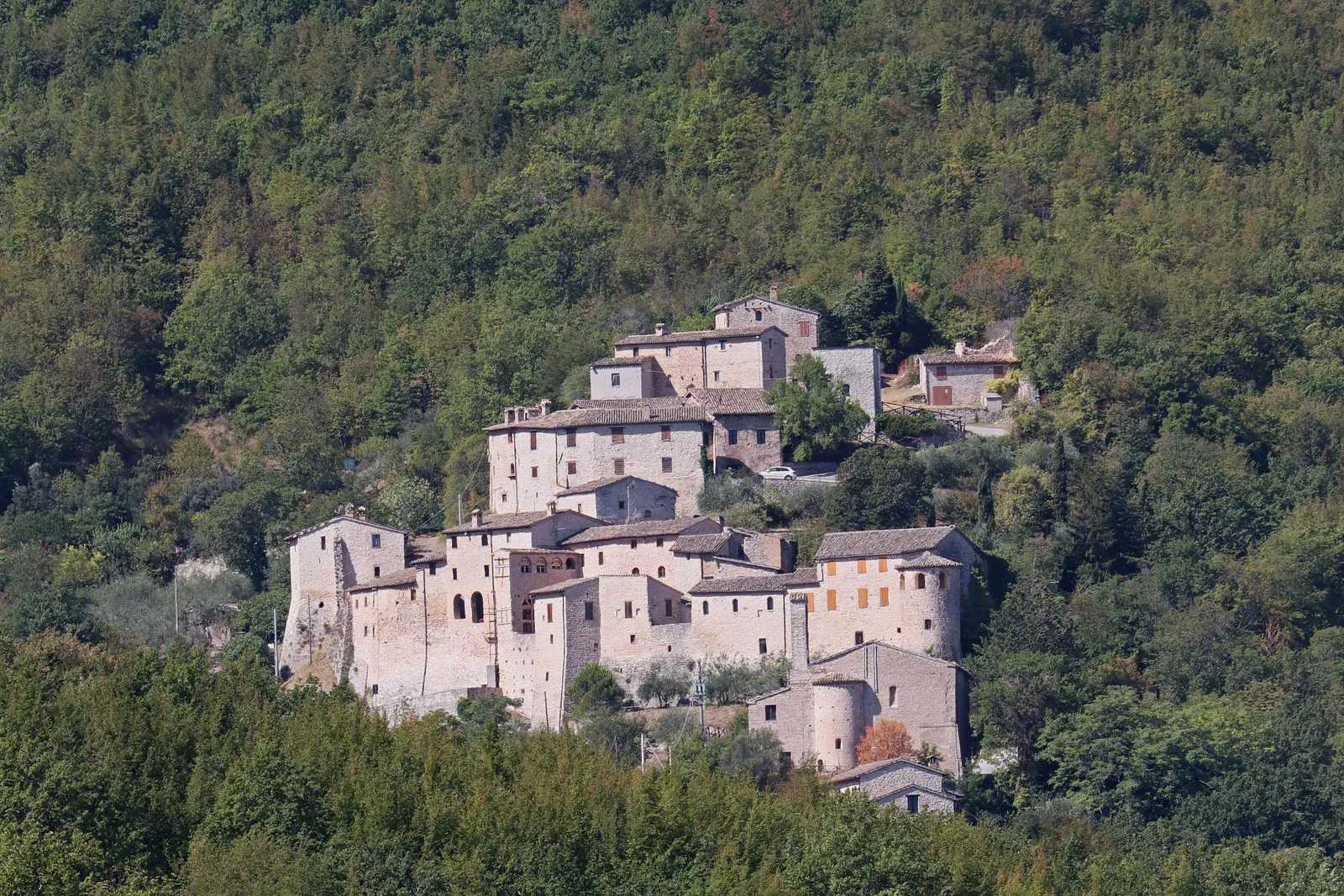
Vestignano Castle (Caldarola)
- Type
- Castle or fortress
- Municipality
- Caldarola (MC)
Source: site database, © OpenStreetMap contributors (ODbL).
The Vestignano Castle (Castello di Vestignano), in the municipality of Caldarola (province of Macerata), is a fortified village that is one and the same as the hamlet itself. It is recognizable by its walls with a cylindrical tower and several square turrets. Inside there are narrow lanes, low houses with pitched roofs, archways and underpasses. The only entrance is a single gate. The castle is recognized as an Italian cultural heritage site.
On the map
Points from the site database. Map © OpenStreetMap contributors · Protomaps.
History of the Vestignano Castle in Caldarola
The Lombards, who occupied the area in the 8th century, built a temple there dedicated to their protector, Saint George. In the 9th century Louis II assigned the castle to the monastery of Casauria, and under the monks the village led a relatively peaceful life throughout the Middle Ages. In 1468 the Da Varano took it over in a state of complete decay and renovated it. Vestignano then remained part of the defensive system of the Camerino territory. It was also one of the ring of small castles through which the Counts Pallotta controlled the area around Caldarola.
What to see at the Vestignano Castle
The entrance is the most striking part. Just past the gate, imposing buildings rest on large arches, or on a high gallery that runs above the arches of the street. In a lunette near the entrance, Nobile da Lucca frescoed the Virgin and the patron saints, in a small painting from the early 16th century.
The church of Santi Martino e Giorgio in Caldarola keeps the east-facing apse of the Romanesque building. Above the door is a high relief of Saint Martin on horseback giving his cloak to the poor man. The inscription in Gothic letters dates it to between the 12th and 13th centuries. Inside are frescoes by Giovanni Andrea De Magistris, including one signed and dated 1551. The end wall with the high altar is decorated by Simone De Magistris, with a Crucifixion.
How to visit the Vestignano Castle
The village is inhabited. Residents live in private houses both inside and outside the walls, so it is best visited on foot and discreetly. Parking is available near the church of Santi Martino e Giorgio, from where the castle can be seen well. The church was damaged by the 2016 earthquake: before visiting, it is advisable to check whether it is open by asking the Comune di Caldarola (town hall).
Where the Vestignano Castle is located
Vestignano is a hamlet of Caldarola, on the last foothills of Monte Fiegni, toward Montalto and Cessapalombo. From Caldarola, head out toward Sarnano and take the first turning on the right, after about half a kilometer. Caldarola is reached via the Val di Chienti expressway, from the exit of the same name.
Around the Vestignano Castle in Caldarola
In Caldarola, the Pallotta Castle overlooks the town. The other fortified hamlets are Croce, Pievefavera and Valcimarra. Croce has a Da Varano castle with the church of Santa Croce, and Pievefavera is a fortified village above Lago di Caccamo. For a comparison with other fortifications in the area, see the page on castles of the Sibillini Mountains or the Montalto Castle (Cessapalombo).
Frequently asked questions
Is Vestignano an inhabited village?
How do you get to Vestignano from Caldarola?
Who ruled the Vestignano Castle over the centuries?
Which works of art does the church of Santi Martino e Giorgio hold?
Nearby
What to see nearby
- under 100 m
- Museum of Peasant Art (Caldarola)Museum or art galleryunder 100 m
- 1.6 km
Where to stay
- 1.1 km
- 1.2 km
- 2.1 km
Where to eat
- Il Giardino delle Farfalle, CessapalomboRestaurant2.3 km
- Caffè Manzoni, CaldarolaBar and café2.7 km
- La Mia Braceria, CaldarolaRestaurant2.7 km
Straight-line distances.