


Montalto Castle (Cessapalombo)
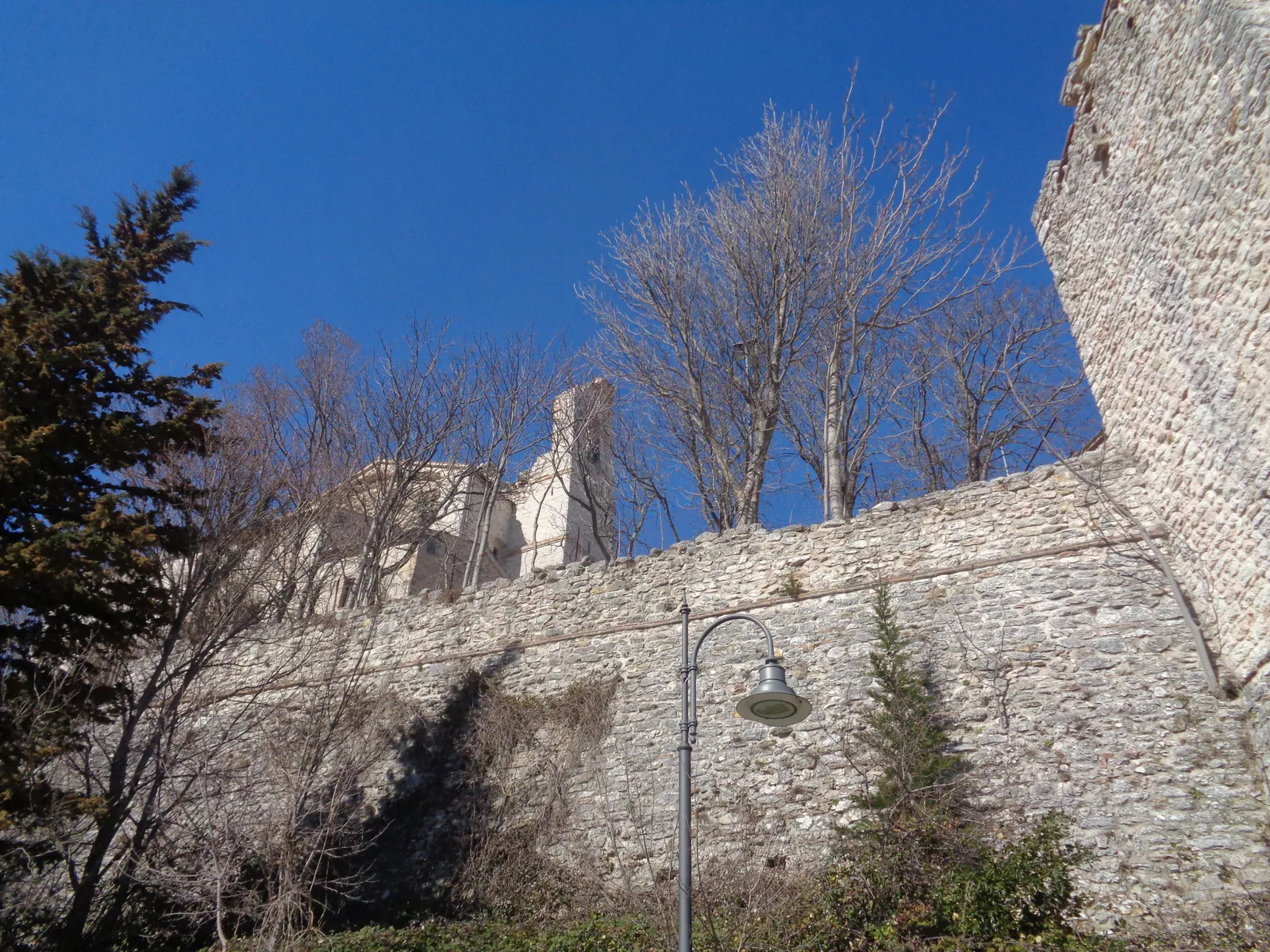
Montalto Castle (Cessapalombo)
- Type
- Castle or fortress
- Municipality
- Cessapalombo (MC)
Source: site database, © OpenStreetMap contributors (ODbL).
The Montalto Castle (Castello di Montalto), in Cessapalombo (province of Macerata), is today a complex of ruins in the hamlet of Montalto, within the Sibillini National Park in the Sibillini Mountains. The earliest records date to the 9th century, when the site was linked to the Benedictine world. It later passed to the Varano of Camerino and came to have three rings of walls. Stretches of wall, towers, a cistern, a few caves and the church of San Benedetto remain.
Before setting out, it is advisable to check whether the ruins are accessible. A project to make them safe is under way, described below. The ruins can in any case be seen from the trails and roads that climb to Montalto.
On the map
Points from the site database. Map © OpenStreetMap contributors · Protomaps.
History of the Montalto Castle in Cessapalombo
Records of the castle begin in the 9th century, when the site was a Benedictine monastery. The territory of Montalto, recorded as "Monte Alto", appears among the twenty-two Benedictine curtes (estates) of the Camerino area confirmed to the abbey of San Clemente a Casauria by a diploma of Otto I dated 23 December 967. The fortress was probably built by adapting an existing Benedictine settlement.
After the Benedictines, the castle passed to the Paganelli family, vassals first of the Brunforte of Roccacolonnalta and then of the Varano of Camerino. From the 13th century it belonged to the Varano. Together with the Col di Pietra Fortress in Cessapalombo it formed an important defensive stronghold, which is why Rodolfo II da Varano had a fortress added to it. In 1356 Montalto is listed among the castra et ville of the territory in the Descriptio Marchiae Anconitanae, drawn up at the behest of Cardinal Albornoz.
What to see at the Montalto Castle
The castle's distinctive feature is its three rings of walls, built at different times. The outermost, added later, is recalled by a section of wall and a tower, and protected the castellans and servants. The second defended the soldiers and those in charge of defense. The third, the innermost, sheltered the vassals and the ruling lords and contains a water cistern that supplied the whole community. The towers, with circular and square bases, show the many changes they underwent over the centuries.
Inside the walls stands the church of San Benedetto, already mentioned in documents from 1299-1300. It holds 16th-century frescoes by Giovanni Andrea De Magistris: the Mysteries of the Rosary, dated 1526, and a Madonna and Child with Saint Anthony Abbot, from 1544. After the 2016 earthquake the church was declared unsafe, so it is best to check before counting on a visit inside.
The site also bears the memory of the massacre of March 22, 1944, when 32 people were killed at Montalto. The partisans had taken refuge in the community house attached to the castle before being captured. Every year in April the Marcia della Memoria (March of Remembrance) arrives at the castle. The municipal road leading there from Vestignano is called Via dei Partigiani, and there are memorial stones along the way.
How to visit the Montalto Castle
The current state of the ruins should be checked. In November 2025 the mayor of Cessapalombo stated that the work to make the ruins safe was nearing completion, with the aim of making them accessible in safety. Funds have also been allocated for the restoration and enhancement of the castle, particularly the tower and the ruins, and for the improvement of the outdoor areas and paths. Until the work is finished, it is advisable to ask the town hall for information.
Montalto can also be reached on foot. The castle is a stop on the Cammino Francescano della Marca: coming from Polverina, a steeply climbing trail ends among the houses of Tribbio, with the ruins up on the left. From Vestignano, a few kilometers of asphalt along a small municipal road lead there. The castle can be seen all year round. Before a hike, it is advisable to check the weather.
Where the Montalto Castle is located
The castle stands in the hamlet of Montalto, in the municipality of Cessapalombo, in the Marche region. Montalto is made up of three clusters of houses, Tribbio, Villa and Valle, which spread out around the castle. Cessapalombo is a mountain municipality in the upper Fiastrone valley, partly within the Sibillini Mountains National Park. The ruins enjoy a very panoramic position.
Around the Montalto Castle in Cessapalombo
From Villa di Montalto starts the trail to the Grotta dei Frati, a refuge of Benedictine monks around the year 1000. The route is described as easy: about 5 km, 90 minutes out and 90 back, starting at 510 m above sea level. In the hamlet of Tribbio is Palazzo Simonelli, formerly home to the Museo delle Carbonaie (charcoal-burning museum). It has been closed since the damage of the 2016 earthquake, but in 2025 redevelopment work was under way.
Also in Cessapalombo, the Rocca Col di Pietra overlooks the Fiastrone: ruins remain, with the watchtower and some vaulted halls. Along the Cammino Francescano della Marca is also the Vestignano Castle in Caldarola, in the municipality of Caldarola, rebuilt by the Varano in the 15th century. For a comparison with other fortifications in the area, see the page on castles of the Sibillini Mountains.
Frequently asked questions
Can you visit the Montalto Castle?
Who owned the Montalto Castle?
How many rings of walls does the Montalto Castle have?
What happened at Montalto on March 22, 1944?
Nearby
What to see nearby
- 700 m
- 800 m
- 1.9 km
Where to stay
- 1.6 km
- Bucossi, CessapalomboFarm stay2.0 km
- 2.5 km
Where to eat
- Il Giardino delle Farfalle, CessapalomboRestaurant400 m
- La bottega, CessapalomboRestaurant2.8 km
- Caffè Manzoni, CaldarolaBar and café3.7 km
Straight-line distances.