


Valfornace: things to see and do
At a glance
- Municipality
- Valfornace
- Province
- Macerata
- Region
- Le Marche
Valfornace is a scattered municipality in the province of Macerata, in the Marche region, created on January 1, 2017 by the merger of Pievebovigliana and Fiordimonte. The name comes from the Fornace stream: both towns lie in its valley. The main town is Pievebovigliana, and part of the municipal territory falls within the Sibillini National Park, in the Sibillini Mountains. The landscape here is made of mid- and high-altitude hills. On one side the valleys slope down toward the Marche plain; on the other they climb toward the first mountain pastures of the Sibillini. Hamlets such as Alfi, Nemi, Roccamaia, San Giusto and Taro are scattered among fields and woods.
The area has a long history. In Roman times the settlement was a station on the transit route toward Umbria; in the early Middle Ages it passed to the Benedictine monks and later to the Da Varano family, lords of Camerino. Pievebovigliana received the Bandiera arancione (Orange Flag) of the Touring Club Italiano in 2006. One thing is worth knowing before setting out: the 2016 earthquake badly damaged the whole municipal territory, and most of the churches and the museum are still unsafe and closed. Today a visit to Valfornace combines the monuments that can be seen, often only from the outside, with two lakes and easy trails that can be walked in every season.
On the map
Points from the site database. Map © OpenStreetMap contributors · Protomaps.
Things to see in Valfornace
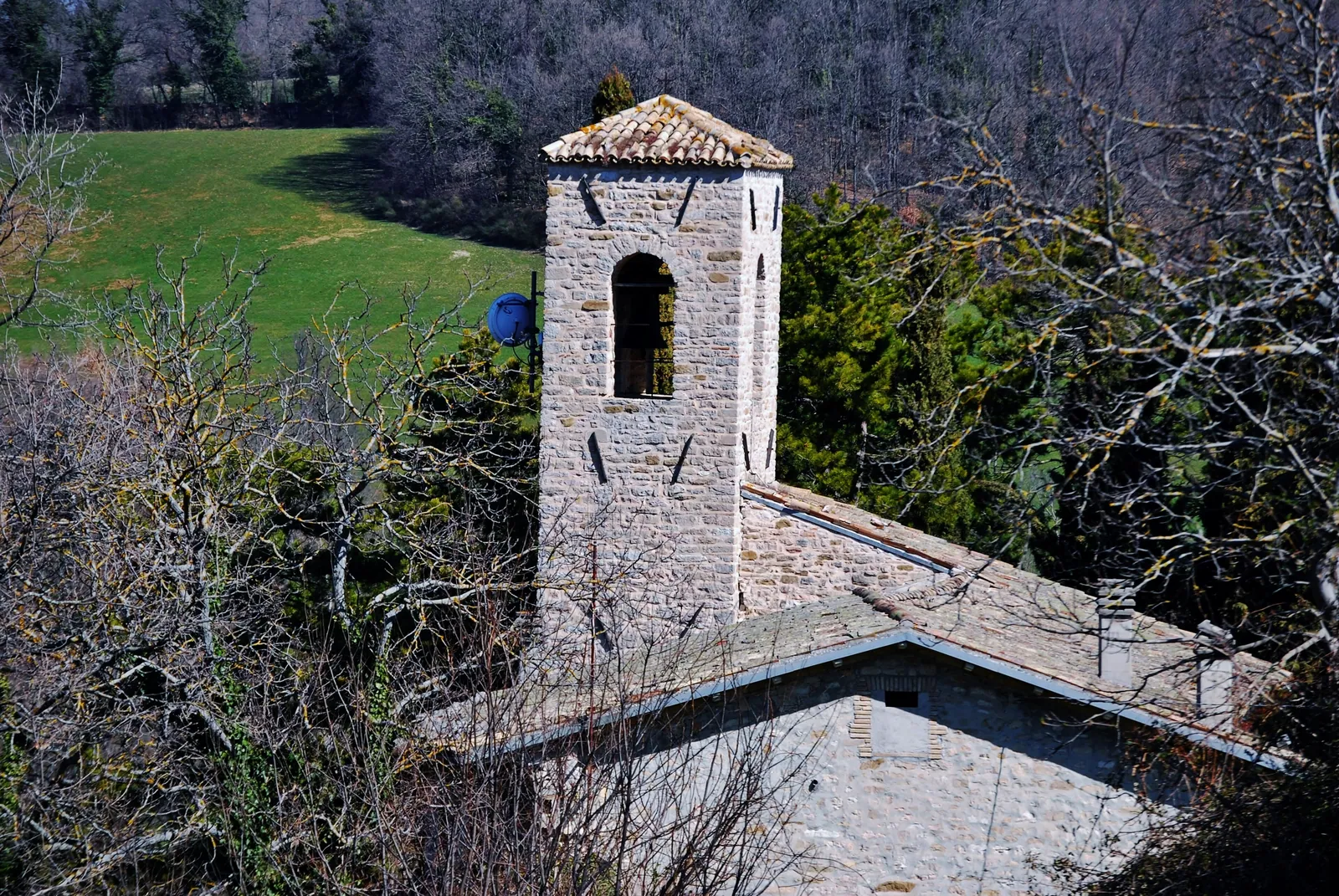
The church of San Giusto, in the locality of San Maroto, is the monument in Valfornace that can be visited again today: the 2016 earthquake had damaged it, but the restoration work has been completed. Founded by the Benedictines, it was built between the 11th and 12th centuries on a hill overlooking the valley, not far from the castle of San Maroto, with which it communicated by light signals in the Middle Ages. This Romanesque church has four chapels set against the central body, and its bell tower preserves remains of 14th-century frescoes.
In the upper part of Pievebovigliana stands the Church of Santa Maria Assunta, which is temporarily closed because of damage from the 2016 earthquake. Its medieval origins are documented by the crypt and by a stone inscription from 1162; the building was renovated in the 18th century. Its most valuable part is the Romanesque crypt, recovered in 1930 and divided into five small aisles by columns, some of them of Roman origin.
The Castello di Beldiletto, on the plain below Pievebovigliana, was built at the end of the 14th century by the Da Varano family as a summer residence. In 1382 it hosted Louis I of Anjou and Amadeus VI of Savoy. In 1510 Pope Julius II stayed here with seven cardinals and 200 horsemen. In the second half of the 15th century Giulio Cesare Da Varano turned it into a Renaissance villa. The plan is quadrangular, with towers at the corners, and a moat fed by the Chienti river originally surrounded the building. The largest hall still has 15th-century frescoes of knights such as Robert Guiscard and Tancred of Hauteville. The castle is privately owned, unsafe and closed to visitors: in 2024 it was in a state of decay. It can be seen from the outside, for example along the route of the Cammino Francescano della Marca.
In Pontelatrave stand the Romanesque bridge, from the 14th century, built on Roman foundations from the 1st century AD, and the church and convent of San Francesco. According to tradition, the convent was founded by the saint himself around 1215. The church dates from the 14th century and has been rebuilt several times. It holds a 19th-century copy of the San Damiano Crucifix of Assisi: tradition says the original was kept here and was destroyed in a fire in 1892. 20th-century restorations brought to light frescoes attributed to Cola di Pietro and a Madonna della Misericordia attributed to Girolamo di Giovanni of Camerino.
The museum complex in the Palazzo comunale (town hall) of Pievebovigliana tells the story of the area from prehistory to the present. It includes the Museo archeologico "V. Cianfarani", the Museo civico "R. Campelli", the Museo storico del territorio and the Museo della Civiltà Contadina (rural life museum). After the 2016 earthquake the complex suffered serious damage and is unsafe and closed.
Fiordimonte, too, is a rural village that grew up at the foot of a fortified castle. Of the old Castello di Cornacuna, a stretch of wall and an entrance gateway remain. Inside the fortifications stands the church of Sant'Antonio, which holds a "Crucifixion with the Madonna and Saints" by Girolamo di Giovanni. The hamlets have other churches with works of art:
- in Villanova, the Church of San Sebastiano, with a 15th-century polychrome wooden statue;
- in Nemi, a church with paintings by Paolo da Visso from 1447 and a Madonna and Child by Boccati;
- in Alfi, the Church of San Marco, with a work from 1513.
After the earthquake many churches in the area are unsafe and closed: access conditions for these buildings should be checked before a visit. Other places in the area include Santa Maria Maddalena, a rural Romanesque stone church with badly deteriorated frescoes attributed to Cola di Pietro, and Villa Marchetti in Gallazzano, the 19th-century home of the composer Filippo Marchetti. For more detail, see the page on things to do in Valfornace.
Nature and trails near Valfornace
Lago di Boccafornace is the easiest and closest walk from Pievebovigliana. It is an artificial lake fed by a karst spring that does not flow continuously. In dry periods the natural cave next to the lake can be visited; in winter the water level reveals the karst siphon that feeds the basin. A loop of about 2 km goes around the lake. Along the way, some inscribed stones have been placed at the most scenic points. Starting on foot from Piazza Vittorio Veneto, in the main town, the route is 6 km and takes about 2 hours. It follows a dirt road for most of the way, with no particular difficulty except for a short climb before the lake. By car, the lake is reached from the SP 99 "Pontelatrave–Fiordimonte" road by following the signs.
Lago di Polverina, an artificial lake created by damming the Chienti river, marks the boundary between the territory of Valfornace and that of Camerino. It is part of the Oasi di Polverina, a nature reserve managed by Legambiente that protects 241 hectares between Camerino, Fiastra and Valfornace. In winter and during migrations, gray herons, great crested grebes, little egrets and cormorants can be seen. In spring and fall the reserve becomes a stopover for birds of prey such as the osprey and the marsh harrier. Along the lake there is a walking path and a birdwatching hide. The shores are largely flat, and the lake is also popular with sport anglers. To get there, leave the SS 77 at the Pontelatrave junction and take the Strada Provinciale 138 "Cantochienti".
For shade, there are the chestnut woods of Isola, Monte San Savino and Roccamaia. Valfornace is also a stage on two longer routes: the Cammino Francescano della Marca, whose stage from Colfiorito to Polverina passes by the convent of San Francesco and the Beldiletto Castle, and the Grande Via del Parco for road bikes, which can be reached from Pievebovigliana.
Where to stay in Valfornace
Pievebovigliana has accommodation that also serves walkers on the Cammino Francescano della Marca: a footpath to the village branches off the route of the stage ending in Polverina. Staying in the main town is also convenient for hikes, because the route to Lago di Boccafornace starts from the main square. The full list is on the page where to stay in Valfornace.
Where to eat in Valfornace
For eating outdoors, along the Lago di Boccafornace loop there is a picnic area with a masonry barbecue grill and several benches with a view. Other options are collected on the page of Valfornace restaurants.
Local products of Valfornace
The Valfornace area is known for its honey. Lavender is one of the more recent crops: in Taro di Fiordimonte, at about 700 meters above sea level, lies the La Melanda lavender field. Flavio Orsolini started it in 2018, moving from Rome at 24 to farm the land of his great-grandfather Decio. Over time, he and his family have planted thousands of Lavanda Vera (true lavender) seedlings. The harvest is used to make essential oils, hydrosols and body and home care products. The lavender field also hosts events, such as evenings dedicated to stargazing.
Weather and how to get to Valfornace
Valfornace is a hilly area in the altitude zone classified as inland mountain. The town hall stands at 441 meters above sea level, while Fiordimonte reaches 569 meters. The area can be visited in every season, and each season offers something different. At Lago di Boccafornace, fall brings the colors of the woods, spring the first blossoms and winter the karst siphon; with snow, the trail around the lake turns white too. At the Oasi di Polverina, spring and fall are the seasons of migrating birds of prey, winter that of herons and waterbirds. In winter it is wise to check the forecast before setting out.
Valfornace is reached via the SS 77 della Val di Chienti, the 95 km expressway linking Foligno, in Umbria, with Civitanova Marche. Pievebovigliana lies about 40 km southwest of Macerata and 70 km southwest of Ancona. The Pontelatrave junction is the main landmark: from here the SP 99 climbs toward Pievebovigliana and Fiordimonte, while the SP 138 leads to the Oasi di Polverina. To discover the other towns in the area, see the page on the villages of the Sibillini Mountains.
In this section
3 results
 Things to do in Valfornace18 places
 Where to stay in Valfornace9 places to stay
 Valfornace restaurants3 places
No results with these filters.