


Hiking accessories: thermos, headlamp and binoculars
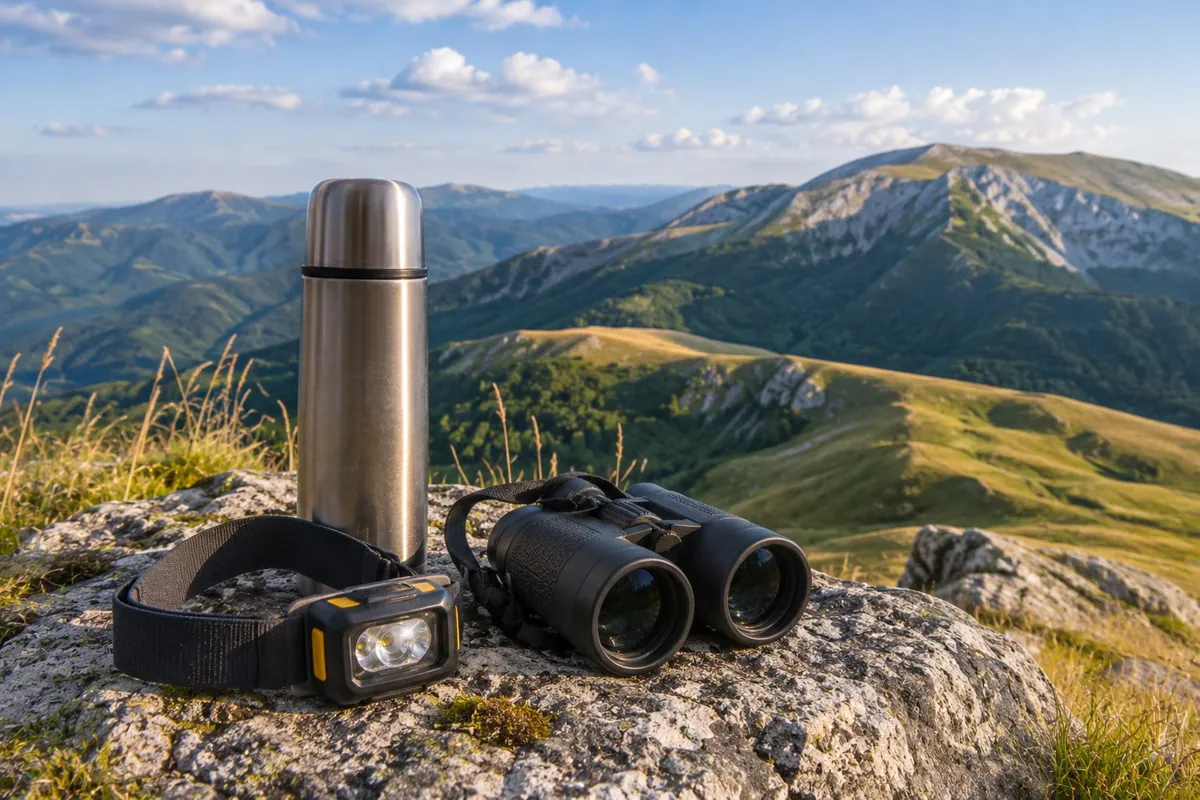
Three hiking accessories, a thermos, a headlamp and binoculars, complete the backpack with three different functions: binoculars make it possible to watch animals without getting too close, a thermos carries a hot drink alongside the water bottle, and a headlamp gives hands-free light if something unexpected means darkness falls before the return.
In short: for binoculars, the standard formats for hiking are 8x42 and 10x42, weighing under 700 grams; for a thermos, what matters is a double stainless steel wall with vacuum insulation and, on long outings, a capacity of 0.7-1 liter; for a trekking headlamp, a light model is needed, with a maximum output above 200 lumens and spare batteries in the backpack.
Thermos, headlamp, binoculars: how to choose
Binoculars: reading the two numbers. Every pair of binoculars is identified by a code such as 8x42 or 10x50. The first number is the magnification, the second is the objective lens diameter in millimeters, which determines how much light gets in. For hiking and birdwatching the standard is 8x42 or 10x42. An 8x has a wider field of view, is steadier handheld and performs better at dawn and dusk; a 10x brings distant subjects closer and suits open terrain, but amplifies every movement of the hands. In the mountains an 8x is easier to use handheld, especially when tired or without a tripod. Below 8 magnifications the image does not come close enough for finding birds; above 10-12, hand tremor makes it unsteady, and at 15 or 20 magnifications a tripod is needed.
Thermos: steel, capacity and lid. A thermos that holds heat well is made of stainless steel, double-walled, with vacuum insulation. A larger volume cools more slowly: for long hikes the recommended capacity is 0.7-1 liter, while smaller models are lighter but lose heat sooner. A screw cap insulates best; a pour-through stopper is more practical but can shorten heat retention a little. Outdoors, a lid that doubles as a cup is common. For materials, cleaning and use with cold drinks, see the guide to the insulated water bottle for hiking.
Headlamp: output and weight. A headlamp is worn on the forehead with an elastic band, on the head or on a helmet, and leaves the hands free, which a flashlight does not. It is light and compact: it can stay in the backpack in every season, whatever the length of the hike. Light output is measured in lumens. About 150 lumens is the minimum for walking in the dark, with even light up to about ten meters; for trekking the recommendation is a light model with a maximum output above 200 lumens, ideally adjustable to save battery. Below 150 lumens a lamp is fine for lighting a tent, cooking or reading.
Thermos, headlamp, binoculars: what to look for
Binoculars: exit pupil and light. The exit pupil is obtained by dividing the objective diameter by the magnification: about 5.25 mm in an 8x42, about 4.2 mm in a 10x42. In daylight about 3 mm is enough; at dusk the pupil of the eye dilates to 5-7 mm, and for observing at those hours an exit pupil of at least 5 mm is advisable. Objectives of 25-32 mm belong to compact instruments, suited to daylight; those of 40-50 mm offer the best compromise between brightness and weight.
Binoculars: field of view. Field of view is expressed in meters visible at a distance of 1,000 meters. A wide field helps find the subject and follow it when it moves. For an 8x42, about 130 meters is a good value and about 140 a better one; for a 10x42, about 115 meters is already high.
Binoculars: weight, waterproofing and eyeglasses. For hiking it is best to stay under 700 grams. Waterproof binoculars are needed on outings in humidity or rain, and nitrogen or argon filling prevents condensation inside. Roof prisms make a compact, straight instrument; Porro prisms are bulkier. Eyeglass wearers should check the eye relief, which should be at least 15-16 mm.
Thermos: shape and opening. A tall, narrow body holds heat longer than a wide one, and a small-diameter opening lets less of it escape.
Headlamp: beam and tilt. A wide, short beam shows where to put your feet; a narrow, deep beam shows the direction ahead. The simplest models have only one type of beam, others allow it to be adjusted. Almost all headlamps have a pivot to tilt the light toward the feet or farther ahead, but it is worth checking.
Headlamp: batteries or rechargeable battery. Headlamps run on alkaline batteries, on lithium-ion batteries rechargeable via USB, or in hybrid mode. Alkaline batteries lose brightness gradually and perform poorly in the cold; lithium batteries keep the light constant down to a threshold, then drop quickly, which is why a charge indicator is useful. For several days with no chance to recharge, disposable batteries are preferable, with a spare set. Run time ranges from a few dozen hours to about a hundred in power-saving mode.
Headlamp: water, red light, buttons. An IPX4 rating means protection from splashes and is enough for most hikes; IPX7 or higher means resistance to temporary immersion. Red light is not for lighting the trail: it does not dazzle companions, preserves night vision and attracts fewer insects than white light. Most headlamps weigh between 80 and 120 grams. Buttons should be easy to find and press in the dark.
Thermos, headlamp, binoculars: practical tips
Warm the thermos before filling it. A thermos keeps heat longer if it is preheated with hot water, filled with a very hot drink and opened only when needed: each opening loses heat. Frost and wind cool it faster; keeping it inside the backpack or in an insulated sleeve reduces the effect. In winter a thermos with something hot is added to the water bottle.
Always keep the headlamp in the backpack, with spare batteries. A headlamp with spare batteries is essential if something unexpected means darkness falls, and it also serves to signal your position. The personal kit of mountain rescuers also includes a headlamp with a spare battery.
Know the distress signal. The alpine distress signal consists of six signals in one minute, one every ten seconds, given with light, voice or whistle, and repeated after a one-minute pause. Whoever receives it replies with three signals a minute, one every twenty seconds. The headlamp's flashing mode serves to signal your presence.
Adjust the binoculars before using them. Set the distance between the two eyepieces until a single full image is visible, then compensate for the difference between the two eyes with the diopter adjustment on the dedicated eyepiece. A neck strap and eyepiece covers protect the instrument from knocks and scratches on hikes.
Watch wildlife from a distance. Binoculars make it possible to watch animals without getting too close, and on a hike they are also useful for looking at the landscape and picking out routes. In the Sibillini Mountains the Apennine chamois has been reintroduced since 2008 with animals from the Abruzzo parks; at Bolognola, on the Marche side, the National Park has set up a wildlife area between 1,100 and 1,300 meters, designed for watching the chamois from outside the enclosure without disturbing them.
Add a small first aid kit. Essential first aid supplies include adhesive bandages, sterile gauze, a bandage, an elastic wrap, disinfectant, tweezers (including a tick remover) and common painkillers. The backpack should also hold an emergency thermal blanket, which serves as a cover in a forced bivouac, and a whistle, the best way to signal your position when help is needed.
Complete the gear. For packing everything there is the guide to the hiking backpack; the list of other guides is on the mountain hiking gear buying guide page.