


Hiking pants: how to choose them
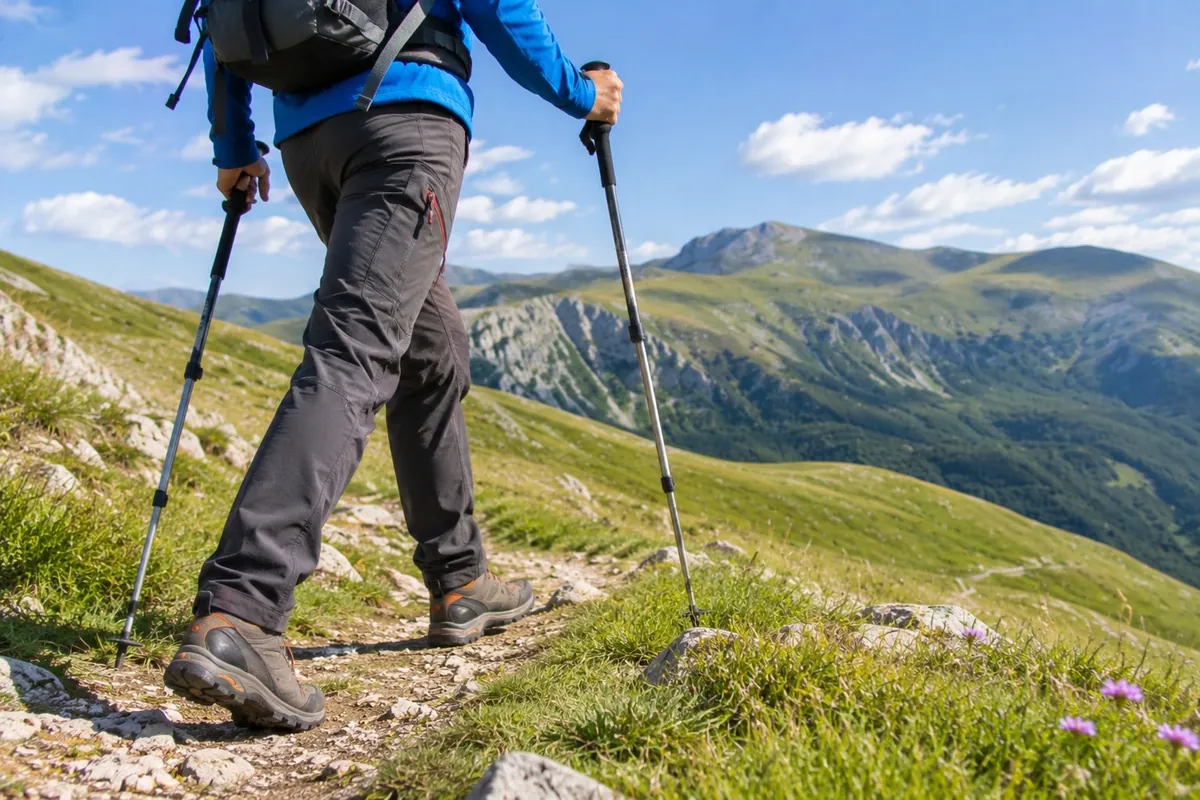
Hiking pants are chosen according to the season and the type of route: light, breathable and quick-drying for summer; more protective and warmer, often in softshell, for winter and altitude. In every case they should allow free movement and not hold moisture. That is why jeans stay at home: when damp they get heavy and no longer keep you warm.
Good hiking pants are the ones you do not notice while walking: they do not make you sweat, do not chafe and do not pull at the knees when stepping up onto a rock.
Hiking pants: how to choose
For summer. The most important quality is lightness, meaning not just the weight of the fabric but the feeling of not wearing the garment at all. Breathable fibers are needed, which wick sweat away and dry quickly after a downpour, a stream crossing or a wet meadow. Nylon and polyester dry much faster than cotton. Cotton-blend models remain an option for easy walks in the heat: they are soft and comfortable, but slower to dry.
For winter, altitude and unsettled weather. This is where softshell comes in, a two-layer fabric with different properties inside and out. It offers more comfort, more thermal insulation and more protection from the cold; in exchange it is somewhat heavier, warmer and more expensive than a simple fabric. For intense cold there are lined models.
For spring, fall and multi-day treks. Sturdy technical pants are the best choice, with reinforcements at the most exposed points, paired with rain pants kept in the backpack.
Shorts or long pants. Shorts are cool and comfortable on hot days, but they leave the legs exposed to stones, brambles, stinging plants, insect bites and tick bites, and offer little protection if the weather changes. The middle ground is convertible pants, with a zip on the leg that turns them into shorts. They have one possible drawback: the zip around the thigh can be bothersome.
Hiking pants: what to look for
Fabric and stretch. A stretch fabric follows the stride uphill and downhill. The stretch can be two-way or four-way. Close-fitting stretch pants do not flap in the wind; looser ones give a greater feeling of freedom. It is a personal preference.
Knees and crotch. Many models have articulated knees and stretch gusset inserts: they help when lifting the legs high to climb onto a rock or get over an obstacle. On technical routes it is worth checking the seams and stretch precisely in these areas.
Breathability. The faster sweat evaporates, the drier the skin stays and the easier it is to regulate temperature on climbs. Open-weave fabrics, mesh panels and side ventilation zips help. The areas that sweat most are the back of the thighs and the backs of the knees.
Water repellency. Many pants have a surface treatment, labeled DWR, that makes light raindrops bead off without the fabric absorbing them. Water-repellent, however, does not mean waterproof. The treatment wears off with use and can be renewed with dedicated sprays. For walking in any weather, a waterproof, breathable membrane or rain pants are needed.
Sun protection. Many summer technical pants carry a UPF rating, that is, protection from ultraviolet rays. It is useful at high altitude and on very sunny trails, where exposure lasts for hours: the recommended value is 30 or higher.
Reinforcements. The points that wear first are the knees, seat, hips and ankles. Thicker fabric in these areas, reinforced seams and a tear-resistant weave, called ripstop, extend the life of the pants on trails with rocks, branches and undergrowth. The lightest summer models often lack reinforcements: it is the price of lightness.
Waist and pockets. An elastic waist is more comfortable than a traditional belt on long hikes, especially with a heavy backpack. To save weight some pockets can be given up, but not all of them.
Leg hem. On winter models, an elastic hem that covers the boot reduces the chance of snow getting in.
Men's and women's cuts. Women's models have fuller hips and a narrower waist; men's have more room at the waist and a longer leg.
Hiking pants: practical tips
Try them on while moving. When trying them on, squat, lift the knees as if stepping up, spread the legs: every movement should be smooth. If in doubt between two sizes, the more comfortable one is better than one that is too tight.
Choose for the route, not the season on the calendar. In the mountains the weather can change quickly, in the Sibillini Mountains too. Light long pants, or convertible ones, cover more situations than a pair of shorts.
Long pants where there is vegetation. On trails with tall grass, brambles and undergrowth, covered legs are protected from scratches, stinging plants, insects and ticks.
Do not look for total waterproofing in the pants. For normal use a water-repellent fabric stands up to light rain. For longer treks, rain pants to put on when needed are a flexible solution.
Think about the rest of the clothing. Pants are only one part of the equipment. The full picture, with the layers for the upper body, is in the guide to mountain hiking clothing; for the feet there are the guides to hiking shoes and hiking boots.