


Mountain hiking clothing: layers, materials and tips
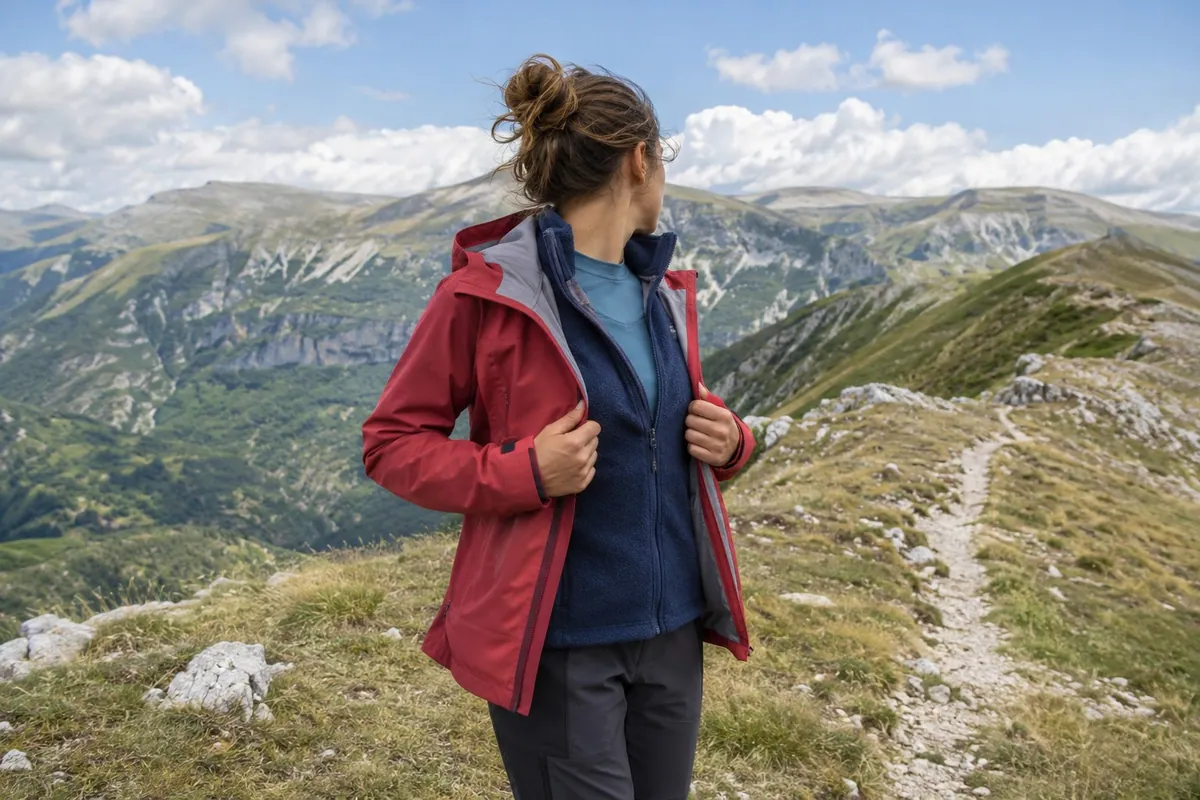
Mountain hiking clothing follows a simple principle: dress in layers, the "onion" method. Three garments are worn one over the other, each with a precise job: the first keeps the skin dry, the second retains body heat, the third protects from wind, rain and snow. The advantage is that layers can be added and removed according to temperature and effort, which is impossible with a single heavy garment.
The system suits the climate of the Sibillini Mountains well, where summers are cool and snowfall is concentrated between November and April, peaking in January and February. Around Lago di Pilato, at 1,941 m, snow can linger until late spring.
Mountain hiking clothing: how to choose
Base layer: the shirt against the skin. Its job is to wick sweat away. It should be close-fitting, light and made of technical fabric: if it does not get rid of moisture, sweat builds up and the body cools quickly. This happens in summer too, when a wet shirt and a bit of wind are enough to feel cold. Suitable materials are merino wool and synthetic fibers, such as polyester and polypropylene. Merino wool regulates temperature, limits odors and stays comfortable even when damp, but it dries more slowly and can cost a little more. Synthetic fibers dry faster and tend to hold odor. On multi-day outings wool is more pleasant. Cotton should be avoided: it absorbs sweat, dries slowly and, when wet, draws heat from the body.
Mid layer: the mountain fleece. The middle layer retains body heat and lets sweat vapor pass outward. Polyester fleece is the most common choice: it is inexpensive, durable and light, dries quickly and insulates even when you sweat. Thinner microfleece works as a mid layer all year round; thicker, warmer fleece is for winter and rest stops, but during intense effort it can cause sweating. In very cold temperatures, at altitude or during breaks, a down jacket or a garment with synthetic insulation is added. Most down jackets are not waterproof: in bad weather they must be covered by the shell.
Outer layer: the mountain shell. This is a windproof and waterproof but breathable jacket that protects from wind, rain and snow while letting vapor out. There are two families. Softshell is made of soft fabric, lighter and more breathable but less waterproof: it protects from light rain and sleet and can be enough on day hikes in stable weather. The rigid shell, called hardshell, is sturdier and more waterproof but less breathable: it is the best choice when there is a risk of serious bad weather.
Legs. Legs usually do not need a base layer. In winter and on snow, thermal tights are worn under the pants. Fleece on the legs is impractical, because it does not stand up well to contact with rocks and damp surfaces. The selection criteria are in the guide to hiking pants.
Mountain hiking clothing: what to look for
Merino wool weight. Fabric weight guides the choice by season. Under 150 grams per square meter the shirt is suited to summer; around 150 to spring, fall and intense activity; between 200 and 250 to trekking and winter. Fabrics that blend merino wool and synthetic fibers last longer and dry faster, at the cost of a slightly reduced anti-odor effect.
Shell waterproofing. It is measured in millimeters of water column: from about 5,000 for the simplest jackets to 20,000 for the most protective. Full protection starts at 15,000. The water-repellent treatment of the outer fabric, labeled DWR, resists light rain and fog but is no substitute for a waterproof shell.
Breathability and ventilation. There is a trade-off between waterproofing and breathability: the more a shell protects, the less vapor it lets out. That is why many jackets have ventilation zips under the arms. Breathability matters most in intense activities such as trekking.
Construction and details. A good-quality shell generally has two or three layers: a water-repellent outer fabric, a microporous membrane and an inner lining. Two-and-a-half-layer shells are waterproof and light, but they resist abrasion less and wear out sooner than three-layer ones, which are preferable in steady rain or with a heavy backpack. In a waterproof hiking jacket, check the taped seams, watertight and smooth-running zips, the adjustable hood, and the weight and bulk when packed.
Hiking socks. They keep the foot dry and reduce friction. They are made of merino wool, synthetic fibers or blends, with wool inside and synthetic outside; cotton holds moisture against the skin and encourages blisters. Reinforcements at the heel and toe protect the areas under most stress, and the inside should be smooth, without protruding seams. A sock that is too tight irritates; one that is too loose forms folds that rub. Thicker socks are for the cold, thin ones for the heat. As for height, mid-calf for spring and fall, knee-high for winter.
Mountain gloves. They should resist wind and water and be sturdy. In the cold the body reduces blood flow to the hands and feet, which therefore need insulating. In winter and at high altitude it is worth having two pairs: a light one for walking and an insulated one for stops. Trekking poles wear gloves out faster.
Mountain hats. Covering the head matters all year round, against both sun and cold. A wide-brimmed hat shades the head, eyes and skin. A beanie is for winter, altitude and snow: preferably breathable and not too heavily padded, because very warm ones cause sweating. A tubular neck gaiter is versatile: it becomes a neck warmer, an ear band or a cover for nose and mouth, and it dries quickly.
Mountain gaiters. They stop water, snow and mud from getting in over the top of the shoe and keep the bottom of the pants dry. In the Apennines they are needed mainly in snow: they should reach at least to just below the knee and cover the boot's instep well. A water-repellent material is enough, with no expensive membranes. Those who use crampons choose close-fitting ones, so they do not snag; for snowshoe outings looser ones, easier to fasten, also work.
Mountain hiking clothing: practical tips
Start out slightly underdressed. Starting to walk with one layer less avoids sweating too much in the first few minutes.
Always carry the shell. A compact waterproof jacket should stay in the backpack even when the weather is good in the morning, because conditions in the mountains change quickly.
A warm layer for stops. As altitude increases the temperature drops, and on the summit wind on sweat is unpleasant: a fleece or a light sweatshirt makes breaks more comfortable, even if it is hot down in the valley.
Beanie and gloves even in summer. They are light and always fit in the hiking backpack, along with the neck gaiter. On summer trails, two layers are generally enough: a technical shirt and a fleece or a softshell.
A spare shirt at the end of the hike. Changing during the walk is rarely worthwhile; a dry shirt is most useful at the end of the outing or on multi-day treks.
Look after the shell. A quality jacket lasts several years. When it starts letting water through it should be treated again with a waterproofing product, or replaced.
On snow, complete the gear. Winter outings call for heavy socks, gaiters, sunglasses against the glare and waterproof, insulated hiking boots that work with snowshoes or microspikes.