


Hiking Boots: How to Choose and Care for Them
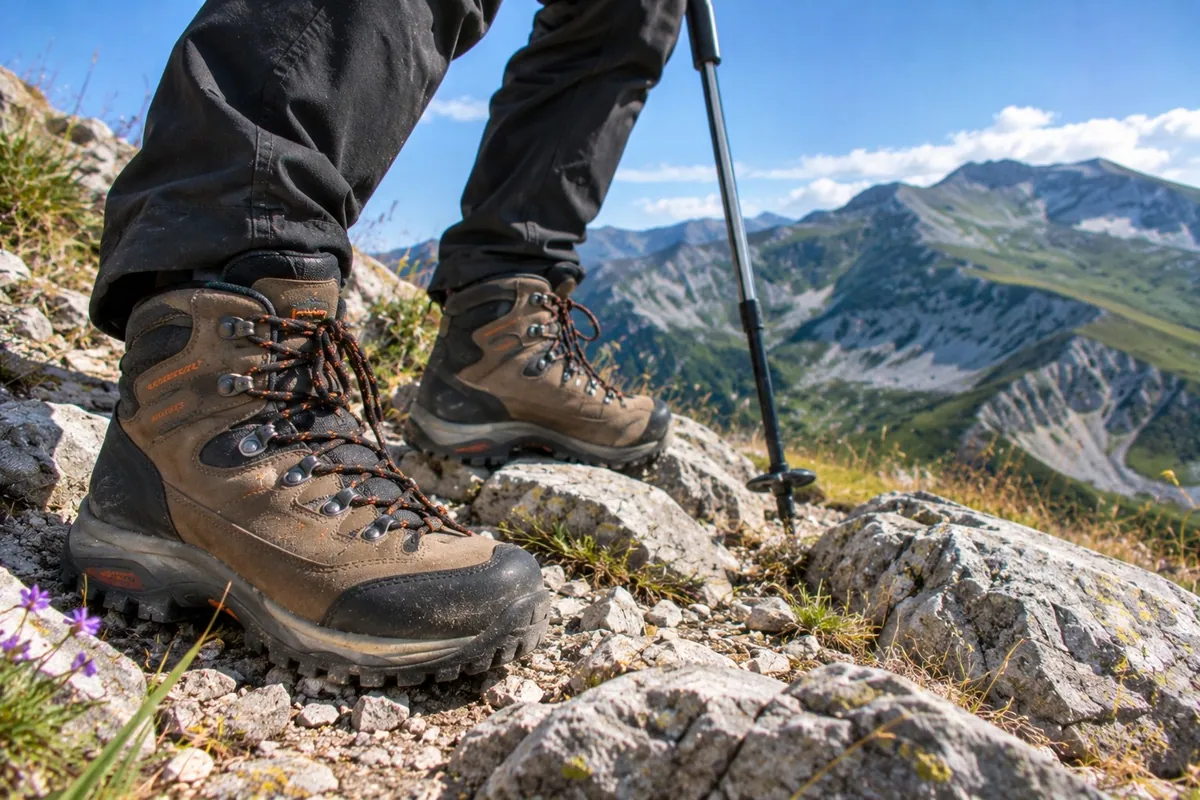
Hiking boots are high-cut hiking footwear: an upper above the ankle, a stiff or semi-stiff sole, sturdy construction in leather or heavy technical materials. They are needed where the terrain becomes demanding, that is, on rocky trails, steep scree, snow and via ferrata routes, or when the pack is heavy. On easy, well-marked trails they are more than necessary: there, low hiking shoes, lighter and more flexible and described in a separate guide, are enough.
In the Sibillini Mountains the difference matters most in the cold. At the end of November 2024 the alarm was raised again about hikers climbing the Apennine peaks in summer hiking shoes and without ice axe and crampons; in those days on Monte Vettore the snow was completely frozen, with sheets of verglas (thin, clear ice) that called for great care even from those with crampons and an ice axe. The Corpo Nazionale Soccorso Alpino (Italy's national mountain rescue corps) recommended suitable winter gear starting with footwear, which cannot be smooth-soled sneakers or light boots meant for summer walks.
Hiking boots: how to choose
Choosing hiking boots starts from the terrain, not from the idea that the highest, stiffest footwear is always the safest. On simple routes, with little elevation gain and an even surface, a light shoe with a flexible sole is better. As the terrain becomes more technical, a stiffer sole, which gives stability, and a high upper, which supports the ankle, make sense.
Above the low shoe there are two steps.
Mid-cut boot. It covers the ankle without locking it completely and has a semi-stiff sole and a more structured build than a low shoe. It gives more support on uneven ground, more protection from side impacts and more stability with a loaded pack. It suits routes with stretches over boulder fields or unstable ground and multi-day hikes.
High-cut boot. The collar rises above the ankle, the sole is stiff or semi-stiff, the upper is full-grain leather or heavy technical materials. It is the footwear for demanding mountains: snow, steep scree, via ferrata routes, rocky trails. Used on a moderate trail it is overkill: a boot that is too stiff reduces the feel of the ground and tires the ankle and calf.
The difficulty scale of the Club Alpino Italiano (Italian Alpine Club) offers concrete help. Routes graded E (hiking) run on trails or tracks over varied terrain, through pastures, debris and boulder fields, and require suitable footwear and equipment. Those graded EE (for expert hikers) involve rugged and treacherous terrain, steep or slippery slopes of grass, rock and debris, boulder fields and short, not steep snowfields: here a sure foot and suitable gear are needed. For E and EE trails, the mid-cut boot is a good compromise between stability, protection and freedom of movement; when the terrain is technical, the stages are consecutive and the load is significant, a sturdier boot with a stiffer sole and more structured lateral support makes sense.
The pack also matters. With a light pack you are more agile and can use less structured footwear; with a heavy pack, perhaps loaded with a tent and stove, supportive footwear is better, giving extra stability especially on technical terrain. The hiking backpack has its own guide.
In winter, high boots are often used together with snowshoes. On hard snow and ice, crampons are needed instead, and they require a stiff or semi-stiff sole: semi-stiff boots have a welt only at the heel and accept strap-on or semi-automatic crampons, while stiff boots have welts at front and back and are compatible with automatic crampons. Ultralight microspikes and ice cleats work for not slipping on an icy road, not for moving on a slope of hard snow.
Hiking boots: what to consider
Sole. It is the most important element: traction, stability on wet rock and protection of the sole of the foot all depend on it. The rubber compound and the tread pattern both count. A softer rubber grips better on rock, dry and wet, but wears out sooner; a harder one lasts longer but slips more on wet and smooth surfaces. Deep, wide lugs work well in mud and on soft ground, low, dense ones on rock and compact ground; on mixed terrain the most versatile compromise is a tread with medium lugs, 4-5 millimeters deep.
Stiffness. On rock, roots and gravel, a fairly stiff sole protects the foot from repeated impacts. Too much stiffness, however, takes away sensitivity: the foot feels the ground less and adapts less well to irregularities.
Upper. It can be leather or synthetic technical fabric, sometimes with rubber or plastic reinforcements at the toe and on the sides. Light footwear in synthetic fabric wears out faster and protects less on very technical terrain than footwear in leather or sturdier mixed materials. Models in light, breathable materials can be used in all seasons, heavier ones mainly in winter.
Membrane. Waterproof hiking boots owe their water resistance to a membrane placed between the upper and the inner lining, which blocks water and lets vapor out. The protection has a cost: the boot breathes less. The membrane is useful in fall, winter and spring, when rain, frost, snow or wet ground are likely; in summer, in dry conditions, the foot sweats more and heat builds up.
Lacing. Mid and high models have dual lacing, traditional in the lower part and with hooks in the upper part. The tongue, laid flat under the laces, keeps pebbles and dirt out.
Weight. Weight on the feet is more tiring than weight carried elsewhere on the body, and heavy boots can become uncomfortable over time. For a one-day hike, however, it remains a secondary criterion compared with grip, fit and construction.
Women's hiking boots. Men and women should not choose the same model at the same size: the female foot is narrower, and men's versions are also roomier in the part that wraps the ankle. In footwear that is too wide, the foot moves, rubs and blisters form.
Hiking boots: practical tips
Try them on in the late afternoon. At that time feet are slightly swollen, as at the end of a hike. Try them with the technical socks you will use in the mountains, because thickness changes the fit.
Check the size on a descent. Usually about one size larger than everyday shoes is needed. On an inclined ramp, found in many specialist stores, the boot must hold the foot still without the toes hitting the front. From the first fitting there should be no pressure points: it is the boot that must adapt to the foot, not the other way around.
Prefer a store. Especially for a first purchase of a new model, trying them on in person avoids getting the fit wrong.
Break them in early. Mid-cut boots need 4-6 outings, high leather boots as many as 8-10 before they fully adapt to the foot. Better not to buy them the week before a demanding trek: neglecting the break-in is among the main causes of blisters.
Do not neglect socks. A technical hiking sock manages sweat, reduces the friction that causes blisters and keeps the foot at the right temperature.
Clean and dry them well. Mud and dirt are removed with warm water and a brush that is not too hard, without soaps or detergents and never in the washing machine. After snow, road salt must also be removed, as it can damage the upper. Boots are dried in a ventilated corner, away from radiators, hair dryers and direct sun; a sheet of newspaper inside absorbs moisture and odors.
Care for leather and sole. Leather should be treated with specific water-repellent creams or sprays after every 3-5 demanding outings: if untreated it absorbs water, hardens and over time cracks. Soles are almost always glued, and glue degrades with moisture and heat, so it pays to check the edge now and then: an early separation can be repaired by a specialist cobbler. When the lugs are worn down to a smooth base, grip decreases and it is time to replace the boots.
For the cold season, the kit is completed by the guides on microspikes, snowshoes and mountain hiking clothing.