


Hiking Shoes: How to Choose the Right Pair
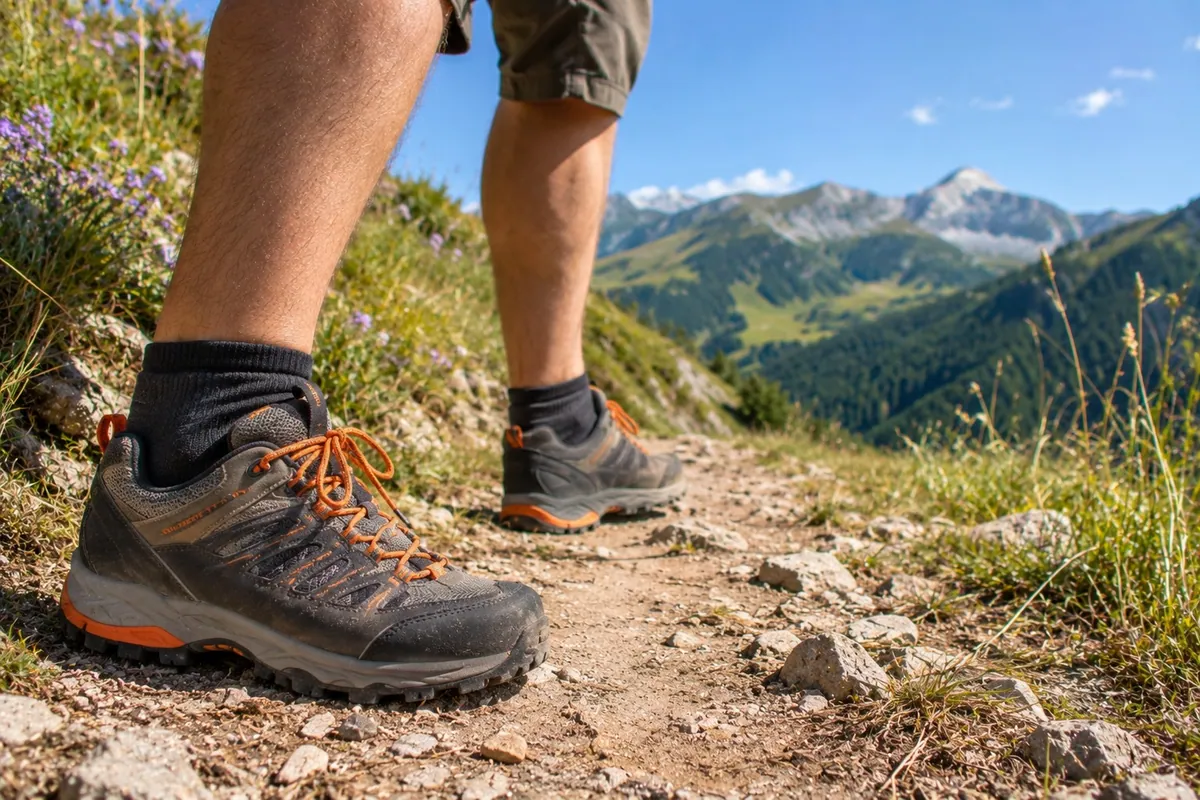
Hiking shoes are chosen starting from the terrain: a low, lightweight model works on easy, well-kept trails, while rough routes, snow or a heavy pack call for higher, stiffer footwear. Price, color and fashion come later. What counts is the type of route, the season, your own fitness and, above all, the fit.
In the Sibillini Mountains this distinction has practical consequences. The same itinerary can be a summer walk or, early in the season, a route still under snow: in May 2025, for example, approaching Lago di Pilato required crampons, an ice axe and experience of alpine terrain. In those conditions, a low shoe is not the right footwear.
Hiking shoes: how to choose
Hiking footwear falls into three families, based on the height of the upper.
Low-cut. The cut does not go above the ankle. These are the lightest and suit easy walks on well-kept, low-difficulty trails in mild weather. They do not protect the ankle from sprains and are therefore not recommended on rough terrain.
Mid-cut, or light boots. They rise just above the ankle bone. They partly protect the ankle while leaving more freedom of movement, and suit moderate routes and undemanding dirt tracks.
High-cut, or boots. They cover the ankle completely, are stiffer and offer maximum stability. They suit any mountain terrain, help on descents and are the choice for demanding, rocky trails with snow and ice. This footwear has its own guide on hiking boots.
Then there is a fourth option, trail running shoes. They have a softer sole and can also be used for walking, but they are not ideal for long routes or for crampons, which require a stiff or semi-stiff sole.
Three questions are enough to find your way among these families: what terrain you will walk on, how heavy the pack is, how long the hike lasts. On simple routes, with little elevation gain and an even surface, a light shoe with a flexible sole is better. As the terrain becomes more technical, a stiffer sole, which gives stability, and a higher upper, which supports the ankle, make sense.
Those who hike in different seasons and on different routes often end up with more than one pair: no single shoe suits every condition.
Hiking shoes: what to consider
Sole. It must be non-slip, usually in high-grip rubber. Deep, staggered lugs of different sizes improve grip; mud, dirt and wet ground call for deep grooves, while a shallow tread only works on even, well-kept surfaces. A hard rubber grips without wearing out too quickly.
Upper. This is the top part of the shoe: it can be leather, especially suede, or synthetic technical fabric. It must protect and support the foot without squeezing it, because a compressed foot is more prone to blisters. Some models have rubber or plastic reinforcements at the toe and on the sides.
Waterproof membrane. Neither leather nor synthetic fabric is waterproof on its own. Waterproofing comes from a membrane placed between the upper and the inside of the shoe, which blocks water while letting the foot breathe. Breathability matters as much as waterproofing: if sweat stays trapped, blisters are more likely. There are more breathable membranes, designed for spring and summer, and insulated versions for winter. Summer shoes must above all be breathable.
Insole and padding. The insole must be anatomical and fixed: if it shifts while walking, it gets uncomfortable. Foam padding is preferable to sponge rubber, which lasts less. Good cushioning helps balance on steep, gravelly or stony terrain.
Weight. A hiking shoe generally weighs between 400 and 700 grams, depending on the model and materials. Weight on the feet is felt more than weight on the shoulders: 100 extra grams on each shoe are equivalent, in effort, to about half a kilo more in the pack.
Lacing. Low shoes often have elastic laces; mid and high models have dual lacing, traditional in the lower part and with hooks in the upper part. The tongue, laid flat under the laces, keeps stones and dirt out.
Men's and women's models. They are not interchangeable at the same size: the female foot is on average narrower, and a shoe that is too wide lets the foot move, causing rubbing and blisters.
Hiking shoes: practical tips
Choose the size with some margin. Usually at least one size larger than everyday shoes is needed. The toes must be able to move, and on descents the big toe needs a few millimeters of room so it does not hit the front. In width, the foot should be free but not slide. Keep in mind that feet tend to swell after hours of walking.
Try them on calmly. It is best to buy in a specialist store, asking the staff for advice, and to try the shoes on for a few minutes. Ideally, test them for a few hours at home and exchange them if they do not fit. The real test should not happen during a hike.
Suitable socks. The shoes are worn with hiking socks, thick terry or technical ones; to choose them, it is best to get advice in a specialist sporting goods store.
Break them in before a long hike. New shoes should be softened up with short walks on unpaved trails.
Check laces and wear. It is worth carrying a spare pair of laces. The best models last for years and can exceed 500 kilometers, but on rugged trails the sole wears out faster. The shoes should be replaced when the upper is damaged, when the lugs are worn down to a smooth base or when the insole is damaged.
Consider whether they are enough. With snow, ice, rocky terrain or a heavy pack, low shoes do not offer enough support: in these cases it is better to switch to boots. To complete the kit, the guides on trekking poles, the hiking backpack and mountain hiking clothing are also useful.